The issues facing companies, whether strategic, economic, managerial or environmental, are constantly subject to change. developments imposed by unpredictable events… despite all efforts at anticipation.
From strategic deployment to team management, the traditional risk management in business (GRE), which relies on prediction and a certain continuity, finds its limits in this VUCA context (volatile, uncertain, complex, and ambiguous).
Is our conception of decision-making outdated? Is it still reasonable to seek balance in our choices in the face of constant instability? How can we adapt our corporate decisions to the growing complexity of society?

How to make decisions in an uncertain context?
To define the decision-making process, find ways to to clarify its decisions and give them meaning, At a webinar, talenco collected the Testimonials from specialists confronted with the reshaped art of decision-making in an unstable environment:
- Bernard Huarte, Deputy Director of Risk Management and Ethics-Compliance at Savencia (ex-Bongrain), former fighter pilot and commander of an Air Force Air Base,
- Marion Genaivre, Philosopher, Co-author of « The decision-making process » (ed. Dunod 2021) and Co-founder of the philosophy agency Thaé,
- Raphaël Kattan, General Manager & Partner Talenco and advisory to executives and managers of large companies.
Here is a summary of these inspiring exchanges, which you can watch the video replay below!
Summary:
- What is decision-making? (definition)
- How to make better decisions as a leader?
- How to give meaning to decision-making?
- 12 decision-making skills for leaders
What is decision-making? (definition)
Deciding means giving up
According to Marion Genaivre, if we refer to the etymology, « To decide is to decide on a course of action; to cut, to break down; to choose another course of action. In short, to decide is to give up. ».
« Deciding means making a final decision and adopting the chosen option »(Paul Ricoeur). The decision therefore also entails a notion of responsibility.
Deciding, it takes preparation
Bernard Huarte
When you fly a fighter jet at 900 km/h, you have to prepare the mission well!
For Bernard Huarte, « A successful mission is a mission that is 50% well prepared. »The other half rests on the irrational, adaptation, and intuition that feeds on a « Unconscious experience », of sharing with others: « There is a part of inborn and a part of acquired ».

Making good decisions is something that can be learned
For Bernard Huarte, « Making decisions is partly learned. Training allows you to acquire methods, recipes, develop skills and practice making decisions. ».
Deciding is part of a collective action
When we ask company managers about the factors that make the decision-making process difficult in an uncertain context, 50% of them answer «not being able to make the decision in a collaborative way».
Due to lack of time, managers often have to make individual decisions, which does not encourage team commitment.
For Raphaël Kattan, « There is a lot of work to be done on the implementation of more agile rituals which allow for effective and short collective times during which decisions can be made/arbitrated ».
Need support in decision-making?
Discover our short training for managers!
How to make better decisions as a leader?
Dare to decide… and act
82% of executives declare themselves «anxious» about the decision-making process (Oracle-Netsuite study 2020) and might be tempted to stop deciding.
For Bernard Huarte, « The decision only has value through the action it authorizes. It is this decision that will allow progress to be made. ». The important thing is to make an informed decision.".
We cannot wait to have all the parameters in hand to make decisions; the time frame of the business does not allow for that. It is therefore important to work on the right to make mistakes and accept that we are fallible.
Seek consultation and consent
Undoubtedly influenced by the new generation, the current trend leans towards more consultation and consent in decision-making.
Marion Genaivre
According to Marion Genaivre, « consent allows the collective to mobilize to avoid pitfalls, and to make the decision by informing it of the objections of the stakeholders, while being aware of the risks ».
The more diverse and inclusive a group is, the better the decisions are..This allows us to confront ideas, beliefs, cultures, and thought patterns, to welcome objections, and to weigh the risks and consequences.

Being aware of one's cognitive biases
To make a good decision, according to Marion Genaivre, « One must not be cut off from one's values by biases, by a narrowed frame of reference, by ethical blindness (systemic pressure from time, from the group, authority, role). ».
Indeed, Raphaël Kattan adds, « one must be aware of one's cognitive biases (confirmation bias, result bias…) to take them into account in his decision ».
Accepting doubt and identifying the context
The one who never doubts is certainly blinded by his own cognitive biases, That is why, according to Raphaël Kattan,« accepting doubt is very healthy. Therefore, one must work on oneself to be aware of one's own biases and to think about it when it comes to arbitrating ».
It is also necessary to identify in which type of situation We are (simple or complex) because we do not activate the same decision-making processes depending on the context.
Reducing uncertainty and taking risks
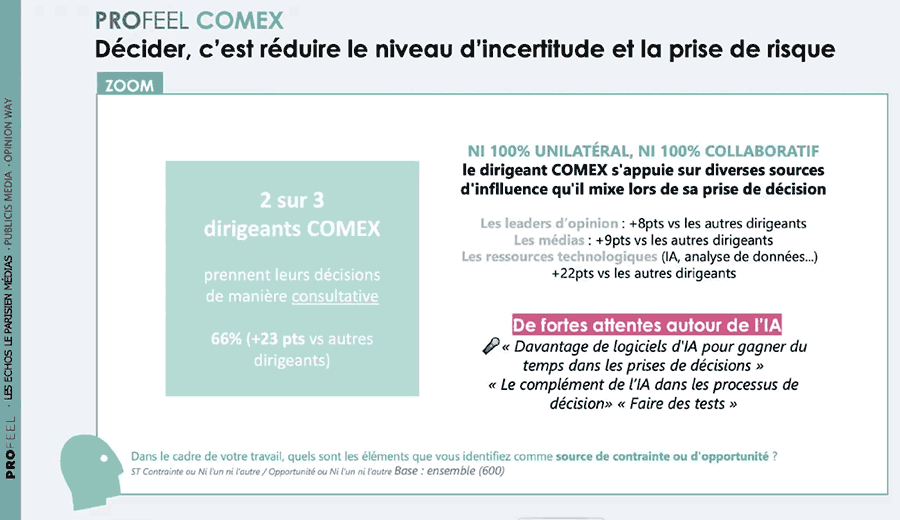
According to the’Profeel study 2024 conducted by OpinionWay among 600 decision-makers (C-levels), Deciding on a daily basis for a leader consists of reducing the level of uncertainty and taking risks.
Thus, Two-thirds of the members of the Comex make their decisions in a consultative manner (+23 points vs the other leaders) relying on various sources of influence: opinion leaders, the media and technological resources.
To help them in their decision-making, Executives are increasingly open to generative artificial intelligence (AIgen), among other things «To save time in decision-making, to »do tests« or to »compare their strategic choices«.
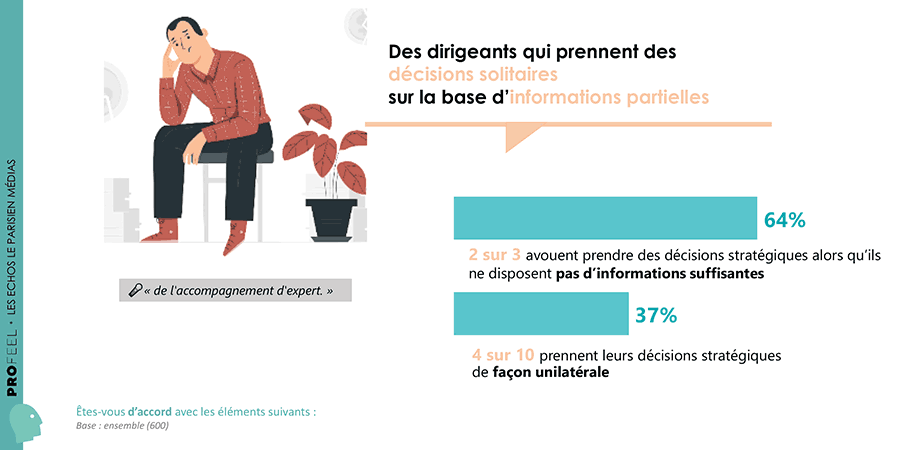
Nevertheless, behind these consultative approaches, 2 out of 3 executives admit to making strategic decisions without having sufficient information !
How to give meaning to decision-making?
Show common sense and humility
It is not always possible to simplify the most complex situations, but it is important to rely on common sense and return to the essentials when it is possible or to proceed in stages.
For Marion Genaivre, « To make a decision with serenity, one must remain humble and courageous ».
Appropriate and take responsibility for the decision
The whole point is to make the decision we take our own to have meaning. The decision is therefore closely associated with the notion of responsibility.
For Bernard Huarte, « Behind the decision lies the courage to decide, especially when the stakes are high. One must have their own interest in the decision that personally affects us and places our responsibility on us. ».
Staying connected to your values and overcoming your fears
To make a decision with serenity, it is important to Building on our values and using them as levers of arbitration.
However, our fears can blur our bearings and cut us off from these values, which can lead to decisions with dramatic consequences, as Marion Genaivre reminds us when she talks about the case of the Ford Pinto in the 1980s, which caused many fatal accidents due to a lack of a recall decision…
Capitalizing on the lessons learned
Experience is fundamental in decision-making. We learn a lot from our own failures and experiences, but we also learn a lot from the good and bad experiences of others!
That is why, according to Bernard Huarte, it is important to formalize the times for sharing experiences and knowledge. feedback and to train towards that goal.
Developing leadership skills
Knowing how to arbitrate in an uncertain context requires leadership skills to give meaning, set a framework and be sure to link your decisions to the company’s strategy. The OKR method can greatly help to create this alignment.
It is also essential for leaders to develop the soft skills (kindness, assertiveness, listening…) to ensure that in no part of the organization are good ideas and initiatives restricted.
12 decision-making skills for leaders
Among the important decision-making skills for leadership, here is our selection of essential skills for effective decision-making :
3 strategic skills
- Knowing how to collect, sort and analyze the relevant information
- Taking into account the impacts of your short- and long-term choices
- Anticipating and managing risks financial, operational, etc.
3 analytical skills ⚙️
- Knowing how to choose opportunities depending on the context
- Being prepared to Agile management of crises
- Being able to deciding in an uncertain context
3 skills of adaptability
- Demonstrate flexibility in the face of uncertainty
- Develop The art of critical thinking
- Dare to originality, creativity, innovation
3 leadership skills
- Having self-confidence and accept their choices
- Involving the stakeholders and collaborate
- Knowing how to communicate and convince the teams
In conclusion, to decide as calmly as possible, the first thing you need is a state of mind and a a climate of trust that allows initiatives to be unleashed.
It is also important to make a work on oneself, learning to stop, breathe, and draw inspiration in order to make good decisions!