

We conclude our interviews with decision-makers on the strategic priorities of companies and their transformation challenges in uncertainty with Mauricio Manzano Podversich, Director of Progress and Transformations at Michelin, who reveals the pillars of change in service of the group’s ambitious growth.
On the CAC 40, Michelin Michelin is a global leader in tire manufacturing and a pioneer in materials science for more than 130 years. Beyond its headquarters in Clermont-Ferrand, the group employs 130,000 people with industrial operations in 18 countries. In 2021, Michelin launched its transformation plan «Michelin in Motion» which defines the group’s sustainable growth strategy for the 2030 horizon.
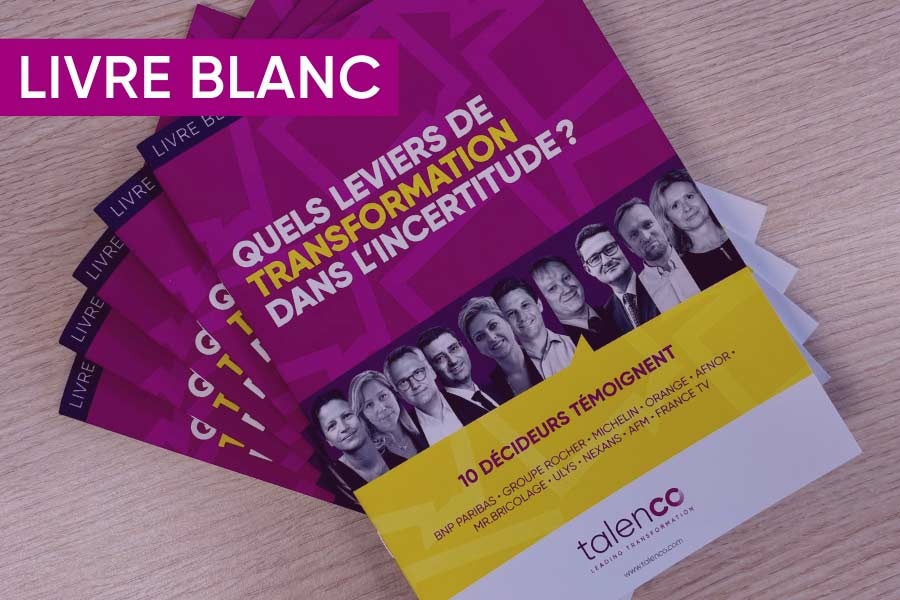
10 testimonies from leaders
What levers of transformation in the uncertainty?
How do you identify the major challenges that Michelin must face in a turbulent context?
Mr. M.M.P. In this context, one of the first axes of transformation was to we open outwards, what is called « awareness » in our leadership model. This translates into an openness to the rest of the world, both within Michelin and beyond it through partnerships with other companies and organizations.
This helps us to grasp the complexity of all this environment that surrounds us and to develop collective intelligence.
It is through these the opening process that we have seen the priorities emerge that are ours and that contribute to the building of our Dream for Michelin in 2050: an innovation leader that will have had a significant impact on humanity.
Through a a large-scale co-construction process, On a scale of all the employees of the group, which has even been extended to customers or close friends invited to participate in this process, we have brought to the fore the 4 major boundaries of our «dream».
This key aspect of our approach enabled our executive committee, in the end, to make a synthesis. Feeding the strategy.
What are the main challenges you have identified and those that you have chosen to prioritize?
Mr. M.M.P. The four borders of our «dream», which emerged from the overall process of co-construction, provide the issues and the broad perspectives that revolve around many things. the human aspect.
- «We will all have the same chance of having a job that we love.
- «Everyone will live healthier and longer.».
- «Human activity will reverse the course of global warming.» That’s quite ambitious!
- «Everything that will be produced will be recycled endlessly.
Today, All our concrete actions are linked to one of these four «dream frontiers» which are very strong sources of inspiration.
The whole approach around our tires that use durable materials, the positions taken by the company regarding a decent universal wage… these are examples that fit into this perspective.
Could you give an example of a transformation implemented at Michelin?
Mr. M.M.P. Among the 6 major priority transformations, I can mention one ongoing transformation that we call «IM Michelin» (Michelin In MotionIn this transformation, there are two major pillars:
- On the one hand, what we call the « ownership »And collective intelligence, where we will find a model of leadership defined, valuing skills and behaviors such as the ’ awareness »the fact that every Michelin employee must develop their ability to draw inspiration from their surroundings";
- the second pillar, which we call « Talents in Motion »where we will discover how to develop the talents we need tomorrow in this new Michelin world that we are building.".
This transformation, which is based on the human aspect," is the key component of the group's overall transformation.
How do you ensure the transition from vision to execution within your group?
Mr. M.M.P. The key points are to have structured these transformations into 3 stages :
- The first year was a key year for ’ alignment on the top ». With the Transfo-Office, we worked a lot with the top 100 of the group to ensure that the direction of our transformations and our levers of influence was clear« understood by the different entities of the group.
- Then we worked on what is called the ’ agility in the middle ». We have incorporated the transformations into our governance and management processes from the very start of our strategic plan. End of 2020. As of 2021, all the key players in the management teams, the experts, and everyone who contributes to building this plan had already been mobilized on strategic plans, projects, and concrete actions to be implemented in support of the transformation.
- And of course, at the same time, it was necessary to launch the « Mobilization at the front »That is, explaining to everyone what we are going to do. Our sponsors played a very strong role!
And the final key point is that each of the entities (countries, regions...) has defined a structure to animate internal transformations : of Multidisciplinary poles bringing together people capable of advancing these transformations.
We were able to create a community of more than 1,000 people involved directly in the transformation, across the entire group.
Our role at the «Transfo-Office» is to animate this initiative by giving meaning, maintaining communication, creating links to share ideas and good practices, and inspiring others.
How can we remain agile and able to adapt quickly while preserving our DNA and values?
Mr. M.M.P. I think that The key is collective intelligence. Once we had defined with the Management Committee what our « Polar star », we can rely on values Very strong among our group to maintain its homogeneity, the sense of shared values, in order to successfully adapt flexibly to the various challenges.
Yes, the world is changing, but Michelin remains Michelin!
Another key point of Michelin is innovation. This level of innovation was initially very developed in the tire industry, where we have a wealth of expertise. For example, starting from a piece of this flexible composite (tire), we can make boat sails and inflatable elements that will be used by patients in hospitals, etc.
This shows that the fact that Our knowledge and values allow us to adapt and seize new opportunities..
But all of this was built up gradually thanks to collective intelligence, in a a process of permanent co-construction.
Did you use a particular method to define your priorities?
Mr. M.M.P. Prioritization existed before our major transformation, since each entity defined its strategic plan and key priorities. What was lacking, however, was Link these major priorities to actions and up to the last employee of the group. That chain is a key point.
We started with this first step which is collectively define the priority objectives in relation to the strategic plans of the different entities. Thanks to this, we can achieve this Alignment around priorities of different business lines and different regions.
These « Share goals »widely shared and transparent" are the key to employee engagement since they will allow the definition of KPIs, Key Results in connection with the transformations, and which, if successful, will impact variable remuneration systems and benefit employees.
Have you been inspired by the method of the Objectives & Key Results (OKR)?
Mr. M.M.P. Yes, we took a little inspiration from this logic: a goal that speaks to the heart and the head and milestones to measure the achievement of that goal. Moreover, in some places within the company, OKRs are used to establish links with the « Share goals« .
White paper «The OKR method: from vision to execution of your strategies»
We didn’t start from scratch; but, on a scale of 130,000 people, we had a strong need to have a clear polar star, which brings together the efforts of the entire collective intelligence towards the priorities of our transformation and our business.
Have you put in place a specific mechanism to support the teams in this transformation?
Mr. M.M.P. The 6 major transformations launched at Michelin are highly complementary and sometimes require the development of certain skills. For example, we cannot talk about « Data-driven company » without developing the skills of people to be able to benefit from this technology, or to innovate, or to better serve our customers.
As part of « Talents in Motion »Michelin has launched in France the Talents Manufacturing (Talents Campus on a group level). It’s a place where we go provide our employees with all the means to develop their skills, At the level of professions, leadership and more... And today, we are duplicating these models all over the world.
Therefore, in the transformation phase, it was crucial to develop this «armed arm» of skills development that is our Manufacture of Talents.
Moreover, in the spirit of the Michelin «dream», Some training programs are open to external participants, This illustrates the consistency of having an impact around us.
Among the training options offered, we have heavily developed everything related to leadership. What we call our model of leadership « I care », which was originally a management model, has become what we call the « I care for everyone », and to accompany the development of these skills, we have developed specific modules.
Another example is everything related to support and training around the « safe spaces », that is, the abilities that we have the ability to express what we think. It is a key and it is related to Issues of diversity.
In your opinion, what are the key elements of a successful transformation?
Mr. M.M.P. For me, the main keys to success in transformations are:
- Having ambition, a clear polar star And shared at the top: it is the starting point and the foundation of leadership on the scale of the company, but also on the scale of a team.
- Getting to finding the chain which allows everyone in the group, right down to the last link, to understand the meaning and how it contributes to the success of our transformation.
- Another key element is Accountability, It is about trusting the employee once they have understood the meaning, and giving them the space to act and do what is good for the company.
Establishing this guiding thread top at bottom, For me, that is the key to the success of our transformation!
Interviews conducted in June 2024 by Cyrille Chaudoit, Co-founder of talenco, on the occasion of our White paper on the levers for transforming companies in uncertainty. Many thanks to Mauricio for his testimony!