


UX (user experience) is the buzzword that is on everyone’s lips. But UX isn’t just a trend: working on the user experience at all levels of your company, It must be at the heart of all your innovation projects, the main driver of your transformation.
Entering into empathy with your customers allows you to understand:
- how they perceive your products and services
- identify the barriers to buying, the irritants and points of suffering to work on
- understanding how your customers bypass and “hack” your products
You probably already understood this. But how exactly do you “enter into empathy” with your customers? To understand your customer, their inner motivations and irritants, you simply have to put yourself in their shoes. To do this, designers, who swear only by user experience, have developed methods inspired by social sciences to help them define the problem experienced by the user that they will need to solve through design.
We present you 4 of them, which will help you on a daily basis to understand what your customers or prospects are experiencing in order to truly embark on a “UX” (User Experience) approach.
The in-situ observation
To put yourself in your users’ shoes, start by observing them in the field, in their environment. But not in any ordinary way! Take inspiration from the observation technique AEIOU (Activities – Environments – Interactions – Objects – Users) to structure your observation and identify the important details.
AEIOU is a framework that will help you interpret the elements observed. This will make it easier for you to put them into perspective and identify the “problem” your users are facing.
The 5 components of the framework that you will need to observe are as follows:
Activities: List here the actions that your users are performing. What are the tasks they are performing at the moment you observe them?
Environments: Note all the characteristics of the environment in which your users are located and where the action takes place: what time of day is it, is the location indoors or outdoors? is it empty or is there a crowd around? etc.
Interactions: All the interactions that your users have with a third person or an object. Here, it can be important to observe the distance between these people or with the objects.
Objects: What are the objects used by the people observed?
Users: All the people involved in the observed activity. Who are they? What are their roles?

Attention: For the observation to be effective, if possible, be as discreet as possible. If the user does not know that he is being observed, he will naturally act accordingly. On the other hand, if he feels observed, he may adapt his behavior and your analysis could be biased. This refers to “non-participatory” observation.
Once your AEIOU canvas is filled out, you will need to decide what is interesting to keep, and what you can set aside because it is not useful for detecting your users’ problems.
To do this, focus on the recurrence of the observed elements: if they keep coming back, that means they are legitimate to keep. You can also choose them based on your gut feeling! But be careful of cognitive biases that could lead you down the wrong path.
The qualitative interview
Once the users have been observed, you can go further by interviewing them.
Again, it’s not just about asking them questions. The questionnaire must be prepared in advance using qualitative survey methods to get the people you’re observing to open up to you and express their emotions, which will help you understand their needs and motivations.
Here are some rules for conducting an empathetic interview:
Prepare the questions in advance.
To do this, note down all the questions that come to mind (you can organize a brainstorming session with your team), then group them by topic to exclude those that are too similar.
Ask why.
During the interview, bounce back to the answers given by the interviewee by asking “why?”. This will lead the person to go deeper into their answer and you will then be able to understand their motivations.
Encourage stories, invite people to experience them.
Encourage your interlocutor to share stories or anecdotes. These often reflect the way they perceive their environment.
Take into account non-verbal expressions.
Observe as much as you listen! Body language is just as important and revealing. In fact, it is not forbidden to take photos during the interview.
Do not ask closed questions.
The person being interviewed must be able to develop their answer if you want to take something away from it. Also, do not ask questions whose answer could be “Yes” or “No”.
Ask neutral questions.
Do not include any indication of sentiment in your questions, so as not to bias your interlocutor’s response.
Stop as little as possible.
Leaving silences.
They will encourage your interlocutor to go further!
The map experience, to map the emotions and motivations of your users.
The map experience is a visual representation of the use of a service or product by a user or a client. It gathers all the information before, during and after the experience lived and allows the user to record all the feelings they experienced, whether positive or negative.
By mapping the customer experience, you build an organizational understanding of the behaviors and needs of users across the various channels they use to contact you. This allows you to highlight the elements of frustration—the so-called “irritants”—that you will need to work on to improve the customer experience.
You can create your own map experience by drawing inspiration from models or by using an already created model. There are several map experience models available depending on the elements you want to highlight: emotions, touchpoints, the temporal aspect of the experience… Here are a few of them:


Personas, to build typical users and find differentiating solutions.
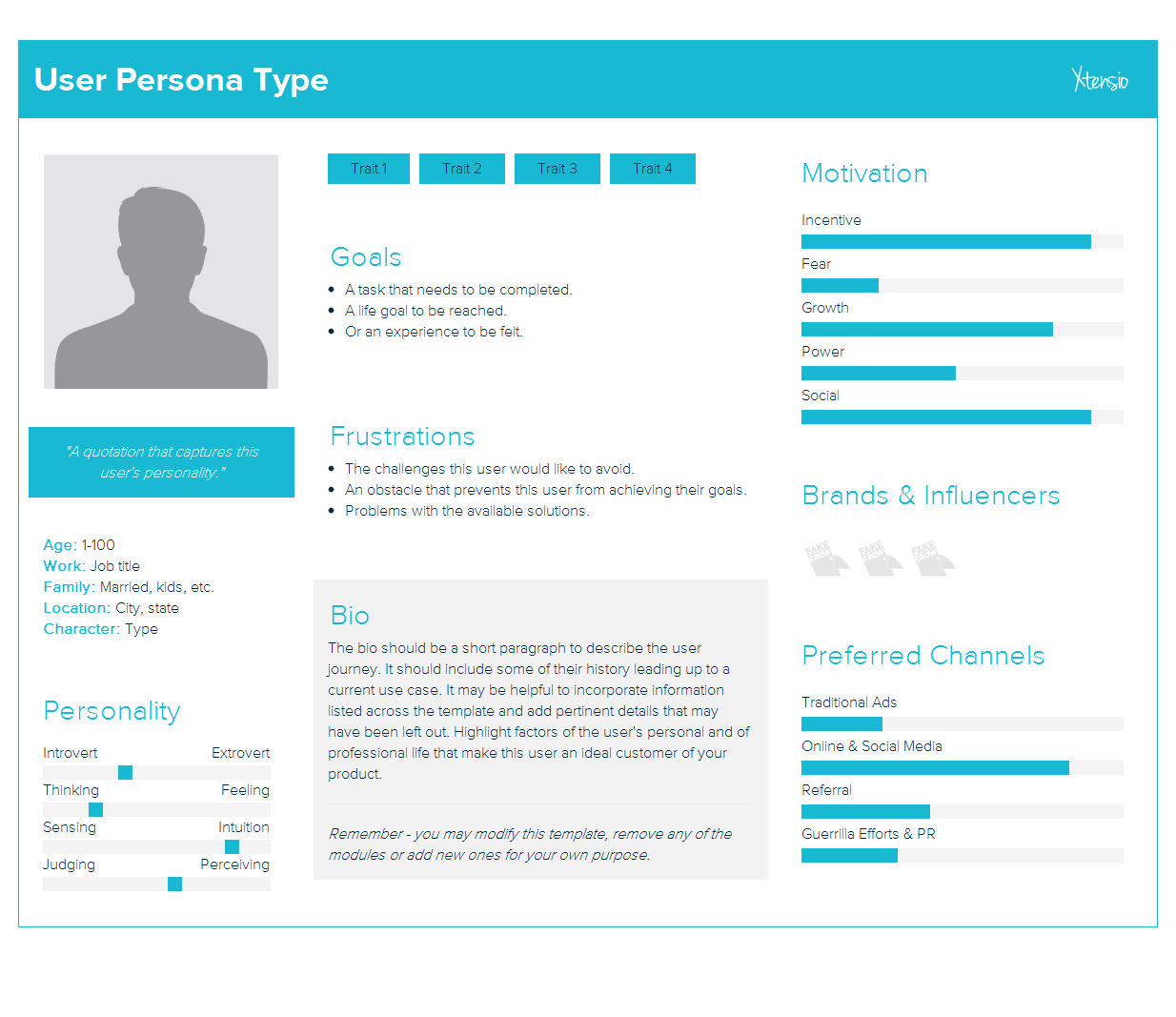
Personas are fictional users who embody real concerns of users. For a persona to be effective, it must be personified: give it a name, an age, associate it with a photograph, imagine its character traits… The more your persona is personified, the better you will succeed in empathizing with it.
How to build your personas?
Re-take all the information collected about your users during the observation and interview phases and define several typical profiles. It is important to have different profiles, because the expectations will be different depending on them (the profile can vary in terms of age, gender, profession… here, it’s up to you to define it based on your target audience!)
Starting from a previously defined blank template, place the insights (relevant information) on the personas.
What information should you fill in for your personas?
The persona profile can vary depending on your problem, the product or service you want to improve. However, certain information blocks are common to all personas and filling them out will help you empathize with your users. Don’t be afraid of the details! The more specific the information about your personas, the better you will be able to empathize with them.
- The identity of the persona Name, first name, age, gender, family situation, profession
- The history of the persona What are his/her interests? his/her passions? his/her personality traits? Tell the story of your persona in the form of a short text, or accompanied by a quote to make him/her speak directly will help you to personify him/her.
- His motivations and obstacles at the time of purchase of the product/service.
- His/her relationship with you or your product Is this a customer? a prospect? what is the frequency of use of the product or service?
You can add the following information, depending on its relevance to your problem:
- The preferred media used
- The relationship with technology
- The goals related to his profession (target B2B), his goals in life
- His work environment, his daily tasks
- The applications he uses
- etc.: all the information that will help you understand the behavior and motivations of the persona regarding your product/service is good to take note of!
A blank sheet of paper to help you build your personas:
You are now ready to put yourself in the shoes of your customers / users. Beyond the framework of Design Thinking or projects related to innovation, these techniques for measuring the user experience will also be essential for your marketing, communication, and sales teams… Entering into empathy with the customer is beneficial for the entire company, because UX concerns everyone!