



The digital revolution is not only technological; it is a revolution that puts the human being at the heart of the processes by adapting the latest technologies to new behaviors. Training is no exception to this upheaval. For the last ten years, the pedagogical modalities of training have already evolved considerably, especially with the emergence of new online tools: e-learning, intranets, MOOCs, etc. But the feedback on these tools shows that they are not always fully effective and sufficient.
This is proof that the digital transformation of training does not only involve an evolution of pedagogical material, but also a revolution in policies that truly puts the learner at the heart of the process. Training becomes community-based, collaborative, and social in order to align with our true aspirations.
E-learning is almost dead...
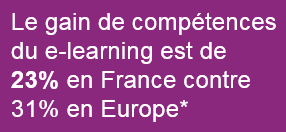
The experiences gained over fifteen years of practice show that although e-learning modules are occasionally followed and sometimes appreciated, their effectiveness remains extremely low. Several reasons for this:
- Objectionctifs blurred, oscillating between sensitization and professionalization;
- Des pédagogies oAbsolutely in relation to usage (video games / etc.);
- Union trainingLateral and descending, without the possibility of interactions;
- A methodologyan approach to learning that is poorly suited to the French cultureThe main reason for the failure of e-learning in France is that people do not know how to learn on their own and independently.
Evidence of the lack of effectiveness of e-learning: leading companies are developing little of this type of device in their projects and are instead opting for short video learning modules that meet an operational and specific need.
…Long live social learning!
Social learning enables the development of learning through collaborative modes and the development of collaboration through learning.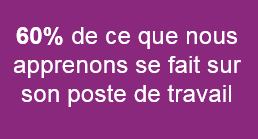
- A collaborative training: Now, everyone in the company becomes an actor in the training process: sometimes a trainer, sometimes a learner. Learning is structured around learning communities, in an interactive and ongoing way.
Collaborative work methods are one of the main challenges for companies. They represent an extraordinary source of efficiency. Collaborative work methods, in particular, allow employees to be united, engaged, and involved. Collaborative learning enables this collaborative culture to be instilled in employees’ skills.
- Tools at the service of collaboration: More than traditional digital learning tools (Learning Management System, Intranet…), the tools will be structured around Enterprise Social Networks (CSR), which will serve as a single interface for the employee and, therefore, the learner.
- The whole point is therefore to creating and sustaining learning communities.
A new spirit is blowing over the training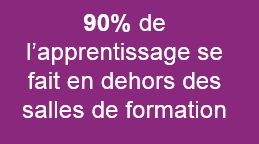
Training is no longer limited to the time of a single session. It must be considered with support and over a period of time.
- Before and after trainingWhile attendance remains at the heart of the training program, the prerequisites and post-training support are equally important in the learning process. It is necessary to inspire and develop an appetite for learning in advance of the training, and then provide individual or collaborative support over the long term.
- Raising awareness, professionalizing, and providing support An effective training program can only be conceived by respecting these 3 essential steps for understanding training as a whole.
- Inspire a «digital minded» mindset» New reflexes must be developed and new practices must be established to involve employees in a new culture of training and collaboration, thus creating the conditions to «dare» to implement new practices.
*CrossKnowledge Barometer of e-Learning in Europe
Also worth reading : Interview with Juliette Roy (Danone): «One learning a day»: learning on a daily basis, learning in the field!