


Interview with Jean Baptiste Gouin by Lucas Jakubowicz for the JDN (Journal du Net)
[14 March 2016]
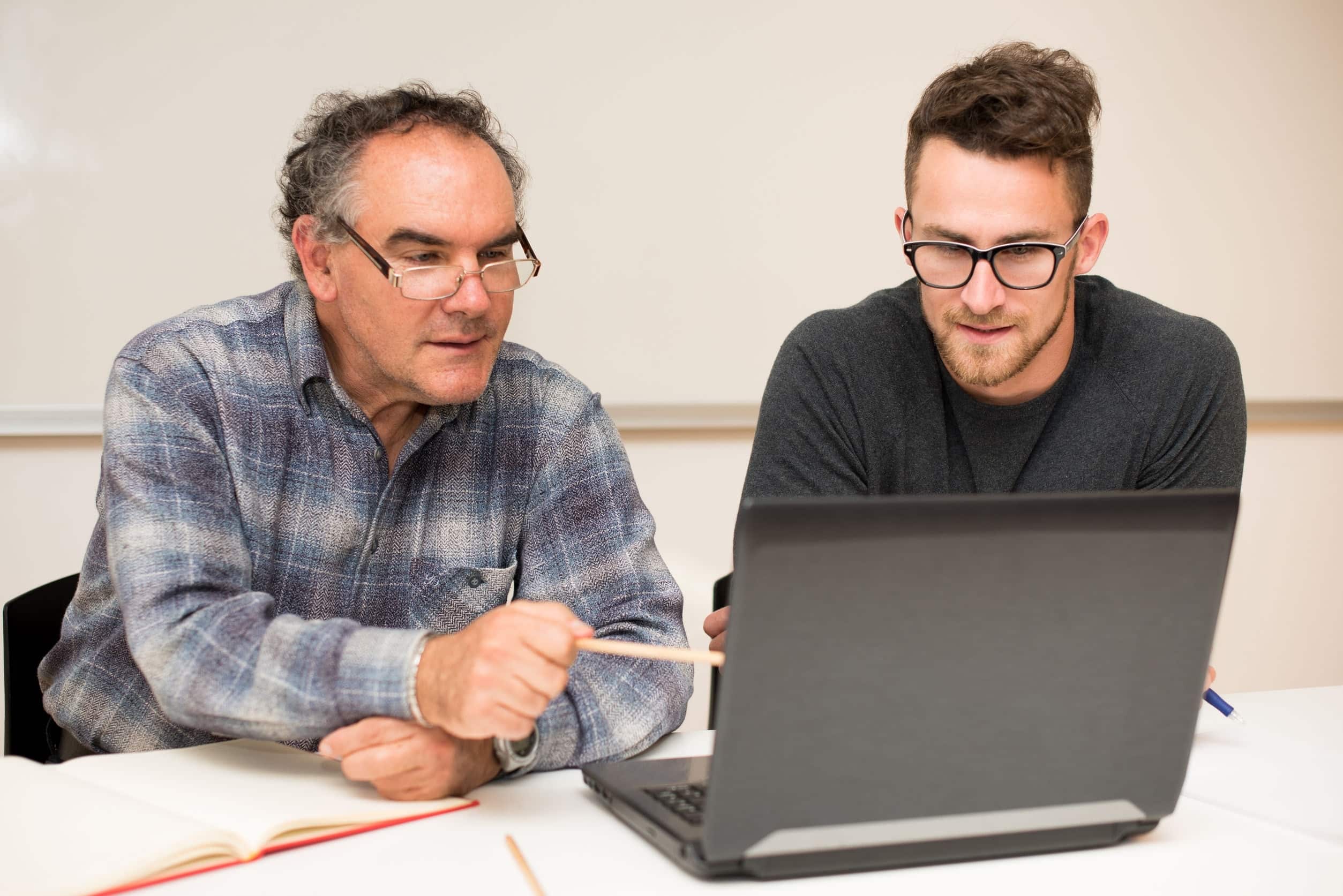
Imagine a company where managers with many years of experience regularly follow the lessons of employees who sometimes have less than a year of experience. Unlikely? Yet this type of learning exists and is attracting companies. We’re talking about reverse mentoring.
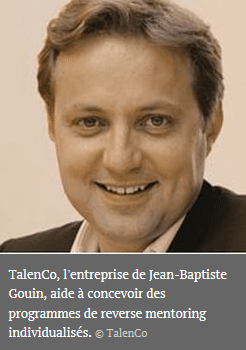
«This way of learning is in full development over the last two years,« says Jean-Baptiste Gouin, head of talenco, a company that helps companies transform themselves through digital technologies by, among other things, implementing reverse mentoring programs. It is true that digital technology changes everything. Knowledge is becoming increasingly obsolete. Managers who are sometimes unaware of new technologies must adapt to these changes in order to successfully implement growth strategies.
In this context, young people from the Z generation become a valuable source of teaching. «This is an important paradigm shift. In traditional education, we always think that knowledge resides in its antiquity. That is not the case with reverse mentoring, which is a form of reverse mentoring that is increasingly gaining popularity,» adds Jean-Baptiste Gouin.
A meticulous organization…
Like Sanofi and the SNCF, Axa is one of the companies that have succumbed to the siren song of reverse mentoring. «We launched a program of this type in July 2014. Our goal is to train 1,500 managers. At the moment, 600 have been trained. Two major reasons explain the adoption of this form of learning: the need to sensitize the group’s leaders to digital technologies and the conviction that intergenerational learning is the best way to operate,» explains Nicolas Rolland, Director of Innovation, Learning and Culture at Axa.
Although reverse mentoring may at first glance seem childish and easy to implement, it must follow certain rules. «We don’t have a choice. A top manager’s schedule is valuable. He can’t waste time; he needs immediate results. Everything must be done down to the last detail,» admits Jean-Baptiste Gouin.
 The first step is the selection of teachers, which must not be done randomly. «Our 130 mentors are selected on a voluntary basis and work voluntarily. They are on permanent contracts and temporary contracts, although we do have a few apprenticeships. We asked human resources to identify the most suitable employees. Their CVs and presence on social media are, for example, examined. Subsequently, young people have been able to introduce some of their peers into the program,» says Nicolas Rolland.
« We believe that a mentor must master both the tools and the usage. We give them quizzes, we check their Twitter account for a Twitter mentor, for example. Then we train them in advance. It is necessary, in particular, to ensure that the mentor can effectively communicate with a top manager or a senior executive », details Jean-Baptiste Gouin.
One of the strengths of the reverse mentoring concept is the individualization of the training. «We really tailor the training to each individual. Each learner will choose what they want to develop,» confirms Nicolas Rolland.
Once the program and mentor are chosen, the training can be conducted five to ten times over an hour face-to-face. For reasons of concentration and time management, this is the most suitable hourly format.
… from which everyone comes out a winner
Reverse mentoring would be beneficial for all stakeholders, whether it be experienced executives, young mentors, or the company itself. According to Nicolas Rolland, for young teachers, there are three major benefits: «The ability to teach tools that one is familiar with still allows one to progress in the knowledge of these tools and become more effective. Moreover, the young person gains visibility among experienced executives. They build a network that can help them in their career.» This opinion is shared by Jean-Baptiste Gouin, who believes that this mechanism creates a transgenerational bond that can persist over time. Mentors, in turn, are more receptive to the new methods in a practical way.
 All of this is also extremely beneficial for the company, which has executives who are aware of the issues and new digital practices. By building generational connections, it creates a team spirit. The practice of reverse mentoring also allows the company to save money. There is no longer a need to invest in expensive training programs. However, this economic aspect is secondary to the pedagogical value added: «In no case has our program been designed with the aim of saving money so as not to have to pay for trainers,» confirms Nicolas Rolland.
A difficult digitalization
The goal of reverse mentoring is to help older employees master digital technologies. Yet the experts surveyed are unanimous: learning must take place face-to-face rather than on digital platforms.
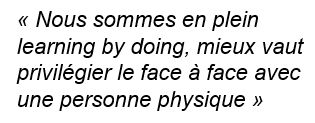
However, the experiences of reverse mentoring programs have enabled the insurance company to develop a COOC. «Since January 2015, we have launched the COOC Do you speak digital, which incorporates some of the content we developed as part of the reverse mentoring program,» explains Nicolas Rolland. However, this does not mark the end of the reverse mentoring program. The future would rather be a mix of genres. «Now, the mentees can use Do you speak digital between two face-to-face sessions. This means that learning now takes place in a more interactive way,” explains Nicolas Rolland. blended learning, That is, by mixing the present and the distant».
And one day, who knows, managers may no longer want to leave their digitized platforms...