


[Management – April 2016 – By Marie Lelong]
Many large groups entrust the task of introducing the older generation to the intricacies of digital technology to the younger generation. Mentors and mentees are delighted.
Transmit the codes. Beyond the purely pedagogical aspect, this practice aims to connect generations, including those that are not so far from one another. «Even in a group like Accenture, where the average age is 32, we noticed that some of our leaders, despite knowing about these tools, were afraid to use them out of ignorance of the codes. Reverse mentoring is there to make them more competent and more autonomous,» emphasizes Arnaud Babin, 27, social media manager at Accenture.
These new mentors, all under 30 years old, thus find themselves teaching their hierarchy how to search for or relay information on a community platform, how to participate in a discussion, how to position themselves as opinion leaders, etc. At Axa France, where the reverse mentoring program already reaches a thousand people (135 mentors for 850 trained managers), the challenge is also to understand industry trends. In other words, explains Nicolas Rolland, director of culture, innovation and training, «we need to allow leaders to experiment with the tools used by customers in order to grasp what the company can offer them in this area.».
Shared opening. To help managers envision a world they have never known before, nothing is more effective than personalized coaching in a spirit of shared openness. Last year, Catherine Aragon, 59, Director of Support at Axa France, was coached by Pauline, 23. «Between this young woman and me,» she enthuses, “an intelligent relationship has developed: she was able to immediately feel useful to the company while, on my part, I acquired within a few hours skills I did not have. Today, I tweet every day, I participate in discussions, I relay the information that interests me. In short, I am an actor of my time; I play my role as an inspiring manager.”.
Training mentors. In order for this «intelligent relationship» to be established, the young mentors must adopt the right posture. Axa offers them a training course during which, in addition to digital topics, pedagogical issues are also addressed. «The goal is to provide executives with valuable and accessible expertise,» insists Nicolas Rolland. “That’s why we encourage our mentors to share their digital experience and engage in conversation with the people they will coach, in order to better understand and identify their needs.”.
Tailored follow-up. Because you obviously don’t address an individual who barely knows how to use a search engine in the same way as someone who has been on social media for several years. Generally, coaching therefore takes place in five or six one-hour or two-hour sessions, face-to-face, in order to allow for appropriate follow-up. Axa has identified three types of requests: pure beginner training, advanced training for those who want to discover Instagram or Snapchat, and development for those who are already on social media but are not fully exploiting their potential.
From expert to expert. The young mentors also gain a great benefit from this experience. First because they gain confidence in themselves through contact with the leaders, but also because they open up to the company. «The exchanges we have with each other are very diverse,» says Arnaud Babin from Accenture, who has numerous coaching experiences to his credit. “We find ourselves in direct contact with different professions and, by seeking to understand the specific needs of each one, we significantly enrich our knowledge base. At a time when we are asked to be multi-taskers, this is an asset for the future.” In other words, an expert-to-expert relationship is established in a dialogue of equals.
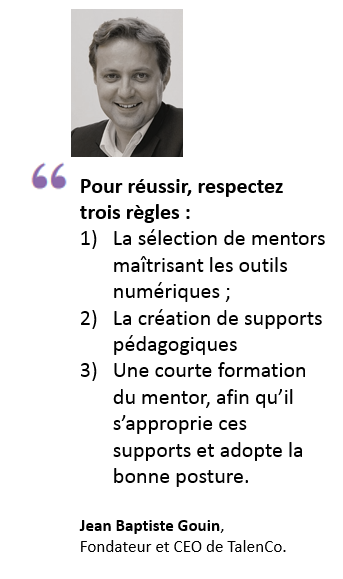
Disconnecting knowledge from power. But then, what happens to hierarchical relationships? «Thanks to reverse mentoring, it’s a whole new vision of management that’s evolving,» points out Jean Baptiste Gouin, founder of the talenco consulting firm, which specializes in training on the impact of digital technology. From a cooperative mode, where a team gathers around a project, we move to a collaborative culture where everyone takes ownership of the tools and where the younger generation clearly contributes their own piece to the common edifice. We accept the idea that knowledge is no longer necessarily the preserve of power and we unleash the creative forces of the company.”.
Moreover, at Accenture, we are already placing young mentors in each team. It seems that there is no better way to bring people together in the field than through digital technology…