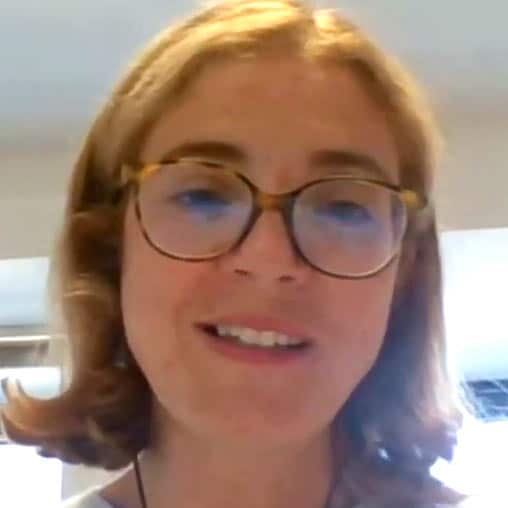
How to effectively manage teams that alternate between teleworking and in-person attendance? This remote management in a «hybrid» mode requires specific skills that will become indispensable in 2021. Clara Jakubik, Director of Training and Competence Development at Keolis, We present his video testimony on the hybrid management training deployed talenco by this major player in the transport sector (interviews conducted in April 2021).
Cyrille Chaudoit: What is the origin of the choice of this training method?
Clara Jakubik: We launched this distance management training because following the Covid situation, we had to quickly implement teleworking – even at 100% % during the first lockdown. Then, in the summer of 2020, We switched to a model that we called «hybrid» with some people coming in person and others staying in telework.
In any case, we have problems today regarding remote management with teams that are no longer seen on a daily basis as they were before.
CC: More specifically, what were your expectations for such a program?
CJ: The main expectations were to discover the tools of remote management, how to run a team while working from home, and how to do feedback, How do you keep teams motivated, how do you continue collaboration and teamwork, and how do you monitor activity as a manager, from a management perspective? reporting, KPIs...
We also had expectations regarding the entire management that a manager can perform, because, from a distance, it becomes more complex. We expected tools, good practices, but also the sharing of experiences around this topic.

CC: Why have you chosen talenco to accompany us on this topic?
CJ: We chose talenco it for two main reasons. The first was that it was The format of the device and the approach : an hour-long webinar, then a series of virtual classes. It was a 3x2h virtual classroom setup for fairly small groups of 10 to 15 managers, allowing for sharing, exchange, and expressing their difficulties, and leaving with quite concrete tools, very operational things that can be implemented quickly. Moreover, the fact that this format is short (2 hours) makes it easier to integrate into a manager’s schedule.
The second reason for choosing Talenco, is the quality of the participants. When we met your teams talenco and the trainer who was going to lead these training sessions, we found that she was of excellent level, that she had a background who really met our expectations, that she also had the energy to lead these training sessions, because in a virtual classroom it’s not that simple.
CC: Following the implementation of this measure, what were the returns and feedback ?
CJ: We have had a very strong enthusiasm for this training which surprised us a lot, since in our country there is no very developed training culture. We promoted this training via email, with simple communication, and we had a huge number of signups…
The feedback They were very positive from the perspective of the people who participated. We have received very positive feedback, excellent satisfaction rates, and above all employees who have recommended the training to other colleagues., And that’s how we have a very high demand for this training. We had to schedule new sessions!
Clara Jakubik, Director of Training and Competence Development
CC: In your opinion, what is the strength of this training program?
CJ: In my opinion, The greatest strength of this training is the sharing of the experiences of managers, The fact that they have the opportunity to explain concrete cases and that we can discuss together how to manage such or such a problem.
Furthermore, it is extremely practical, and the person leaves with an action plan and things they can implement quite easily.
CC: Do you see any improvement points to suggest?
CJ: What I see here, in retrospect, is that Two hours pass very quickly, Especially in the first sessions, when you have to go through a group formation process to create a group. That can be quite frustrating. So, in retrospect, I would definitely try a format of about three hours, so 2×3 hours instead of 3×2 hours.
CC: Would you recommend this training to others? hybrid management ?
CJ: This is a training I would strongly recommend to other colleagues in positions similar to mine. Moreover, for the record, it was a colleague, the training director, who recommended that I work with you! ☺
CC: In conclusion, how do you see the years ahead in terms of the «future of work»?
CJ: It is obvious that we are not going to go back to what we were before. I think in particular that teleworking for office-based activities will continue. This requires companies to consider the topic in its entirety., Including the local aspects, the organization of meetings, dedicated rooms, etc.
We had to learn to work collaboratively, much more than we did before, using and training in collaborative and remote tools. It is clear that skills must evolve very quickly. You need to have very strong agility, and HR needs to be there to support you and ensure that everyone stays on track, if I can use an analogy in our fields…
Short training course «Hybrid Team Management»
Methods and tools for reengaging hybrid teams
Case study: Adapting management and team-building practices to hybrid work
In a context of hybridization of work modes between face-to-face and remote work, talenco Keolis trained managers in new practices in management and team leadership in a hybrid mode.