

In a volatile and uncertain context, it is essential to transform the strategic management of the company. To help companies move from vision to execution of their strategies, I talenco support leaders and their teams with the OKR method (Objectives & Key Results) since 2018.
Raphaël Kattan, As Managing Director of talenco and expert at OKRMentors, he shares his experience with OKRs in France.

What is the OKR method and how does it impact strategic management?
RK: The OKR method is in a way the extension of the goal-oriented management of the 1950s. It is a fairly logical and simple method to understand. aligning and refocusing the entire company on the right priorities for action, involving the entire hierarchical line, generating commitment, empowering, and better managing projects.
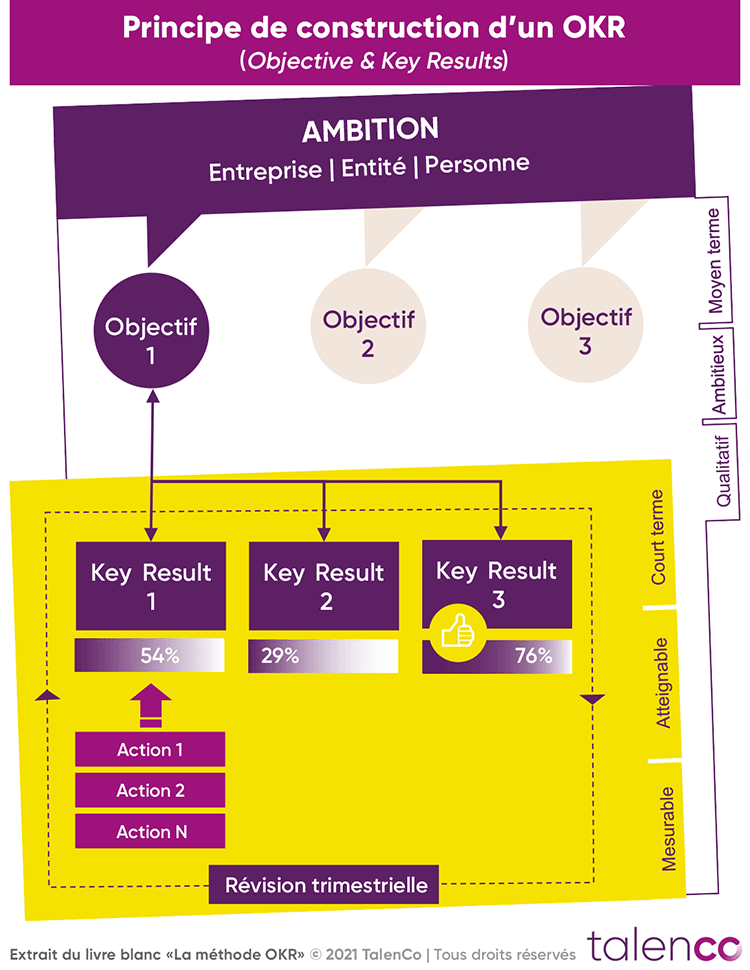
It is about expressing, at the head of the company and for each team, what the the 2 to 4 objectives to continue: a medium-term ambition – 4 or 5 years – which aims to inspire the teams.
Then, for each of these objectives, it is necessary to define 2 to 4 Key Results (KR) which show, in the short term (often over the next quarter), what we are going to measure as we move towards the goal. These key measurable results form the basis for the teams’ action plan proposals for the following period.
The Anglo-Saxons probably saw earlier than the Latins the usefulness of this type of method, which has already proven its worth in the United States and in other countries. Google. Perhaps that is why in Europe and in France it is still taking time to take on a significant scale.
I think it was also necessary infuse a more agile mindset in our companies, that the leaders embody and understand this new mindset and then adopt a method that remains close to Agile, which blends well with agile processes and methods within the organization.
How do you explain the growing interest of companies, especially in France, in OKRs?
RK: Indeed, since 2020, there has been a real surge in interest in Objectives & Key Results in Europe and more specifically in France. And this applies to companies of all sizes and from all sectors. Among our clients in the CAC 40, we can cite: Renault Group, Société Générale, Veolia Eau, Michelin...
In addition to some French unicorns, there are also many brands that use OKRs, such as Leroy Merlin and Décathlon, and of course many SMEs and large companies. We even support a municipality in implementing OKRs!
The context of the health crisis, the massive increase in teleworking, and geopolitical instability are certainly a lot to do with it. Currently, it is probably easier to have a vision for 2030 than to know exactly what will happen to us in the next 2 or 3 months. OKR’s help to set both the long-term goal and engage each employee with the right priorities every quarter. Moreover, this alignment is even more necessary when teams don’t see each other in person on a daily basis.
When you know The effectiveness of the OKR method, We can only rejoice at this enthusiasm for companies to accelerate and succeed in their transformation.
The method of Objectives & Key Results Is it suitable for all companies?
RK: OKR are for everyone, provided there is a real dynamic of transformation and business growth.. Whether it is a large group that needs to transform or change business model, or one startup which must double its turnover every six months, or an intermediate company that is in a very volatile environment, the OKR method makes sense in a logic of’strategic alignment !
In a somewhat more tactical way and by extension, the Objectives & Key Results They can be used for directions or Business Units which are in the process of undergoing fundamental transformations and which must trigger major changes.
A piece of advice for all organizations that want to embark on OKRs: The leaders must first refine the raison d’être; otherwise it cannot work. The OKR method is a formidable operational translator of the raison d’être: when it is not strong enough, not locked down, you cannot build OKRs and you end up in a dead end.
What are the obstacles to adopting the OKR method in companies?
RK: Transparency can be a hindrance. However, less than we imagined at the outset when we decided to deploy OKRs in France… We thought that this transparency would be opposed by every Management Committee, but that is not the case.
Often, The most difficult thing for leaders is to be in a genuine collaborative process. At talenco. We like to take the time to prepare in advance a first version of the company’s OKRs and the CoDir, which we call a «brick to be broken» with the leader, who must accept to play the game and be challenged by his Board of Directors: it is an act of leadership.
It is therefore essential to Agree very clearly beforehand on the rules of the game. If the manager is not prepared to operate in this way, we must be able to say that the method is not suitable for their company.
Then, Although the method is very simple to understand at first glance, it is quite demanding in its implementation.. Especially when it comes to defining Key Results. Finding the right indicator that proves that we are moving towards our goal and that holds teams accountable for developing an action plan is not always the easiest task. But when it happens, the magic happens instantly!
Finally, setting up your first OKRs is quite fun and engaging, but The real challenge is managing with the OKRs.
The key is the ability to incorporate regular OKR reviews, discussions, and quarterly retrospectives into the rituals of each team. The energy invested in this step greatly influences the adoption of the method within the company.
The role of manager leader It is obviously essential to drive this process forward. He must also evolve his approach to be at the service of the success of the project. Key Results from the team… and not in a logic of over-control.
«Although the method is very simple to understand at first glance, it is quite demanding in its implementation. Finding the right indicator (…) is not always the easiest task. But when it is, the magic happens instantly!»
How are OKRs generally received within the organization?
RK: The first good surprise is always the reaction of the executives when you present the OKRs to them., They have already tried many other methods of driving performance, managing the company’s strategic priorities, etc. You can see sparks in their eyes!
I remember a manager of a large mutual insurance company whom we have been accompanying for years who jumped up from his chair, almost wanting to leave the office. slides in my place to go faster, because he was so impressed by the method! Or even a HR manager from a large German cosmetics group, who was supposed to lead the digital transformation of his group, who decided to present it in the form of OKRs because he had never seen a method as effective…
Surprisingly, when approaching CoDir members with this approach, we sometimes encounter a reaction of mistrust. But the second good surprise usually comes once we have presented the method and explained the company’s OKRs. Everyone wants to deploy the method quickly among their teams, sometimes even wanting to go faster than the music.
What do you recommend to get started with the implementation of OKRs?
RK: The first advice would be to read the book « Measure what matters »by John Doerr, the founding father of OKRs, which makes it possible to understand the spirit of the method well. But it is not necessarily necessary to apply it literally because the examples used are very focused on the Startups from Silicon Valley. One must be able to adapt the method to the French culture and to that of the company.
That is where our experience can help. Implementing OKRs well requires support (hence our sOKRat solution®) to ensure that the method is properly used, that the objectives resemble objectives and that Key Results to some Key Results. It is important to know the market and the needs of our clients, their activities, and what they really mean when they write in their OKRs…
It is also essential that the OKRs be understandable to everyone in the company, that they carry meaning., This sometimes leads us to ask questions, demand explanations, or rephrase things… Making the goals very inspiring and ensuring that they give teams the drive to get up every morning is not always easy.
To conclude, is there a secret to succeeding in his Objectives & Key Results ?
RK: There is no common pattern. Some people will get into it very easily and quickly understand the approach, others will have a little more difficulty and sometimes… it’s counterintuitive.
For example, at Renault, I saw a Finance Department where OKRs were set in a simple and very natural way, and in other companies, I saw Product Departments, which should normally be the first to be very inspired by this type of scheme; it took time, with many iterations…
It’s an alchemy that needs to be found. You can’t reduce time, It’s like pancake batter; you need to let it rest for a while. between two workshops so that it really takes effect. Every word counts and it’s important to take the time.