

In January 2021, the Renault Group unveiled its short-, medium-, and long-term strategic plan called « Renaulution » to move from volume racing to value creation. According to its CEO Luca de Meo, « This name well sums up the degree of transformation required for the group to restore its competitiveness and performance. ».
To concretize the strategic vision into operational execution and accelerate performance, the automotive group, under the impetus of its CEO, has chosen to deploy the OKR method.
Discover the interview with the three directors of the OKR project, which makes up the core-team appointed to lead this major action plan internally with the support of talenco: Alexandra Malak (DRH innovation HR and Digital Transformation), Beatrice Chavanel (Director of Diversity and Inclusion) and Marcela Ruas Caillet (General Manager Global Talent).

The deployment of OKRs
Alexandra Malak: The genesis of the deployment of OKRs clearly revolves around the strategic plan and the roadmap. The issue of performance and collective transformation.
Alexandra Malak (Groupe Renault)
After diving into the literature on OKRs, reading, in particular, John Doerr’s book, documenting ourselves, and adopting the concepts, we organized two exchange sessions with Luca de Meo to understand his expectations., Define the approach in iterative mode and how to adapt the method to the environment and the specificities of the Renault Group.

The members of the Executive Committee were the first to adopt the method. At a half-day workshop, we defined the Group’s OKRs with them.
We then imagined, based on our three experiences, what a pragmatic and simple approach could look like for the Group’s teams. Our pride is that we started humbly, accepting to learn by doing, working to find the best approach for Renault over the course of weeks of work.
Our vision of OKRs is no longer the same today as it was a year ago. We have tested it, tested it with different people. business (commerce, industry, production engineering, support functions…) and at different levels of the organization. This shows that OKRs are not only relevant to companies in the «tech» sector.
« OKRs are a team sport. We are better when we accept to capitalize on the experience of others.»
Alexandra Malak, DRH Innovation, HR and Digital Transformation of the Renault Group
The reception of OKRs internally
Beatrice Chavanel: The OKR method It was a novelty for everyone. The first approach by the Executive Committee was quite simple, but when we started to expand it to the teams, it was first seen as just another new method and therefore sparked interest but also some reluctance…
Beatrice Chavanel (Groupe Renault)
The advantage of this method is prioritization and transparency.
There is therefore a necessary period of adaptation for the Group. We are proceeding pragmatically. Gradually, people are realizing the effectiveness of the method and overall there is a positive initial impression.
Support on the method
AM: There are several reasons that explain the choice to have someone accompany you:
- First, the cultural framework. Our initial research led us to meet many Anglo-Saxon firms, but few French-speaking ones. We needed to be pragmatic and find a partner that had tested OKRs in the French environment.
- Then, nothing beats experience: it is important to be accompanied by professionals who have tested their approach and methodology in the field.
To accompany us, we chose him talenco for his European roots, for his ability to capitalize on the experience of supporting several clients in the industry. What also appeals to us is the diversity of the project team’s backgrounds, so that we can better adapt our discourse to the Group’s business sectors (industry, marketing, sales, distribution, supply chain…).
This diversity of actors, in addition to our own team, has been enriching. OKR are a team sport. We are better when we work together, when we accept to receive feedback and capitalize on the experience of others to adapt it to our Renault context.
SOKRat® by Méthode d’accompagnement talenco
Move from vision to execution through OKRs
Difficulties encountered
B.C.: This method is simple but difficult to implement. OKR impose this simplicity of expression, this clarity, this prioritization, these choices to be made… These are basic things, but when we have to implement them, we always see a gap between where the employees are and where we want to get them.
A.M.: After designing their OKRs, it is difficult to keep the teams engaged with their OKRs. If we do not accompany them in making the OKRs «operationalizable,» that is, how they will integrate the OKRs into their daily lives, into their team rituals, it is like a puff of air that falls back. Therefore, we must not let go of their hand too quickly, because, indeed, The simplicity of the approach can be misleading.
Marcela Ruas Caillet (Groupe Renault)
Marcela Ruas Caillet: Cultural aspects can also be a difficulty, especially prioritization, because the employees continue to do what they were already doing. It is necessary to learn to say no, to accept abandoning or postponing some less priority projects in order to focus on the priorities chosen in the OKRs.

B.C.: OKR require constant readjustment; that can also be a difficulty. The pace of OKRs leads us to regularly question our priorities, and not just the year… Habits need to change!
The first ones feedback
A.M.: I can share with you a first result: these are the HR OKRs. After a timid start in the first quarter, during which we had to make our teams understand that we had to make a choice regarding priorities, we were able to conduct a first retrospective. The team’s first success is being able to focus on about a dozen Key Results selected.
BC: After a quarter, we are starting to see the first positive signs. The teams were able to measure the relevance of their Key Results and are now more mature to define them. They are beginning to understand the importance of regular revision and the issues that lie behind it. Key Results, And to think about the quarter. That’s a point of satisfaction!
Mr. R.C.: A nice surprise for me is the alignment work. While OKRs are a tool for guiding strategy, they are also a very powerful tool for communication. Telling [in terms that everyone can understand] what priorities are being worked on allows teams to discuss, refocus, and align. This is very important for executing the strategy.
«The pace of OKRs leads us to regularly question our priorities, and not just the year… We need to change our habits!»
Beatrice Chavanel, Director of Diversity and Inclusion at Groupe Renault
Advice for getting started
BC: OKRs are a tool to support a strategy. Therefore, a strategy that is shared within the group is essential.
Mr. R.C.: It has to be Trusting the method. As time goes by, the teams will learn together, practice, and put it into action.
AM: It has to be trusting in disorder. We start by testing and it’s a way to learn. With time, adoption will improve and the quality will also improve. We have to start by trusting.
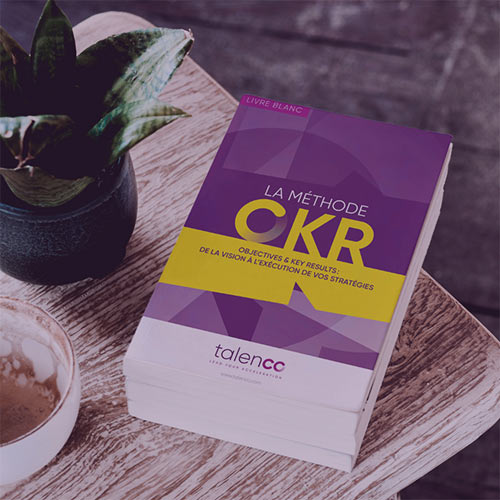
White paper on the OKR method
From vision to execution of your strategies
Photos «Renaulution» © Olivier MARTIN-GAMBIER
Case study: supporting the implementation of the OKR methodology
As part of the Renaulution strategic plan, talenco he supported the deployment of the OKR methodology across the group by implementing 3 strategic initiatives with the leaders and teams.