

Artificial intelligence is no longer just a technological topic: it is becoming a major HR issue. Skills, professions, management, employability, work organization… For HR managers and executives, succeeding in adopting AI requires distinguishing three levels of maturity: anecdotal use, tactical use, and strategic use.
Tribune by Raphaël Kattan, Managing Director at talenco
I am always amazed when a HR manager tells me: «The skills development on AI? That’s done.»
As if pressing a button was enough. As if a two-hour workshop on prompting and an email addressed to the entire company about the responsible use of AI could, on their own, constitute a transformation strategy.
What most HR and management leaders lack is neither the will nor the investment. It is a mapping exercise.
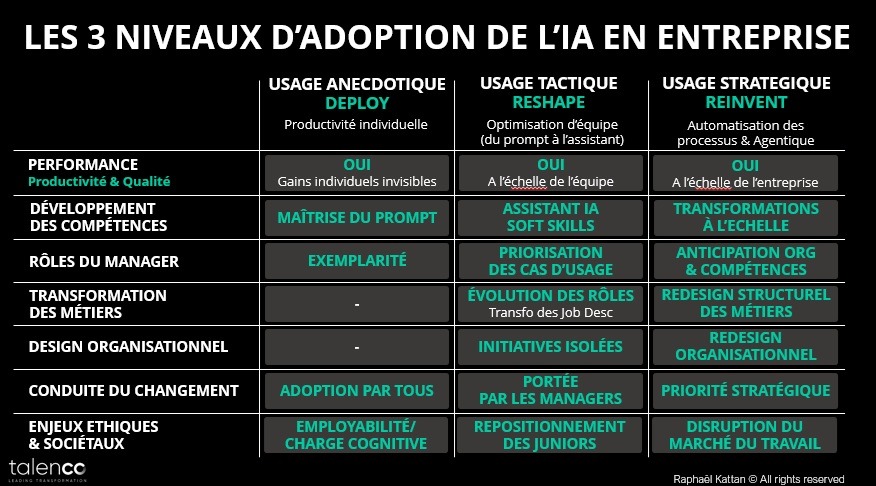
At talenco, we have identified three distinct levels of adoption of AI in organizations: the anecdotal use, the tactical use and the strategic use and, for each of these levels, seven levers of transformation that leaders must address it differently.
⚠️ The mistake most companies make is to treat these three levels in the same way. They do not require the same skills, the same management style, the same intensity of change management, or the same ethical vigilance.
AI and HR: a framework in 3 levels to guide the adoption of artificial intelligence
The three levels of adoption follow a natural progression:
Anecdotal use of iA:
Employees use generative AI individually for everyday tasks: writing emails, summarizing documents, translating content. There is a gain in productivity, but it remains largely invisible at the organizational level.
Tactical use of iA:
Teams are building dedicated AI assistants to optimize their core business activities. Performance improvements become visible at the team level.
Strategic use of iA:
Entire trades or complete workflows are delegated to autonomous AI agents. The impact on performance becomes measurable across the entire company.
Interestingly, the Boston Consulting Group segments AI adoption exactly the same way, using the terms Deploy, Reshape and Reinvent to describe what I call anecdotal usage, tactical usage and strategic usage.
For each level, 7 levers determine whether your transformation produces results or whether it goes quietly into oblivion:
- The measure of performance including not only productivity but also quality and well-being at work
- The development of skills
- The role of the manager
- The transformation of professions
- The organizational design
- Driving change
- The ethical and societal implications
Let’s review each level and examine what these levers require in practice.
Level 1 – Anecdotal IA usage: developing the first HR reflexes
1. Performance and quality: the invisible gains remain gains
When employees use AI to write emails faster, synthesize meeting minutes, or translate documents, does it actually improve the performance of the organization? Yes, but in a way that rarely appears in a dashboard.
Employees who save time thanks to AI tend to reinvest it They advance further in their list of tasks, devoting more attention to the work that truly deserves it.
The gain in productivity does not translate into a measurable increase in production that management could directly observe. It translates into more quality, comfort and commitment.
This is where many leaders make a costly mistake. Because gains are invisible, they conclude that adopting AI at this level does not create value, and they reduce investments, resources, or training programs. They «throw the baby out with the bathwater.».
Your role as HR Director Measuring what seems impossible to measure. Establish indicators capable of capturing this invisible performance: engagement scores, quality indicators, reduction in rework. If you don’t measure it, you won’t be able to defend it.
2. Development of skills: prompting is not a profession!
Let’s stop talking about prompt engineering! This wording gives the impression that it is a specialist role, reserved for a dedicated team, and not a skill to be widely disseminated.
Raphaël Kattan (talenco)
The ability to interact effectively with generative AI is a key skill which must be widely spread throughout the organization, from the CEO to the field manager.

At this stage, the skills agenda is relatively simple: helping your employees understand what generative AI can do, how to provide it with context, how to formulate a task, and how to critically evaluate the result it produces. It’s not complex. It’s achievable in a few hours of well-designed practice.
3. Role of the manager: set an example, without exception
Managers who do not themselves use AI send a devastating signal to their teams. Whether consciously or not, their reluctance suggests that the use of AI is optional, suspect, or in some way unworthy of them.
The most powerful leverage at this stage is deceptively simple: managers must be the first to use generative AI within their teams;, in a visible, regular and committed way. No investment in training will compensate for a management line that remains on the sidelines.
Think about what John Furner, CEO of Walmart USA, has done. For two years, he has opened every meeting he attends with the same question: «How have you used AI to prepare this meeting?» This single habit sends a signal more powerful than any internal policy document.
Now imagine if every manager in your company asked the same question.
4. Transformation of professions: not yet, it is too early
At the anecdotal level, no significant transformation of the professions is underway, and this should not be expected.
Individual prompting habits do not fundamentally change job descriptions or team structures.
Resist any temptation to make organizational decisions based on this level of adoption.
5. Organizational design: no changes required at this stage
The same goes for organizational design. Restructuring based on anecdotal uses of IA would be premature and probably counterproductive.
6. Driving change: investing in volunteers, not in resistance
This is not the time for a major organizational transformation. At this level, the driving force behind the change has a primary objective: to achieve mass adoption. To bring the majority of your employees to use iA in their daily work.
The most effective approach is well known, but often poorly executed. Focus your energy and resources on your early adopters, Generally, 16 to 20 % of your employees. If they are truly convinced, and if the tools you provide them are relevant to their concrete work, the early majority and the late majority will naturally follow.
Don’t waste your energy trying to convert the latecomers. Employees who actively resist the adoption of iA will see their productivity and the quality of their work decline over time. This is ultimately their choice.
7. Ethical and societal implications: employability and cognitive overload
At the anecdotal level, the ethical agenda is not abstract: it is already on your desk.
The first issue is employability. One of the implicit responsibilities of any employer is to maintain the employability of their employees. Not using generative AI in their daily work will become a real professional handicap within one or two years.
Organizations that do not actively develop this ability among all of their employees create, whether they want it or not, a future problem of employability.
And this responsibility does not stop at the office door. Most AI adoption programs are designed for office workers equipped with a laptop and a professional email address. What about logistics operators, factory teams, field technicians, and store employees?
If your AI strategy only affects people who have access to a screen, you are not conducting a transformation program: you are creating an internal skills gap that will be very difficult to fill later on.
The second issue is that of cognitive overload. As employees delegate routine and repetitive tasks to AI, their workload does not decrease: it shifts. What remains increasingly involves high-intensity cognitive work, with fewer low-effort tasks between sequences to allow mental recovery.
One Harvard Business Review study A survey of nearly 1,500 workers has identified what researchers now call «AI brain fry»: a state of mental fatigue caused by constant interaction with AI tools and their supervision, manifested by slowed decision-making, mental fog, and a persistent feeling of overload.
The Workforce Intelligence Report 2025 De Deloitte shows that mental fatigue and cognitive tension have now surpassed workload as the main predictors of burnout.
The brain becomes the new bottleneck. It must be monitored, and not assumed that the problem will disappear on its own.
Level 2 – Tactical AI usage: transforming team practices
1. Performance and quality: visible at the team level
When teams build dedicated iA assistants, or a library of prompts to support their core business activities, performance improvements become visible and measurable.
To name just a few examples: a training team that uses iA to produce better educational content, a recruitment team that automatically transforms job descriptions into attractive job offers, and a customer service team that refines its call scripts with the support of iA.
But visibility is not enough. The good question is whether the team’s performance indicators are actually improving. A B2B sales team that uses AI to write more precise and personalized proposals should see its conversion rate improve. If it doesn’t, it means the iA assistant isn’t solving the right problem.
If your teams operate at a tactical level and performance does not improve, something is wrong in the use cases they have chosen, in the quality of the assistants they have built, or in the way the work is organized around them.
2. Development of skills: critical thinking is non-negotiable
At this stage, the skills agenda is evolving significantly. Three capabilities become critical:
The ability to identify the right use cases, not those that seem comfortable or that allow for the saving of marginal time, but those that directly contribute to the team’s core mission and its strategic objectives.
The practical ability to parameterize and configure iA assistants Understanding what they can and cannot do, and how to get the most out of it.
The deliberate preservation and development of a critical mind. As teams rely more and more on iA assistants to structure their analyses, write content, and process information, the risk of cognitive passivity increases. Employees must be actively trained to question the iA’s outputs, challenge its assumptions, and preserve the judgment that makes them valuable.
3. Role of the manager: prioritizing what is strategically important
At this level, the manager’s role no longer consists solely of exemplifying the use of AI. It evolves into a more demanding mission: help the team prioritize the right use cases.
It’s more difficult than it seems. When delivered on their own, teams naturally turn to AI applications that reduce friction in their existing workflows, not necessarily those that would create the most strategic value.
The role of the manager is to ask the most demanding question: not «how does this AI assistant help us save time?», but «how does this AI assistant help us contribute more effectively to what the company is trying to achieve?»
4. Transformation of professions: it starts here, and you need to pay attention to it
This is where the transformation of professions begins, and it’s not too early to prepare for it.
When IA assistants are well designed and truly integrated into the core activities of a team, the first significant evolutions in skills and organizational structure become possible.
Some tasks disappear, some roles evolve, and new skills become necessary. Managers who have reached this level should already be asking themselves: «What should my team look like now?»
In practice, however, these organizational adjustments remain relatively isolated at this stage. Most teams are still identifying the right use cases and building the right assistants.. Deep organizational redesign at the tactical level remains the exception, not the rule yet, but the foundations laid here will determine how prepared your organization will be when that becomes inevitable.
5. Organizational design: isolated cases to be monitored
At the tactical level, significant changes in the organizational structure remain rare. You can encounter isolated cases where a team has gained so much capacity thanks to AI assistants that its structure no longer makes sense, but this remains exceptional. It remains to be monitored, but it is not yet a systemic priority.
6. Driving change: driven by the manager, anchored in the rhythm of work
At this level, driving change is no longer a bottom-up initiative. It becomes a team responsibility, driven by the manager in the daily rhythm of work.
The most effective approach is simple: Teams must regularly review their core missions through the lens of the IA. What could we do better or faster with an assistant? What decisions could be better informed? These conversations need to be ritualized—not as a one-time workshop, but as a recurring practice integrated into team meetings and retrospectives.
7. Ethical and societal implications: the problem of junior talent
In the United Kingdom, since generative AI has become widespread, job offers for interns and entry-level positions have decreased by about 20%. 32 %. This is not just a labor market statistic. It is a strategic issue that HR departments can no longer postpone.
The dilemma is real and uncomfortable. If companies stop hiring junior employees because IA performs their tasks faster and more reliably, who will become the senior experts of tomorrow? Experience is not downloaded; it is built over the years through exposure, mistakes, and progressive responsibility. It cannot be artificially shortened.
Should organizations accelerate the onboarding of junior employees, with the support of the iA to compensate for their lack of experience? This would underestimate what experience really brings.
Should they continue to recruit juniors whose immediate contribution may be less than that of a well-trained AI assistant? The economic equation is difficult.
Should they simply stop recruiting juniors? In that case, they should consider which branch they will have to sit on in five years.
There is no simple answer today. But this is precisely the type of question that cannot remain confined to the HR function. It must be on the agenda of the executive committee, and it is the HR managers who must put it on the agenda.
Level 3 – Strategic AI usage: redesigning professions and organization
When agents drive your business, who drives your agents?
1. Performance and quality: finally measurable on a scale
At the strategic level, the impact on performance is no longer a matter of inference or indicators. It is direct, significant, and measurable at the enterprise level.
Consider what Walmart has accomplished by deploying AI agents to manage the content of product pages on its platform: 85 pieces % of content were rebuilt in 2025, at a speed and scale that no human team could have matched. Consider an agent tasked with managing the accuracy of assortments and purchases in a large distribution network: the cost savings and revenue gains are calculated in millions, not percentages.
When agential AI is deployed on an activity at the heart of the value chain, the question of performance is no longer: «Is it working?« It becomes: «At what speed can we scale?”
2. Development of skills: a shift on a large scale, not on the margins.
At this level, the evolution of skills no longer concerns only individuals acquiring new abilities; it concerns entire occupational groups that are being redefined (some are shrinking, others are expanding, some are disappearing and new ones are emerging) that did not exist before.
The case of Walmart’s fresh produce department is instructive. For years, assortment decisions (which products to stock, in what quantities, at what price) were made by the store managers. Year after year, the AI algorithm proved more accurate than the human manager.
The value of the manager no longer lies in making these decisions. It lies in defining the operational rhythm of the team, coaching the employees, managing exceptions, and ensuring that the organization’s values are reflected in how the recommendations of AI are implemented.
What is the new added value of this manager? That is the question that every organization deploying agents on a large scale must answer, job by job, team by team.
3. Role of the manager: organizational anticipation and skills
At the strategic level, the role of the manager evolves into something that most current management development programs do not prepare for: continually anticipate the transformation of the professions and skills of its team.
HR cannot do this alone. They cannot be experts in hundreds of different job roles present in a large organization. You must give managers the means to carry out this anticipatory work themselves.
That is why, at talenco, we have developed the Future of Jobs & Skills Review©, A structured method that helps managers to plan ahead every six months, around four sets of questions:
- How do the jobs I manage evolve under the influence of external trends?
- What transformation is in store in light of our strategic priorities and our roadmap for technological investments?
- What is the impact on organizational design and the skills required?
- What intensity of change does this require?
This conversation should become a regular dialogue (every six months, for example) between the managers and their HR Business Partners.
This is not a theoretical scenario: collaborators are already receiving instructions from AI systems. Managers are already supervising hybrid teams composed of humans and artificial intelligences. The challenge of driving change is to make this transition legitimate, transparent and fair, rather than arbitrary, opaque or threatening.
Accepting this new reality is not a given. It requires investments, communication, and above all, managerial leaders capable of concretely demonstrating what it means to collaborate with AI rather than resisting it.
4. Transformation of professions: a structural redesign, at a pace never observed before
At the strategic level, the transformation of professions is no longer incremental. Some professions will fundamentally change, others will disappear. New professions will emerge, which we cannot yet fully describe today.
What differs from previous waves of technological transformation is the speed. The Industrial Revolution redesigned professions over several decades. The digital transformation has redesigned them over several years. AI agents could redesign them in a few months.
You cannot redesign your organization in a reactive way. By the time the transformation becomes obvious, it will already be too late to respond to it in a thoughtful way.
That is precisely why the structured and proactive dialogue between operational leaders and HR — the one that the Future of Jobs & Skills Review© is designed to enable — is not a «plus.» It is an urgent necessity. The organizations that will do best are those that have already made it a ritual, not those that start when the pressure becomes unbearable.
5. Organizational design: redesign before deploying, not after
This is one of the most common and costly mistakes I observe in organizations that deploy strategic IA. They first deploy IA automation, then wonder why the results are not up to expectations.
The sequence should be reversed or, at the very least, carried out in parallel.
Before or during any deployment on a core workflow, ask yourself the following questions: what should the team around this agent or process automation look like? Who validates its decisions? Who handles the exceptions it doesn’t know how to handle? Who is responsible when they make a mistake? Who ensures that their results align with the company’s values?
If you do not answer these questions in time, you will face resistance.
An organization still configured to operate as it always has will naturally oppose the new reality. Not out of bad faith, but out of inertia. And when structure and technology are out of alignment, technology never wins. Transformation gets bogged down, investment is wasted, and the conclusion drawn is that the IA «did not produce the expected results,» when the real problem was never the IA.
6. Driving change: a strategic priority, not an HR program
At the strategic level, driving change is no longer an HR initiative. It becomes a strategic priority at the board level.
Entire segments of the value chain will be deeply redesigned or automated. This is not a gradual evolution but a structural shift that will affect the way work is organized, decisions are made, and how employees live their role on a daily basis. In some cases, AI agents will make operational decisions that will have a direct impact on the activities of employees.
At Lowe’s, an AI agent paired with computer vision is able to autonomously give precise instructions to warehouse employees (deciding, for example, which member of the team should retrieve the contents of a pallet that has fallen down an aisle) in order to optimize logistics operations in real time.
Making this new reality accepted by employees and managers This requires deliberate work on the acceptability of AI. It also requires building a new managerial capacity: the ability to assess whether an AI agent delivers the right ROI, makes robust decisions, and acts in line with the company’s ethical and moral values.
Managers can no longer simply execute; they must also govern. And governance cannot be left to individual teams.
Organizations that deploy AI at this level need a centralized governance structure to drive this transformation, one that sets the standards, monitors the results, and ensures that the change is driven with the consistency and rigor it requires.
Because beyond operational and managerial questions, the deployment of autonomous AI agents making decisions that affect people’s work raises something deeper, almost philosophical: what does it mean to work alongside a system that decides, optimizes, and gives instructions? Another fundamental question on a list that keeps growing longer.
7. Ethical and societal implications: a question that HR cannot afford to ignore
Many organizations that are currently announcing layoffs and staff reductions «due to the iA» are actually conducting delayed restructuring efforts that have been underway for years. The iA serves as a convenient pretext for organizational decisions that should have been made long ago.
But behind the noise, a real question emerges: could it be the first major technological revolution in history that destroys more jobs than it creates? The honest answer is that we don’t yet know. Previous waves (industrialization, computing, the internet) all ended up creating more jobs than they destroyed, even if the transition was painful. AI could follow the same path, or not.
What is certain is that the balance is shifting, and rapidly. A very large majority of roles are going to evolve in depth.
The responsibility of HR and management teams is not to predict the outcome, but to anticipate it with the utmost rigor.
A concrete response consists of building a job observatory, either internally to continuously monitor the evolution of roles within the organization, or at the sectoral level, in collaboration with peers facing the same transformations. In both cases, the goal is the same: making the employability of people a genuine strategic priority, and not a footnote.
From adoption to transformation: the gap that most organizations do not fill
Most HR managers treat AI as a training topic: deploy a prompting workshop, publish a policy on responsible AI usage, and then consider the topic as solved.
The reality is that the adoption of AI in organizations operates on three fundamentally different levels, each requiring a specific leadership response across seven dimensions of transformation.
Performance measurement, skills strategy, managerial posture, intensity of change management, business process redesign, organizational structure, and ethical responsibility: none of these dimensions present themselves in the same way at the anecdotal, tactical, and strategic levels.
The organizations that will build sustainable competitive advantage through AI are not the ones that will deploy the best «prompt engineering» training. They are the ones that will build the managerial and organizational capacity to associate the right transformation response with the right level of adoption and to continuously anticipate what comes next.
Where does your organization stand in this framework of analysis? And, more importantly: are your HR leaders and your senior management aligned with what that requires of each of them?