

Every year, the report State of the Global Workplace by Gallup offers a unique insight into the mindset of employees around the world.
The 2026 Gallup report confirms a worrying trend: Employees’ global commitment declines for the second consecutive year, at 20 %, its lowest level since 2020. Gallup estimates that low engagement costs about 10 trillion dollars in the global economy, that is 9% % of global GDP.
This report is based on data collected throughout the’year 2025, This report is the result of the largest global study on the employee experience. It is based on a panel of approximately 150,000 respondents, distributed in more than 160 countries, allowing for a representative reading of the dynamics of work at the global level.
The 2026 edition reveals a decisive angle: AI will not generate its gains without solid management. The tools work, but their adoption remains hampered by the organization, culture, and especially the ability of managers to support the teams.
1. A commitment to work that continues to decline worldwide
2. Managers, a weak link… and a central lever and key factor of engagement
3. Why generative AI is not yet improving company productivity
4. Wellbeing: a slight improvement, but negative emotions remain high
5. Why Europe remains the region least committed to work
6. France: continued critical engagement, more optimistic employment market
7. The job market: fragile confidence, ongoing restructuring
+ The 5 challenges to be addressed to reengage teams in 2026
1. A commitment to work that continues to decline worldwide
In 2025, only % 20 employees worldwide they are engaged. 64 % are not engaged and 16 % are actively disengaged. No territory has seen its engagement progress over the year; the biggest decline concerns South Asia, with -5 points.

The key point: commitment becomes an indicator of capacity for transformation. In an AI context, engaged employees are more likely to adopt the tools, experiment with them, and contribute to productivity gains. Conversely, disengagement risks neutralizing technological benefits and even increasing operational and security risks.
2. Managers, a weak link… and a central lever and key factor of engagement
The report is very clear: the recent decline in engagement is largely due to: fall in the commitment of managers. Their engagement rate has increased from 31 % in 2022 à 22 % in 2025, or -9 points. Between 2024 and 2025, it will recede by 27 % to 22 %.
This is probably the most strategic message of the report: Managers become almost as detached as the teams they oversee. And when the management relay gets tired, the entire transformation chain grinds to a halt!
Beyond the numbers, this decline reveals a weakening of the managerial role. Managers are now at the heart of organizational, human, and technological transformations, without always having the necessary resources or support. Yet their impact is decisive: The quality of management explains a major part of the commitment of the teams.
In a context of reduced hierarchical levels, expanded teams, and the rapid integration of AI, their workload is intensifying sharply.
The result: a more strategic role, but also one that is more exposed, which tends to erode, and with it, the dynamic of engagement of the entire organization.
3. Why AI is not yet improving company productivity
The Gallup report notes a major discrepancy. In the United States, among employees of organizations that have deployed AI, 65 % believe that AI has a positive impact on their productivity personal. But only 12 % They strongly state that AI has transformed the way work is done in their organization.
The role of the manager is crucial Employees whose manager actively supports the use of AI are 98.7 times more likely to say that AI is actually transforming work, and 97.4 times more likely to say that AI gives them more opportunities to do what they do best.
4. Wellbeing: a slight improvement, but negative emotions remain high
Overall well-being improves slightly: 34 % of the employees declare themselves to be “fulfilled”, against 33 % the previous year.
But the Negative emotions remain above pre-pandemic levels : 40 % state that they felt a lot of stress the day before, 22 % of anger, 23 % of sadness and 22 % of loneliness.
Gallup points out that well-being increases when employees find their work intrinsically rewarding, useful to others, and open to choice. In other words: Meaning, autonomy and impact are not “soft topics”; they are pillars of performance..
5. Why Europe remains the region least committed to work
Europe remains the region in the world where engagement is the lowest: 12 % only employees are employed, against 20 % at a global level. The well-being is relatively high, however : 49 % European employees are “thriving”, up by 10% 2 points.
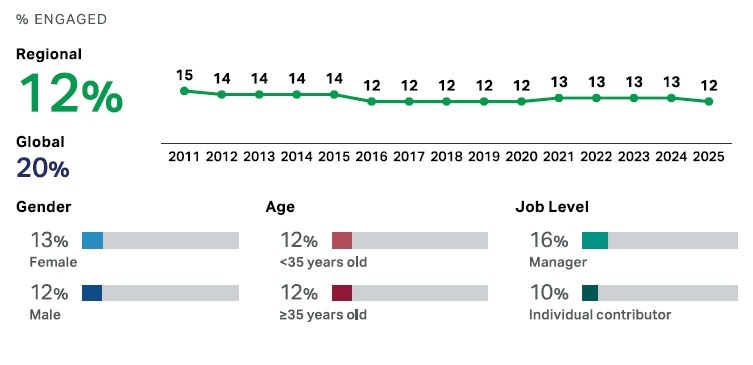
Global Workplace 2026 – Engagement in Europe
The European paradox is confirmed: employees are doing «well» in their lives, but remain very disconnected from their work.
Europe is also showing 39 % from daily stress, 15 % in anger, 17 % of sadness and 13 % of solitude, levels generally lower than the global averages.
6. France: continued critical engagement, more optimistic employment market
France remains in an alert zone: % only 8 employees will be hired in 2025.
The well-being is achieved 40 % of flourishing at work (“thriving”), while 39 % state that they felt a lot of stress the day before, 19 % in anger, 18 % of sadness and 18 % of solitude.
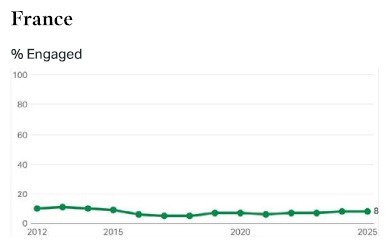
The employment climate improves significantly over time: 48 % French employees believe that this is a good time to find a job.
France accumulates a Very low engagement and one perception of the job market improving. This is not necessarily a sign of immediate mobility, but it is a terrain favorable to silent disengagement, lasting demotivation, or opportunistic departures.
7. The job market: fragile confidence, ongoing restructuring
Globally, 52 % employees believe that this is a good time to find a job, either +1 point. But this improvement comes mainly from employees who are not eligible for teleworking and work entirely on-site.
Conversely, Optimism drops among employees working entirely remotely and among “remote-capable” employees who return to the office.
Generative AI also fuels concern In the United States, 18 % Employees believe that their job could be eliminated within five years due to automation or AI; this figure rises to 23 % in organizations that have already deployed AI.
Retained from the 2026 Gallup study
The 2026 Gallup report not only states that engagement is declining; it also says that the success of AI will depend on the quality of management.
Companies that invest solely in tools risk missing out on the expected gains; those that invest in managers, work practices, and a collective sense of purpose will have a real advantage.
The 5 challenges to be addressed to reengage teams in 2026
1. Reengage managers before asking them to reengage the rest
The manager has become the central point of fragility. Without support, training, and clarification of his role, he cannot lead the transformation alone.
2. Transforming generative AI into a managed project, not just a technological one
Technical integration is not enough. Adoption depends on the ability of managers to legitimize, explain, secure, and ritualize the practices.
3. Giving concrete meaning to work
Gallup shows that well-being improves when employees see their work as useful, chosen, and inherently rewarding. Meaning must become operational, not decorative.
4. Treat negative emotions as a performance topic
Stress, anger, sadness and loneliness remain high. Ignoring them is like turning on a overheated engine in the hope of setting a speed record.
5. Make it’upskilling a lever of hope, not just of adaptation
In the face of AI, employees need not only skills but also a sense of direction. Training is about reassuring, empowering, and putting each person back on an upward trajectory.
FAQ – Gallup Report 2026
What is the Gallup State of the Global Workplace 2026 report?
The 2026 Gallup report analyzes engagement, well-being, and perceptions of work based on the largest global study of the employee experience.
What is the level of employee engagement in 2025?
In 2025, only 20 % of the employees worldwide are engaged, a level that is down for the second consecutive year.
Why is employee engagement declining?
The decline is mainly linked to the disengagement of managers, the transformation of work, and the still poorly understood impact of AI.
What is the link between management and the adoption of AI?
Employees whose manager supports the use of AI are up to 98 times more likely to consider that it transforms their work.
Why do Europe and France have a weaker commitment?
Europe has the lowest global engagement rate (12 %) due to a persistent misalignment between employee expectations and management practices.