


Generative artificial intelligence (GenAI) is emerging as an indispensable transformation lever for French companies. Faced with a labor market in tension and productivity stagnating, its adoption raises as many challenges as it offers opportunities.
According to McKinsey, By 2030, 27 % of the tasks could be automated in France, obliging companies to Reconsidering the organization of work and the skills required.
This transition is not limited to the integration of new technologies: it also requires a change in the way we think. evolution of skills, with an increase in the power of soft skills and technological expertise.
On the manager’s side, the stakes are twofold: to support their teams in this new revolution all at once maximizing productivity thanks to a strategic adoption of generative AI.
In this context, our article highlights the key trends identified by the McKinsey study and the Enterprise Institute.« AI and the evolution of skills in France » and offers concrete levers of action for a successful transition.

1. A strained labor market and stagnant productivity in France
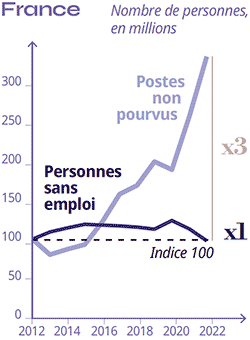
The French labor market is facing increased tensions, These are marked by a historically low unemployment rate and an increase in vacant jobs (3.4 % in 2022, which is three times the level of 2010).
This situation is explained, in particular, by demographic aging and the reduction in working hours.
Furthermore, French productivity is experiencing a a notable slowdown, requiring effective transformation levers.
What impacts does AI have on organizations and HR services?
- Reconsidering the organization of work in the era of AI to better allocate resources and address skills shortages.
- Accelerate the internal skills development in generative AI to avoid talent shortages.
«When AI is applied to very specific cases of productivity, particularly for accelerating or eliminating unnecessary tasks, it represents a major and promising technological advancement.»
Nicolas Dufourcq, General Director of Bpifrance [Institute of Business Research | McKinsey & Company]
2. Generative AI: a catalyst for transformation and a lever of productivity in companies
Generative AI could automate 27 % of the tasks performed by French employees by 2030 (against 30 % in the United States). By 2035, this potential would reach 45 % in France!
Artificial intelligence is already transforming support functions and information systems, although its widespread adoption remains limited (only 8 % of the French companies have deployed it across their entire organization).
What are the AI implications for companies and HR teams?
- Companies must deploying artificial intelligence to serve their strategy and implement a gradual adoption of AI to improve productivity.
- Investing in the training of employees to avoid a gap between technological evolution and the available skills.
- Adopting a child a mixed approach between automation of tasks and reallocation of talents on actions with higher added value.
«Turning an idea into reality isn’t really very complicated; the mountain that stands before us is the redeployment of skills.»
Claire Pedini, Deputy General Manager at Saint-Gobain [Institute of Business Research | McKinsey & Company]
3. Technological skills and soft skills: the evolution of skills with AI
The transition to generative AI logically accelerates the demand for advanced technological, but also socio-emotional and cognitive skills.
Companies are increasingly looking for adaptability, uncertainty management and creativity. (soft skills) while some basic skills in calculation or writing see their importance decrease.
What roles do HR and managers play in AI skills?
- Accompanying cultural transformation and the rise in skills teams.
- Developing retraining and continuing education programs (70 % of the French companies plan to invest in these initiatives by 2030).
- Anticipating talent management by deploying Generative artificial intelligence training on the new skills needed.
«The mother of battles is the provision of personnel trained in new technologies!»
Caroline Parot, Chief Executive Officer at Technicolor Group [Institute of Business Research | McKinsey & Company]

Generative AI training
Discover our career paths
4. French companies at the forefront of integrating generative AI
Despite a constrained public budgetary context (public debt at 110.6% % of GDP at the end of 2023), companies play a key role in the adoption of AI.
Today, 80 % of the French companies have integrated generative AI in at least one function, This is higher than the European average (72 %). However, challenges persist, notably the management of algorithmic biases and the protection of intellectual property (63 % of the executives identify this risk).
What AI priorities for companies?
- Securing investments in generative AI by ensuring the quality of the data and cybersecurity.
- Integrating AI in an ethical and transparent manner, notably by training teams in the use of AI tools.
- Structuring an internal governance of AI to ensure an effective deployment.
«The heart of the subject remains the way we will achieve the combination of technological tools and human intelligence.»
Olivier Millet, Member of the Board of Directors Eurazeo [Institute of Business Research | McKinsey & Company]
5. The levers of action to successfully achieve the IA transition with managers and teams
To maximize the positive impact of AI, companies must adopt a Proactive approach based on four key axes :
- Understanding the potential of AI by evaluating its impact on the professions and the skills expected.
- Involving the management to define a strategic roadmap aligned with the transformation objectives.
- Designing a skills-up strategy, notably through re-qualification programs.
- Massive investment in human capital to ensure a balance between automation and the valorization of talent.
What roles do management play in the IA transition?
- Adopting a child facilitating leadership to support employees in the evolution of their professions.
- Showing evidence of Pedagogy and transparency on the supposed and real impacts of generative AI.
- Encourage experimentation and the rapid adaptation of teams in the face of new AI tools.
Generative AI represents a major opportunity to improve productivity and modernize the labor market in France. However, its adoption involves a profound transformation of skills and management practices.
The companies that will succeed the IA transition will be those that invest in upskilling, structure appropriate governance, and integrate generative AI as a strategic lever at the service of the human being.

Accompanying generative AI
