

Artificial intelligence is now becoming an essential topic for French companies. In just a few months, it has gone from being a technological curiosity to becoming a transformational lever taken on by management. But if adoption is progressing rapidly, the skills and management benchmarks are struggling to keep up.
Executives and managers are at the heart of this equation: they are the first users, but they are also responsible for ensuring that these tools are disseminated to their teams.
The APEC study « Management and AI »A survey conducted in June 2025 among 2,000 executives and 1,000 companies reveals a paradox: enthusiasm is growing, the transparency of usage is taking hold, yet training remains largely behind the times. Between strategic opportunity and shadows of uncertainty, AI reshapes the management landscape and calls for a reinvention of collective practices.
Beyond the French borders, the studies MIT-State of AI in business 2025 and BCG-AI Radar 2025 confirm this dynamic: 75 % of the world’s leaders rank AI and GenAI among their three strategic priorities, But only 25 already % report significant value creation. The gap between ambitions and results highlights that the question is no longer one of experimentation, but rather one of turning investment into real impact.
Adoption of AI: a key factor in transforming management and work methods
Artificial intelligence (AI) is no longer a marginal experiment in French organizations. It is gradually becoming a Strategic leverage assumed by the management and encouraged among the employees.
According to the APEC study, companies are increasingly convinced of the usefulness of AI tools for their employees. March 2025, 76% of the large companies (250 employees and more) claim this usefulness, either a 14-point increase in just a few months, and 55% of the SMEs also share this conviction.
The enthusiasm of large companies is particularly revealing: 53% of them declare that they promote or accept the use of AI among their employees (46 % of the SMEs and 41 % of the micro-enterprises).
This jump illustrates a major cultural change within organizations: AI is no longer perceived solely as a technological innovation, but as a A key factor in transforming management and work methods.
In parallel, the BCG study notes that a third of companies will invest more than 25 M$ in AI by 2025, with an % expected 60% growth in AI budgets over three years. This jump illustrates that Adoption is not limited to France but is part of an international dynamic, reinforcing APEC’s observation of the ongoing cultural change.
The risk of shadow AI
This more official adoption of artificial intelligence does not mean the disappearance of risks. shadow IA — that is to say, the non-controlled use of external tools by the employees — remains a reality.
This practice (Shadow IA) exposes organizations to sensitive data leaks, inappropriate uses, and gaps between generations. For managers, the responsibility is clear: create a framework of trust, secure the tools made available, and support practices so that AI benefits the collective, and not a minority of individuals.
The MIT study highlights that 90 % of the employees already use LLMs personally, While only 40 % of the companies have official subscriptions, this discrepancy illustrates the reality of Shadow AI.
For its part, BCG recalls that executives cite privacy risks (66 %%), a lack of control over decisions (48 %%), and regulatory compliance (44%) as their top concerns %. Encouraging usage becomes therefore an imperative. Both are intended to protect the organization and to establish trust.
Frontline executives: regular use of AI but a need to improve their skills
An increase in the use of AI...
The Executives and managers They are increasingly taking over generative artificial intelligence (AI gen.) solutions to save time, optimize, delegate…
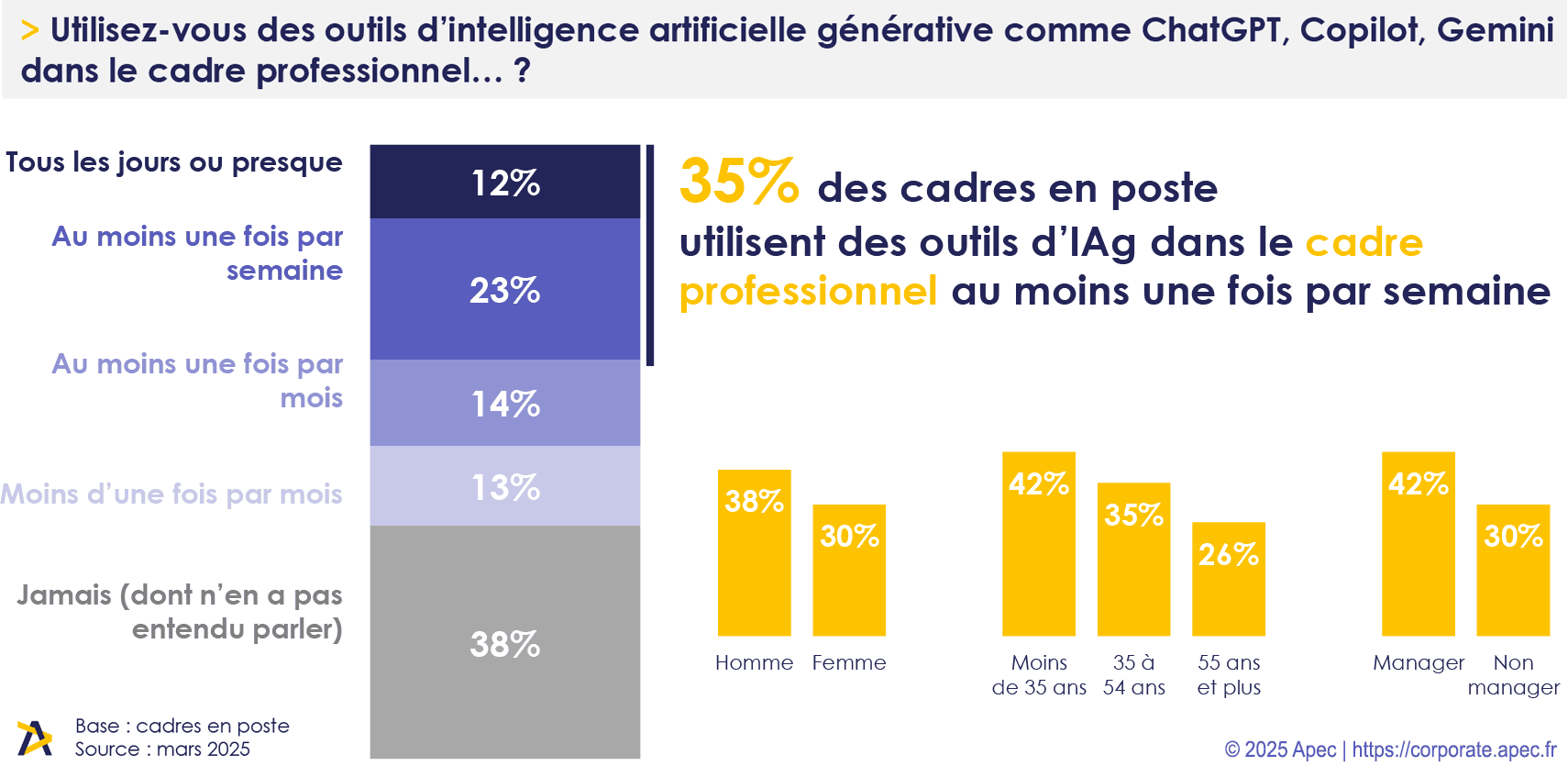
The APEC study reveals that 35 % of them use AI at least once a week in their professional activities. This frequency indicates a gradual integration into everyday practices, whether it be the drafting of content, data analysis, or the preparation of presentations.
The generalization of these practices is in line with global findings: according to BCG, nearly 70 % of the companies have trained less than a quarter of their employees in AI tools. In other words, use progresses much faster than the increase in skills, This creates a risk of misalignment that managers already perceive in their daily lives.
Interestingly, the majority of these uses are now being done in transparency with the hierarchy, This is a sign of greater legitimacy given to these tools in the workplace environments. Where, not so long ago, some executives could test AI discreetly, usage is now accepted and even encouraged.
…but AI skills are lagging behind
If the adoption of AI progresses, skills do not follow at the same pace.
Alone 24 % of the executives have already been trained in AI. That’s barely one in four, whereas 72 % declare that they want to receive training in the future — a figure that has increased by 12 points in a year. This demand is even higher among those who have already been initiated: 82 % want to deepen their knowledge.
Thus, we observe a A race between usage and the development of skills, Where managers often advance without sufficient background to support their teams.
Reminder to HR: there is an urgent need to help managers and support them in their development of skills in AI!

Artificial intelligence training
Discover our solutions
Opportunity or threat? Managers’ shift in perception regarding artificial intelligence
Another important lesson from the Apec study lies in the evolution of the way managers view AI. Over two years, the proportion of those who see these tools as a potential threat has decreased by 10%. opportunity has increased from 22 % to 37 %. At the same time, the share of those who consider AI as a threat decreased from 30 % to 22 %.
The trend is similar internationally: 64 % of the executives surveyed by BCG believe that AI should be considered in a logic of complementarity between humans and machines rather than as a substitute. This repositioning contributes to strengthen the vision of AI as an opportunity, a strong added value, and not as a threat, This consolidates the shift observed by APEC.
AI enables organizations to transform by streamlining operations, automating or optimizing certain tasks for time and efficiency gains, and focusing human energy where it generates the most value and impact on performance.
Now, % 42 executives believe that AI will have a strong impact on their profession (+11 points in a year), and 35 % believe that it will significantly transform their own position (+10 points).
This lucidity reflects a realization: AI is not a gadget, but a factor of profound change in managerial responsibilities, in the skills expected and in the way of driving performance.
For the management, this means that the question is no longer whether yes AI will transform management, but How.
The key role of managers: securing and disseminating practices on the use of AI
In this context, managers play a key role and become strategic actors. Their mission is not limited to using AI for themselves: they must guide and support their teams, Reassure about the risks and Integrating AI into a collective logic. Without appropriate training and without the will of the company, this responsibility becomes difficult to bear.
The identified barriers to the adoption of AI are numerous:
- A lack of structured training, This leaves managers helpless in the face of ethical and operational questions and in the face of decision-making.
- Tools that are sometimes misunderstood, Generative AI is being used as a search engine, while it is based on probabilistic logic and algorithms.
- A generational fracture, Some younger employees are massively adopting AI while others remain behind (risk of disengagement).
- An encore too individual performance, AI is being exploited in isolation rather than as part of collective projects.
MIT points out that globally, only 5 % of the customized GenAI projects manage to go from pilot to effective production. This «pilot-to-production chasm» reflects the difficulty for managers to transform promising experiments into stable and productive tools due to a lack of skills and a framework for deployment.
To overcome these challenges, organizations must invest massively in programs Targeted training. Training managers is not just about passing on technical knowledge; it is also about clarifying legitimate practices, dispelling fears, and putting safeguards in place.
Training managers in generative AI: a strategic imperative for transforming the company
The demand is clear and massive: nearly three-quarters of executives want to be accompanied and trained in AI. But to become more efficient, the training must meet three requirements:
- Adaptation to professions A marketing manager, HR director or CFO will not have the same needs. The programs must be contextualized and directly applicable.
- Ethical and collective dimension Beyond mastering the tools, it is about understanding their limitations, possible biases, and the implications for data governance.
- Continued support One-off training is not enough in the face of rapidly evolving technology. Companies must support managers and employees and offer continuous learning paths that are integrated with management practices.
For Jean Baptiste Gouin, CEO of talenco:
«Alone" training adapted to your profession It allows teams to take action, master the tools, and integrate them into their daily tasks.
By investing in upskilling, organizations reduce the risk of «submissive» AI and give managers the means to highlight their added value and make it a reality. lever for collective performance and productivity.
BCG insists that the value created by artificial intelligence comes from 70% % of human processes and skills, compared to only 30% % for the technology itself. Training managers and contextualizing training according to the professions thus becomes a major strategic lever, rejoining the expectations expressed by French executives.
Leadership and AI: from experimentation to managerial transformation
The APEC study highlights a double movement. On the one hand, AI is progressing rapidly in companies, driven by a Growing and accepted adoption. On the other hand, the skills and frameworks of reference are struggling to keep up with the pace.
The findings of the MIT and BCG studies fully coincide with those of APEC: rapid adoption, risks related to Shadow AI, but above all Massive need for training and mentoring. The equation is universal: AI will only be a lever for collective performance if managers are equipped with the necessary skills. to secure, disseminate and transform usage.
For managers, the equation is clear: AI represents an opportunity. strategic opportunity, But it requires training, support and guidance. Companies that know how to turn this demand into concrete action will be ahead of the game, incorporating AI not as an individual tool but as a vector of collective transformation of management.