


The health crisis has significantly disrupted the global economy, the labor market, and our lifestyles. In the short term, we are already seeing some changes, notably in our work habits and the impact the COVID-19 pandemic has had on certain sectors of activity.
It is easy to imagine that the consequences will not stop there and The study « The future of work after COVID-19 » Published in February 2021 by the McKinsey consulting firm, it already provides very insightful insights into longer-term developments in employment, professions, skills, activities, and work patterns.
Among the notable trends, it will not be surprising to note that Teleworking will accelerate, that, Online commerce will continue to grow, that, New technologies will profoundly impact professions and skills. For example, about 22 % of the jobs in Europe (or 53 million) could be automated by 2030.
The study also highlights the The crucial role of governments and businesses to anticipate changes, facilitate transitions and support workers as they change jobs or improve their skills.
Discover our summary of the study by the McKinsey consulting firm!
The impacts of the crisis on the evolution of activities and work patterns
Remote work and virtual meetings will continue
While the working remotely Although it was timidly beginning to take root in minds and practices, the Covid-19 crisis suddenly gave a huge boost to this trend, since many companies had to resort to it in order to maintain their operations.
Now, teleworking has become a daily reality for a large number of employees. The McKinsey study estimates that 20 to 25 % of the employees could work from home 3 to 5 days a week. That’s five times more than the rate practiced before the pandemic.
For certain professions that do not require specific equipment or special equipment other than a connected computer, the study reveals that: 70 hours % of work could be done remotely without losing efficiency.
The use of teleworking will likely have consequences on the geography of work, as we are already seeing workers become increasingly distant from large urban areas. Moreover, some companies are already anticipating this change towards a model of hybrid work by reducing their workspaces. According to McKinsey, The executives surveyed are considering reducing the surface area of their workspaces by % an average of 30%.. The activity of restaurants, shops, and public transportation could decrease as a result of the ripple effect.
Business travel is also likely to decrease, in favor of videoconferencing, although for some negotiations or important events, a physical meeting remains essential.
E-commerce and online activities will continue to develop
The periods of confinement have been an opportunity for many consumers to discover or practice online shopping and other online activities more intensively. In 2020, the share of e-commerce increased in different countries from 2 to 5 times faster than before the crisis.. The convenience of this purchasing channel means that today, about three-quarters of those surveyed who used digital channels for the first time during the pandemic say they will continue to use them after the crisis.
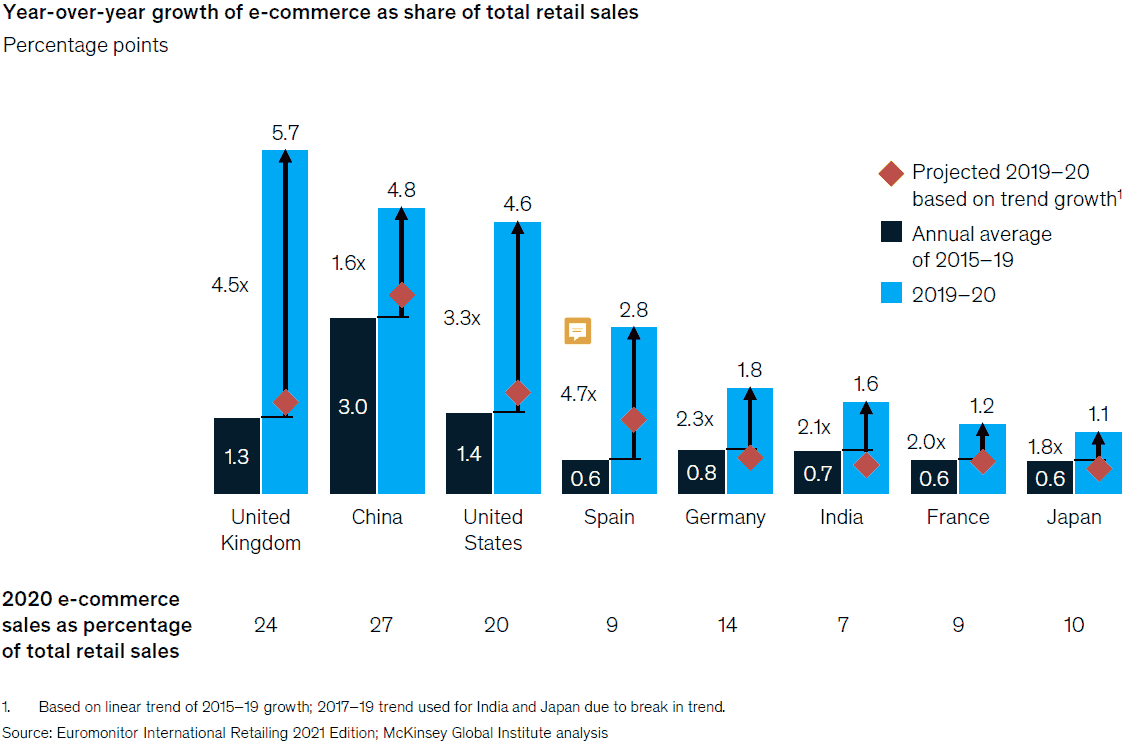
This flourishing of e-commerce has favored the Growth in jobs in the areas of delivery, transport and warehousing. In China, jobs related to e-commerce, delivery, and social media increased by more than 5.1 million during the first half of 2020.
Other types of virtual transactions, Like telemedicine, online banking and streaming entertainment, they have also been a resounding success. In India, for example, online medical consultations via a telehealth company have multiplied by ten between April and November 2020. On the other hand, Docolib, Between March 5 and March 30, 2020, the number of video consultations increased by 100 times, and the number of professionals present on the platform increased from 3,500 before March 2020 to more than 30,000 in April 2020.
These virtual practices should decrease with the reopening of economies, but could nevertheless continue with a rate of usage significantly higher than the levels observed before the pandemic.
Artificial intelligence (AI) and automation will change the skills needs
To cope with the consequences of the crisis, companies had to find solutions to reduce costs, notably by adopting the automation of tasks and rethinking work processes, which resulted in: reduce the share of jobs dedicated to routine tasks.
This trend is expected to intensify as Two-thirds of executives surveyed by McKinsey said they wanted to increase their investments in automation and AI in the coming years.
Many companies worldwide have deployed automation and AI in warehouses, call centers, and factories to reduce the density of the workplace and cope with high demand.
The automation of certain repetitive tasks that have no great added value will force people in low-skilled jobs to Upgrading skills to remain in employment. One figure:
25 % of the jobs in France (or 6.4 million) could be automated by 2030.
The impacts of the pandemic on the evolution of professions and skills
Jobs requiring physical proximity will be the most affected.
The health crisis has revealed the importance of the physical dimension of work. The McKinsey study predicts that in the future, the professions that will be most disrupted will be those that involve great physical proximity, such as those that require frequent contact with other people. occupations related to the hotel industry, sales or catering, This leads to a ripple effect in other longer-term work areas.
- Part of the Business relationship (interactions with customers in stores, banks, and post offices…) has already migrated to e-commerce and other online transactions, and this trend is expected to continue.
- The leisure and travel sector (contact with customers in hotels, restaurants, airports and entertainment venues…) has been severely disrupted, forcing professionals to suspend or limit their activities, or even close their establishments. In the longer term, the transition to teleworking, the reduction in business travel and the automation of certain professions could reduce the demand for labor in this field.
- The office work (in companies, hospitals, courts, factories…) requires only moderate physical proximity to third parties. This sector accounts for about a third of jobs in advanced economies. Almost all potential remote work takes place in this sector.
The least skilled jobs are expected to become more scarce
The arrival of new technologies should have the consequence of’automate at least 30 % of the activities of most professions, This includes those in the administrative, production, and customer service sectors, which could decrease significantly in the coming years.
The impact of this technological shift will be felt particularly in professions requiring the least qualifications. Before the pandemic, a worker losing or leaving a job without qualifications could find an activity with equivalent remuneration, in the same sector or in another. The McKinsey study shows us that after the pandemic, nearly half of the employees those who leave a position without qualifications will not be able to find an equivalent position again, and They will be forced to improve their skills in order to find a new job.
More qualified profiles will be highly sought after.
Due to the impact of the pandemic on low-skilled jobs, the McKinsey consulting firm estimates that almost all of the demand for labor will be in high-skilled jobs such as education, information and communication technologies, health care, and social services. Thus, the STEM professions« (science, technology, engineering and mathematics), Commercial, legal and medical services are expected to grow by more than 20%. % in the next ten years, This would create about 4 million jobs.
Recruitment in the healthcare and STEM sectors could increase further than before the pandemic due to the increased focus on health as populations age and incomes rise, as well as the growing need for skills related to new technologies. For example, in France, all professions in the healthcare sector are expected to see a strong growth in labor demand by 2030.
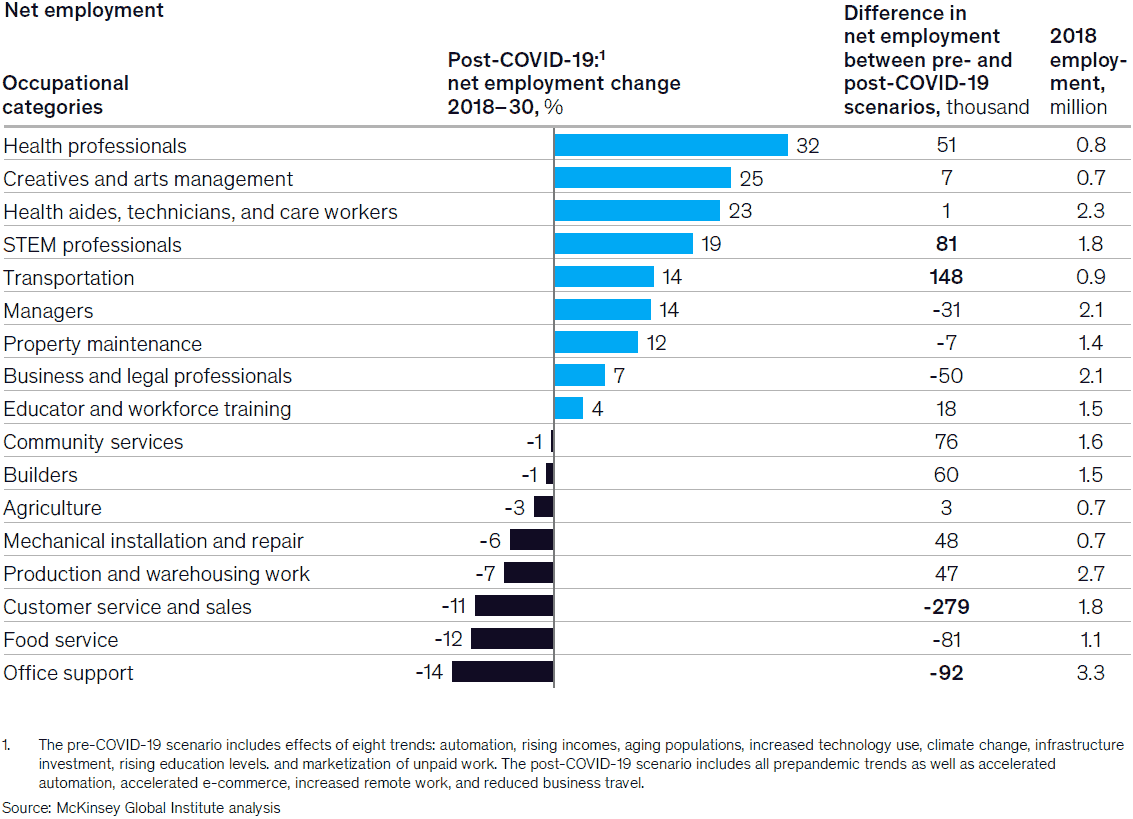
In a panel of eight countries studied by the McKinsey firm, More than 100 million workers (about 6 million %) will have to change their profession by 2030. That’s 12 % more than what the pre-pandemic estimates were, and even up to 25 % more in advanced economies.
A risk of a shortage of expertise in certain fields
Today, Europeans who have completed higher education make up 40% % of the European population. Given the future developments, this is insufficient because 60% % of growing jobs would require such profiles. In the next ten years, it will therefore be more difficult for companies to find the skills they need, particularly in the IT sector and in healthcare. Employees will be forced to change of profession more often.
Most of the jobs that will be filled by 2030 will require a Higher level of skills that today. Thus, 21 million European workers will have to change their profession by 2030, and more 90 million will be needed acquire new skills as part of their job current.
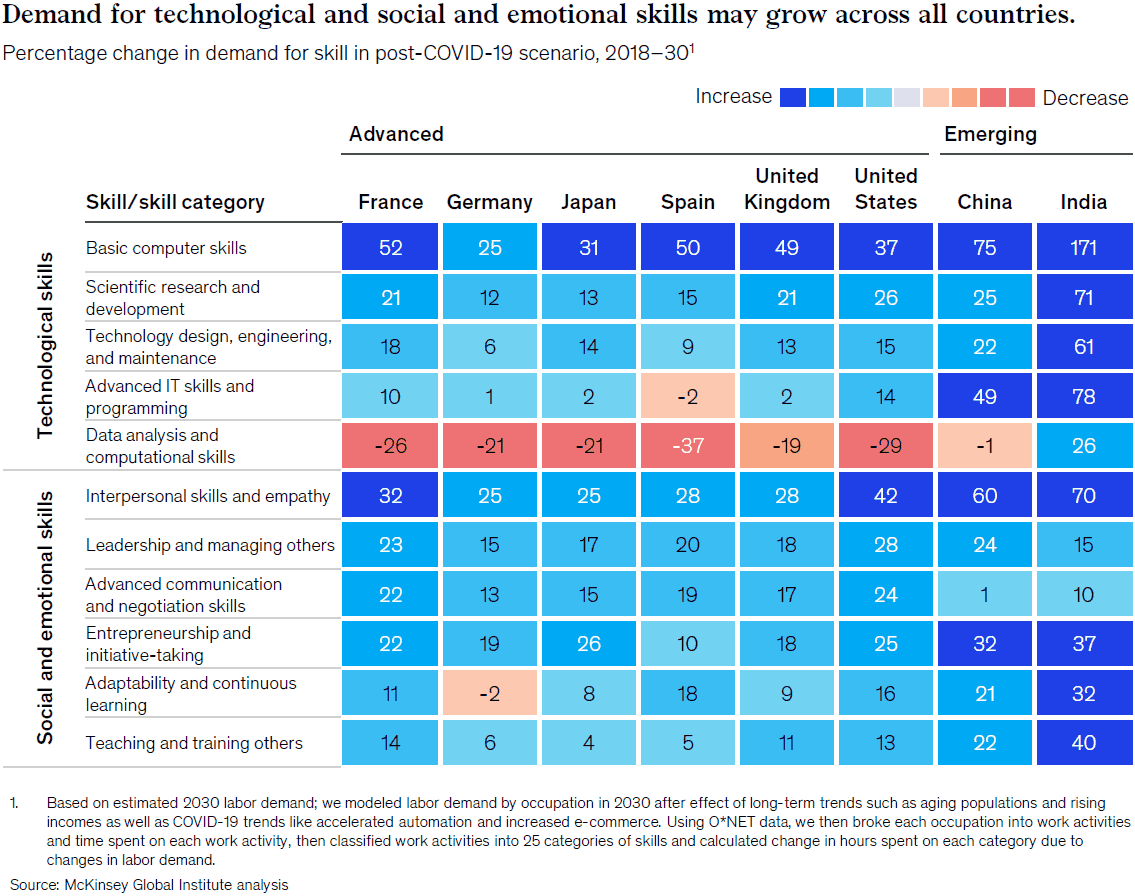
Two categories of skills will be particularly in demand:
- the socio-emotional skills, like teaching or empathy,
- the Technological skills, such as programming or R&D.
The crucial role of companies in supporting the evolution of skills
The McKinsey study highlights the crucial role of companies and leaders in helping employees adapt to changes in their professions and the evolution of skills.
Attracting and developing the right skills
To remedy the shortage of skilled labor, companies need more than ever develop the skills of their employees. To do this, they will need to adapt their training programs and place the Continuing education at the heart of their corporate culture.
Companies will also have to evaluate skills of their employees in order to identify those who need to undergo training, improve their skills, or even change careers, as Amazon, Walmart, and IBM did, which were pioneers of the « upskilling ».
Moreover, it will be necessary to’invest more in recruitment to identify and attract talent and «rare jewels».
Companies and policymakers could in the future collaborate to support workers who move from one profession to another. As part of the Pact on competences Implemented in the European Union during the pandemic, companies and public authorities have invested 7 billion euros in improving the skills of approximately 700,000 employees in the automotive sector.
Anticipating and improving access to employment
The employment development projections for the major megacities in 2030 predict that less than 60 % of the jobs will be occupied by current residents. To meet this need for labor, Several million workers will have to come and settle in the big cities., This will require investing in transport infrastructure and creating more affordable housing in urban areas.
Political decision-makers will also have to supporting training and education programs to accompany these new assets.
Investing in digital infrastructure
Political decision-makers could support businesses by developing and improving digital infrastructure. Even in advanced economies, nearly 20 percent % of rural households do not have access to the internet.
By 2030, the labor market is expected to be very different from the one we know today. Many jobs and professions will no longer exist, and new ones will emerge…
What is certain is that we will constantly need to acquire new skills to adapt to increasingly rapid changes, or even to completely change our profession.
It is already essential to ensure that companies and public authorities train workers in the skills that are actually in demand on the labor market, whether through initial training or Continuing education.
« The future of work after COVID‑19 »
McKinsey Global Institute
Professional training