

Baby boomers, Generation X, millennials, digital nativesToday, four generations coexist within our organizations! A true asset for companies, it is also a real challenge for managers who must adapt their communication and get juniors and seniors to work together, whose reference points, work styles, aspirations, and motivational levers seem very different.
The intergenerational management, which defines itself as the mentoring of people of different generations, requires overcoming stereotypes and implementing some levers and good practices to turning this generational diversity into a genuine heterogeneous and complementary force serving the collective performance.

Four generations of employees have worked at the company, from manager to employee
While far from wanting to box employees into categories, it is nevertheless enlightening to depicting the major trends, behaviors, and expectations of successive generations who collaborate today. Of course, these are rather caricatural characteristics… but since they are often cited as a reference to mark the developments of society, here is a brief description.
The Baby Boomers (1946-1964)
While the first «boomers» born after the Second World War are almost all retired, there are still a number of active individuals born in the late 1950s or early 1960s. The baby boom generation is marked by prosperity, full employment, optimism, the sense of belonging to the company.
Generation X (1965-1979)
The employees of the X generation have already lived a good part of their careers and have experienced many changes in the world of work (digital transformation, participatory management, the first social networks such as Facebook, YouTube, LinkedIn). They generally search for a balance between professional and personal life, They find fulfillment in their work, remain open to change and challenges, and continue to learn and grow*.
The Y generation or millennials (1980-1994)
Millennials work more collaboratively since the beginning of their working life and want their opinions to be taken into account in management decisions. Comfortable with digital and participatory tools, they seek pleasure in work, a stimulating job, a fast pace and quick results. Like the previous generation, they are familiar with the first social media platforms, but also with more recent networks such as Twitter, Instagram, Pinterest...
Generation Z or digital natives (1995-2009)
The digital natives They were born in a digital environment and have developed learning mechanisms with digital technology. They live in the age of the Agile management and collaborative, quick to value feedback and the right to make mistakes. They advocate for well-being at work and a crucial balance between personal and professional life*. Flexibility, a need for meaning and personal fulfillment are conditions sine qua non of their well-being. They are daily consumers of social media, especially Snapchat, TikTok, Twitch…
As for the Alpha generation (born after 2010), managers still have a few more years to prepare for their arrival!
Between young people and seniors: intergenerational management in the face of stereotypes
« Young people do everything through their screens and do not want any constraints. Seniors do not want to change their work habits and have difficulty integrating the new trends. »…
If we stick to these stereotypes, in fact, it seems difficult to get several generations working together because’On the surface, they don’t understand each other, don’t share the same values, the same cultural references, the same aspirations., etc.
For Anne Clotteau, expert in management and consultant for talenco, « This is the first time so many different generations have come together in the same company and therefore in the same teams to manage them! Each generation thinks that the one at the top is too rigid and the one at the bottom too uncontrollable. » (find his testimony in our Webinar on the great resignation).

Instinctively, our perceptual biases lead us to stigmatize these «new generations» when in reality, these «new» needs resonate in all generations, young and not so young. The liberation of the voice of employees in the workplace has thus enabled ALL generations to agree on these unspoken needs… and which are now important for everyone!
As a manager, it is important to take into account the variety of existing profiles in its team in order to best adapt its messages and to ensure that all team members are well integrated and aligned on a regular basis. Two essential questions to ask yourself to succeed in intergenerational management:
- How overcoming generational prejudices to communicate in an inclusive way to all members of the team ?
- How to make respect for the balance and the needs of each individual coincide with the performance of the team and the company ?
Managerial communication, an individual approach rather than a generational one
The IBM study « Generational differences at work«** On aspirations and motivations at work between generations shows that one cannot detect a significant difference between the Y generation and previous generations regarding, for example, job satisfaction or what an applicant is looking for in a potential company.
One of the study’s lessons is that We should first think in terms of individuals and not in terms of groups. To be a good manager, it is essential to Breaking free from generational prejudices, To observe, to listen and to have a good understanding of each employee, His personality, temperament, and intrinsic motivations to find the right levers and adapt his communication to each individual.
As for Generation Z, a majority of them want more benevolent management. the study « NewGen for Good » led by EDHEC in 2019 (the individual approach naturally being involved).
Knowing every member of his team allows the manager to:
- to ensure that we are understood and therefore aim for greater efficiency, performance and commitment,
- contribute to better team cohesion and the alignment of all in respect of each individual’s uniqueness,
- if applicable, Capitalizing on differences between generations and the complementarity of profiles to develop solidarity (this is the case, for example, for the Reverse Mentoring where the digital natives they will accompany senior profiles to develop their digital skills).
What tools and methods to adapt management communication to all generations?
As mentioned just now, adapting management communication to all employees involves first of all better understand the personality and intrinsic motivations of each person. Among the methods that can help managers, here are three approaches that have been tested and approved by talenco!
The Moving Motivators
The card game Moving Motivators is a tool derived from Management 3.0® that allows you to explore the intrinsic motivations of each person and the impact that a decision or organizational change can have on their motivation.
Based on the needs of each employee, the manager can use various motivational levers among the ten proposed (curiosity, expertise, autonomy, recognition, framework…).
By knowing his own intrinsic motivations as well as those of his employees, the manager is able to individualize the relationship with each member of the team and optimize each individual’s commitment.
The DISC method
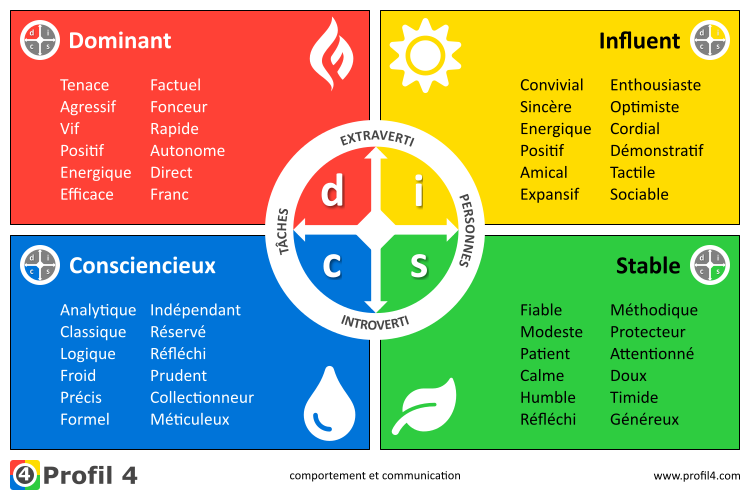
The method DISC is an individual assessment tool theorized in 1928 and since then developed into many versions. It is a Reading grid of human behaviors and communication which, through four major profiles (dominant, influential, stable, and conscientious), allows us to discern each person's temperament.
In the professional context, the DISC test can be used by managers to better understand the profiles of their employees in order to improve communication, productivity, and team relationships.
The practice of feedback
While the above tools facilitate understanding of each employee's expectations in order to better adapt their communication, It is also essential that the manager establishes sharing rituals with his team..
On this occasion, the practice of feedback It allows the manager to assess actions or behaviors that have a positive or negative impact on the team’s and the company’s results, in order to support individual and collective progress.
As for the employees – especially the younger generations – whose autonomy increases as working methods evolve, they are increasingly demanding of their employers. feedback regular – both from their manager and from their peers –, recognition being a powerful motivator.
Talents in all generations... and managers to train
As you have probably noticed, the real issue for managers is not adapting to new or older generations but to the different profiles of his team, In a proactive and continuous manner to ensure effective and engaging communication.
But, Talents are everywhere, in all generations, Whether it’s offering technical expertise, managing a team, or even participating in a shadow comex… Intergenerational management then involves extracting the best from each profile, young or not, in the service of the collective.
«In well-born souls, value does not depend on the number of years.»
Pierre Corneille
Yet, There are still stereotypes about generational differences… As the saying goes Cyrille Chaudoit, Co-founder of talenco, interviewed by Les Echos, « The appointment of Agathe Monpays, 28 years old, as head of the Leroy Merlin France group is a perfect illustration of a certain managerial courage in the face of the market ».
Ultimately, the real challenge surrounding intergenerational management is to give all managers, both young and senior, the means to undergo training in self-knowledge and other skills. This is a bold management move in some companies, but essential to enable managers to better support each talent – regardless of age – and adapt communication to the profiles rather than the years of experience!
Management training
Courses dedicated to managers to engage the teams
* Source Baromètre RH by Kelio
** IBM study «Generational Differences at Work Are Much Ado About Very Little» (2015)