

The second one National barometer of AI in HR* (Parlons RH – 2026), of which he talenco is a partner, has just been published. It confirms what many had been predicting: HR professionals have mostly learned to use artificial intelligence… But learning to use it does not yet mean deploying it strategically.
Source: IA HR Barometer 2026 – Let’s Talk HR
Between a rapid progress of acculturation (+13 points in the use of conversational agents in a year) and practices that are still confined to “augmented office automation”, the HR function is at a turning point. The announced storm has not yet hit, but the pioneers have already started to move.
The 2026 edition of the barometer shows that generative AI is now going beyond the simple question of HR tools to become a The challenge of transforming work, professions and skills, That the HR function must not only accompany but also fully guide the company!
In this article, we return to the Key figures from the barometer, on What really changed from 2025, but also on What the data don't always say.
We will see why transformation remains timid, what pitfalls must be identified by leaders and HR managers, and most importantly, which levers to activate to move from an assimilationist logic to a genuine AI transformation of the company.
*The IA & HR Barometer 2026 is based on a survey conducted between December 2025 and February 2026 with 343 respondents, mostly business HR professionals (DRH, RRH, HRBP, Employer Brand Rep, etc.).
1. AI and HR: what really changed in a year: the numbers that matter in the study
The most striking fact of this second wave is contained in one figure: 80% % of HR professionals now use a conversational agent on a daily basis, compared to 67 % last year. That is +13 points In twelve months. LLMs have become ordinary office tools, just like Word or Excel. This is no coincidence – it’s a successful mass adoption.
But the real surprise of this edition is the intermediate uses that have taken off. The Synthesis of documents and the extraction of’information they jumped from 40 % to 71 %.
Automatic generation of summaries It went from 29 % to 62 %. These practices required a distinct effort of appropriation yesterday; today they are part of the normal workflow. This is, according to the barometer itself, «the big change of this year.»
Source: IA HR Barometer 2026 – Let’s Talk HR
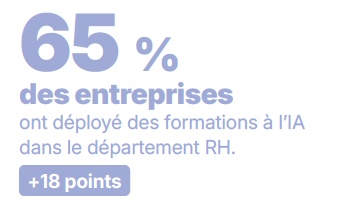
At the same time, 65 % of the companies have deployed AI training in HR departments over the past 12 months – against 47 % in the previous 3 years.
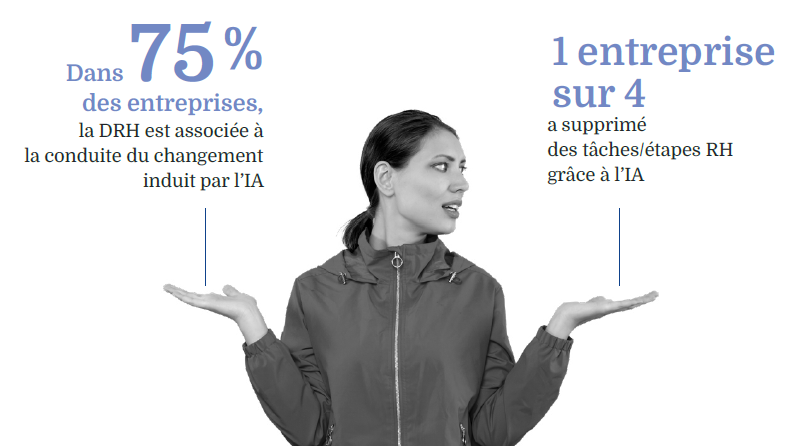
The training effort has accelerated and become more concentrated over time. And in 75 % of the companies, HR is now associated with leading the change induced by AI: This is the signal that the HR function is beginning to establish itself as a legitimate partner in AI projects, not just as a beneficiary or executor.
The data that raises the most questions remains: 64 % of HR professionals believe that companies, as a whole, will use AI to reduce their workforce. But Only 16 % believe that this will happen within their own organization.
This is what the barometer calls «the AI hell, it’s on the other side.» Lucid optimism or cognitive bias? The answer says a lot about how HR functions perceive the risk.
2. One year later, HR is using artificial intelligence better… but are they doing their job better thanks to it?
In 2025, The barometer painted a portrait of a sensitized HR function, curious but confined to simple uses, with only 37 % companies having deployed at least one AI tool in their HR processes.
In 2026, the curve has risen: the self-reported knowledge of AI (good or very good) has increased from 48 % to 60 %, and training has intensified. Maturity has been built.
But the hierarchy of usage has not changed. The predictive analysis remains at 14 % (compared to 13 % in 2025). The collection of information through chatbots is not picking up (22 %, +3 points only). The automation of tasks remains at 24 %. It is precisely the practices that would create the most business value, and they are being undermined.
The «augmented office» remains dominant; the uses that transform processes remain the exception.
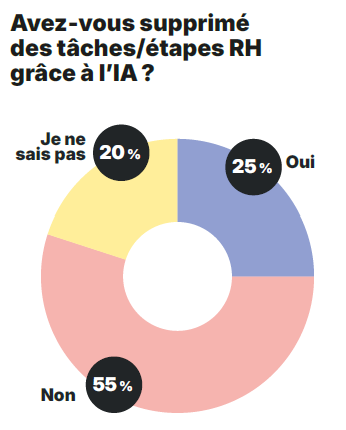
This is where the central tension of this second wave lies: HR professionals are doing better what they already did (writing, synthesizing, rephrasing), but have not yet reconfigured their processes around AI. The pioneers, however, are beginning to take this step: 1 in 4 companies have eliminated HR tasks or steps thanks to AI, and 1 in 5 has created new HR roles directly related to AI.
These figures seem low, but they did not exist at all in the first barometer. This is the start of a vanguard.
In practice, the barometer already points to tasks replaced in recruitment and HR administration Drafting of job advertisements or job descriptions, translation, CV analysis, production of KPIs, interview summaries, and automated responses to employee questions via HR chatbots.
Source: IA HR Barometer 2026 – Let’s Talk HR
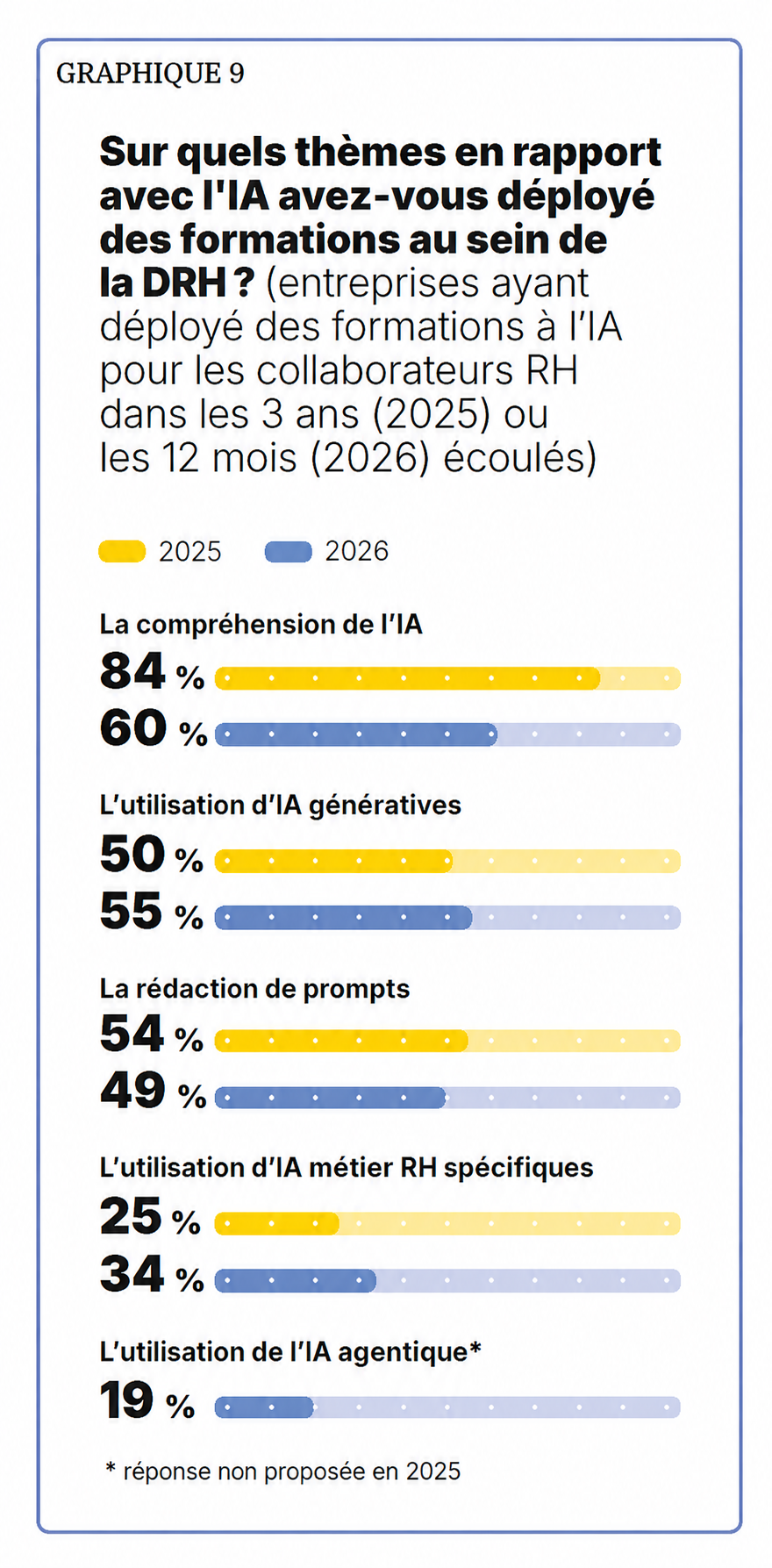
Another significant delta: in 2025, the training focused % on «understanding AI»: the basic effort. In 2026, this figure drops to 60 %. This is not a decline; it’s a normalization.
Companies are training their HR teams more on the real use of business AI tools (+9 points) And, a new development, 19 % of the training companies have already introduced agential AI into their programs. Training is evolving towards practice. This is encouraging, but still insufficient given what is happening.
And the first obstacle identified in 2025, the lack of a clear strategy, remains the first obstacle in 2026, cited by 52 % of the respondents. In a year, practices have changed, but organizations much less so.
What is most surprising about this development is the persistence of an approach centered on language at the expense of processes.
We warned last year about the risk of limiting generative AI to enhanced office automation. A year later, the systemic transformation of HR processes remains the exception rather than the rule.
3. The dead angles of the IA barometer: what the numbers don't say
The barometer is a valuable photograph. But like any photograph, it freezes what is moving and illuminates what is offered to it. Three dead angles deserve to be named.
Optimism about HR employment deserves to be challenged
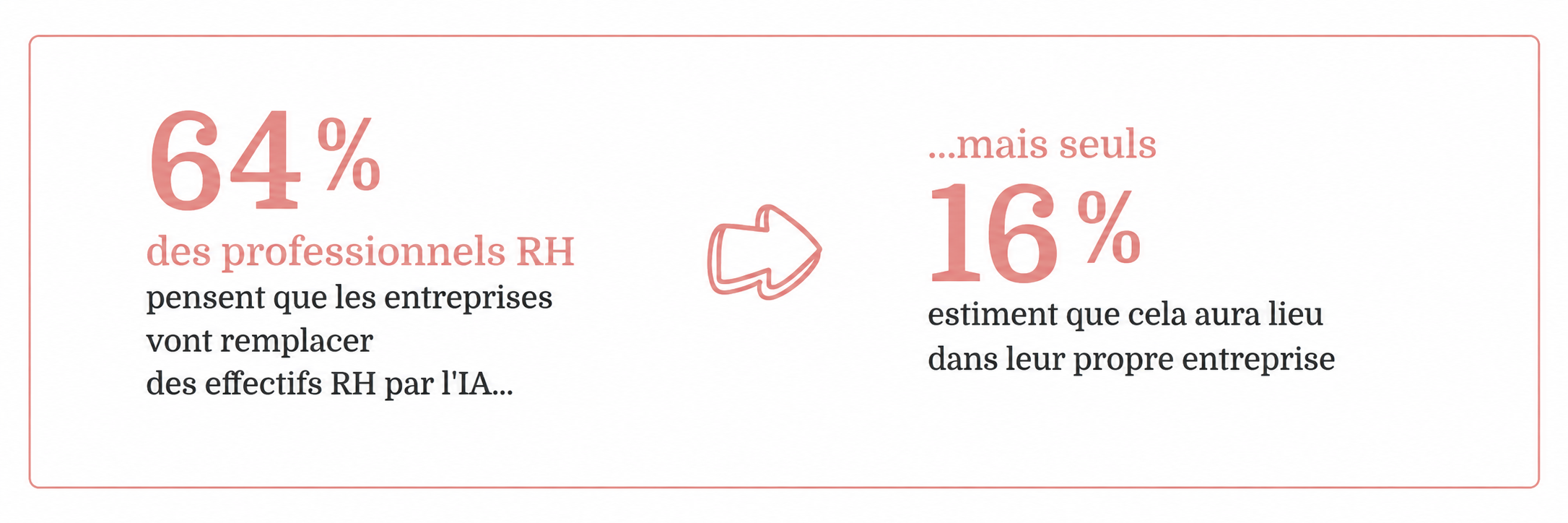
The «IBM jurisprudence» (Reduce HR staff to fund other functions through AI) is considered likely for the economy in general by 64 % respondents, but unlikely in their own country at 56 %. This asymmetry is common in sociology, but it can lead to underestimating the urgency of preparing oneself.
Source: IA HR Barometer 2026 – Let’s Talk HR
What the data from the pioneers show is more nuanced: among those who have already automated tasks, 28 % anticipate a reduction in recruitment staff, compared to only 12 % among the others.
The pioneers see both sides of change: creation and destruction, simultaneously.
Training in agentic AI is dramatically underdeveloped
Only 19 % of the training companies have addressed this topic for HR, and 28 % for non-HR employees. Yet it is precisely agential AI, capable of executing entire workflows autonomously, that will redraw the cards in the next 18 to 36 months.
Training today in basic generative AI is preparing your teams for the wave… which has already arrived!
The involvement of HR managers in business governance remains the missing link
The HR department is recognized as a partner in training and leading the change induced by IA in 75% companies. Companies surveyed. But it is absent or marginal in 41 % companies on issues related to transforming the supply chain, and in 30 % on issues related to production and work tools.
As long as HR remains confined to «adjacent HR» topics and excluded from business decisions, its ability to anticipate the impacts on skills will remain incomplete. This is structurally the most serious problem revealed by this barometer in its most subtle form.
4. The true role that HR should play in IA transformation
Training in IA: why HR managers should be in charge
The point of view of Raphaël Kattan – General Manager and Partner, talenco
Interviewed in the 2nd National AI Barometer in HR, Parlons RH, 2026

Raphaël Kattan – talenco
« HR managers must be the decision-makers regarding training, awareness-raising, and acculturation, in full collaboration with the business departments and IT.»
What is happening in companies today resembles what we experienced during the digital revolution in the 2010s: we sometimes wonder why data and AI teams are taking over training on new tools. Admittedly, they possess the technological expertise, but The skills development strategy and the means to be deployed are HR issues !
Raphaël Kattan proposes a useful reading grid to structure training paths: not all uses of AI are equal, and not all require the same level of support.
Anecdotic Using generative AI for heterogeneous tasks (writing, translation, synthesis). This is where the majority of today’s uses are focused.
Tactics : Orient AI towards key business processes to semi-automate them, often through an assistant. This is the next step for the majority of HR teams.
Strategic Reinventing or automating entire aspects of activity. This step requires a reconfiguration of the organization and structured HR support accordingly.
«The more the company moves towards a tactical and strategic use of AI – especially with autonomous agents – the more the professions will change. (…)
HR is responsible for supporting employees in these transformations, with arrangements tailored to each level of usage.»
AI & HR: adoption is progressing, transformation remains to be built
The analysis by Cyrille Chaudoit – Founding Partner and Head of iA, talenco
This second wave of the Parlons RH barometer leaves me with a mixed impression. The adoption figures are almost «too» good.
Cyrille Chaudoit – talenco
«The enthusiasm of HR is good news” It is better that they themselves experience the benefits of IA for their profession, in order to then support others in leading the change.»

But be careful not to confuse tool adoption with business transformation. The 80 people % who use an LLM on a daily basis are not transforming their function: they work better, no other way. The real leap is that of the 25 % pioneers who eliminated tasks and redeployed resources.
The study reflects well what we observe on the ground: the subject advances, but not as quickly as some would have us believe in the media.
Making IA a real internal strategic issue still requires a lot of work.
One figure illustrates this: 64 % of the respondents consider the extent of AI’s transformations on management to be «moderate,» and 14 consider % it «zero» (sic). To think that way, as HR professionals, is to not (yet) perceive the systemic implications of AI on work. The road is still long!
5. Five levers to move from the stage of acculturation to that of transformation
What the data from the pioneers show is instructive: the difference between them and the «latecomers» is not due to the available technology, but to the organizational choices made upstream. Here are the five HR levers that really make the difference.
1. Formalize an AI policy today that involves the general management, not just the DSI
Only a third of companies have an AI policy in place. Yet a charter reduced to IT safeguards does nothing to change working methods.
The HR department must co-chair the instance that defines the authorized tools, ethical commitments, roles and responsibilities, and the skills-building plan, with measurement indicators. This is the prerequisite for everything else.
Our method Cockpit IA® It is designed specifically to structure this governance.
2. Training in AI: a common foundation for all, with targeted courses based on usage patterns
Training teams in “understanding AI” is no longer enough. Use cases are diversifying and not all require the same level of support. Specifically, in line with the three levels of AI use cited by Raphaël Kattan (anecdotic, tactical, strategic), the training plan must combine three levels:
- one universal base for all employees, covering usage, limits, ethics, risks and confidentiality;
- of Professional modules for HR teams, managers and operational directors, focused on their real use cases;
- and one Hyperspecialization for a limited core of referents, capable of experimenting with agential AI, piloting autonomous agents, and supporting the transition to scale.
This is the whole point of an approach like TALENCO.AI Not to train everyone in the same way, but to allow each person to rise to the right level, at the right time, according to their role in the transformation.
3. Stop the haphazard approach and industrialize three HR processes
The perpetual pilot syndrome is one of the first enemies of AI transformation.
To overcome the scattered experiments, HRDs have an interest in Identify some HR processes with high volume, repetitive and of low human added value (for example, the first round of candidate screening, administrative onboarding, or first-level HR support) then to automate them in a structured, secure and measurable way.
The goal is not to automate to automate, but to free up time on the most time-consuming tasks so that it can be reinvested in missions with higher added value. : support for managers, development of skills, internal mobility, HR management or employee experience.
It is by measuring concretely this time gained, the improved service quality and the resources redeployed that the ROI becomes readable to the top management.
4. Position managers as vectors of AI adoption
The barometer shows that managers are perceived as one of the categories least threatened by AI, but among those most likely to be “augmented”. It is precisely for this reason that they should not be considered mere communication targets, but as partners in the process. Key elements of the transformation.
Preparing managers to lead teams augmented by AI is becoming a priority task.
Evaluating performance when work is co-produced with AI tools, making decisions between algorithmic suggestions and human judgment, maintaining cohesion in groups with heterogeneous levels of ownership, supporting resistance and preserving the quality of the human connection… these are the skills to develop for managers.
Training them now is one of the most useful HR investments before the topic becomes urgent — that is, before everyone realizes that a trained manager doesn’t just magically appear between two Team meetings.
«The support of managers is the cornerstone of the acceptance of AI. They will have to play a central role once again in driving change.».
Raphaël Kattan, Associate Director of talenco
5. Applying artificial intelligence to strategic workforce planning
The forecast for staffing needs is stuck at 5 % for adoption: this is the lowest underutilized figure in the entire barometer.
AI can model the evolution scenarios of professions, identify the critical skills at 18 months, and quantify the requalification needs. This is where the DRH becomes an indispensable strategic partner in the eyes of the COMEX – not by producing more HR dashboards.
HR therefore needs to map out skills, anticipate the evolution of professions, identify gaps that need to be filled and build tailored development plans. It is a matter of employability as well as performance.
The HR department, architect or spectator of the IA transformation?
This 2026 barometer paints a portrait of a mature HR function in generative AI, aware of the risks, but still lagging behind in deep transformation. The optimism of HR professionals is a strength, provided it is not mistaken for an excuse to delay change.
The pioneers have already started making difficult decisions: eliminating tasks, creating new professions, investing in training for agents. They also have something in common: they have not waited for technology to be perfect or for the regulatory framework to be stabilized. They advanced methodically, placing human skills at the heart of deployment.
That is exactly where we talenco can make the difference for you. Whether you are at the stage of building AI policy, training for industrialization, or reconfiguring processes, our offer TALENCO.AI It is designed to accompany you at every step, not to sell you enthusiasm.

FAQ artificial intelligence and human resources
What are the main lessons from the IA RH 2026 study?
The IA RH 2026 barometer from Parlons RH shows that HR professionals are using AI more frequently, are undergoing more training, and are beginning to structure their practices. But usage still remains largely focused on individual assistance: drafting, synthesis, translation, and reporting. Scaling up, governance of AI, and transforming professions remain the next major challenges.
How does artificial intelligence transform HR functions?
Generative AI transforms HR by automating certain administrative, drafting, or analytical tasks. It saves time, improves certain processes, and creates new roles related to data, governance, or the support of AI. But its impact depends on the ability of HR to rethink processes and skills.
Why is AI a topic of organizational transformation?
AI does not just modify tools. It transforms tasks, professions, skills, decision-making modes, management practices, and work processes. That is why it must be managed – especially by HR – as an organizational issue, and not as a simple technological project.
What role should HR professionals play in the deployment of AI?
HR departments must support the development of skills, anticipate the evolution of professions, structure training plans, support managers, contribute to IA governance, and ensure the employability of employees. They must be involved from the outset in IA projects, and not just when training teams.
What are the risks of generative AI for HR?
The main risks concern data privacy, bias, lack of explainability, the dispersion of use cases, shadow AI, the loss of consistency between tools, and insufficient human support. These risks can be mitigated through a clear AI policy, cross-functional governance, and appropriate training.
How to move from AI experimentation to scale-up?
The transition to scale requires defining an AI ambition, prioritizing high-impact use cases, integrating AI into business workflows, training employees based on their actual usage patterns, supporting managers, ensuring the reliability of data, and measuring impacts.
Why are managers essential in the adoption of AI?
Managers are the field agents of AI transformation. They must explain the uses, reassure teams, arbitrate the levels of automation, maintain the human connection, and accompany the developments in work. Their role is central to transforming AI into a lever of adhesion rather than a factor of concern.

Accompanying generative AI