

In a constantly changing world, companies must adapt quickly and undertake transformations to remain competitive. However, piloting and accompanying change in an uncertain context It can be a colossal challenge… and advice, good practices and experiences can be very useful for dealing with it.
What are the characteristics of change? What dynamics of change and what adaptation strategies can companies implement? What are the specific roles of Human Resources and Management in leading change in the company?
These are just some of the questions our speakers answered during the Webinar «How to effectively drive change in an uncertain context» organized by talenco On April 4, 2024, with: Pierre Loupart General Manager at Flexi France (TechnipFMC), Michèle Ruffault : Professional Expert & Coach at Wakai and talenco, Jean Baptiste Gouin CEO and co-founder of talenco.
Their Experiences shared collected by Cyrille Chaudoit, As Co-founder of talenco, they enlighten us on the paths to accompany employees in the change and successfully lead the transformation of the company.
What is meant by change in the workplace (definition)?
The “change“ corresponds to a modification, a transition, and a disruption of balance that take place within an organization in order to “move from point A to point B“. It refers to the approach that accompanies every company in the face of instability and the development of its environment.
For Pierre Loupart, « Changes can be organizational changes, system changes such as a new ERP system, or changes related to crises (…) requiring a strong adaptation of the corporate strategy. ».
Whatever they are, these changes will impact the way we work and evolve the roles of managers and employees.
Agile culture at the heart of change management
It is a fact that not everyone is equal when it comes to change., This is especially true in its ability to accept it, absorb it, and turn it into an opportunity. While the challenges are often the same for everyone around the world, certain markers will differ or vary from one situation to another.
Pierre Loupart explains:« We cannot contemplate change without consider the culture ; The Anglo-Saxon approach is very different from the European approach, for example. The change is also not approached in the same way depending on the country. the age pyramid or the size of the company ».
One of the key strategies for driving change in an uncertain context is to developing an agile culture of adaptability. Companies must encourage innovation, creativity and risk-taking. They must also foster the evolution of work modes, collaboration and continuous learning, in order to adapt quickly to new realities.
For Michèle Ruffault, « change takes time and it is necessary to make small steps using a Agile approach, Allowing oneself the right to make mistakes and to learn by trial and error ».
For our specialist in change management, exemplarity of leaders is one of the first levers, « because it’s difficult to ask the rest of the company to change if the leaders themselves do not question themselves ».
In startups, change is constant and is part of the company culture, its DNA. But in other sectors or In larger organizations, it is often more difficult to adapt, most often due to a lack of anticipation.. According to a 2022 Essec study, 86% of the employees believe that they are not sufficiently prepared for change.
Jean Baptiste Gouin specifies: « Failures in transformations are often linked to a lack of preparation or anticipation. That is why, for the chosen changes, It is important to prepare and to have someone accompany you ».
Methods for supporting change in uncertainty
In the face of a constantly changing environment, companies must develop solid adaptation strategies. This involves rethinking business models, implementing new technologies, and adapting to the changing expectations of customers and society.
There are many principles, tools, and methods for understanding and supporting transformations and overcoming resistance to change.
To know whether we are really facing an uncertain situation to the point of having to adapt our habits, there is a tool called model Cynefin which allows us to understand the complexity of problems or situations by classifying them into 4 categories: Simple, Complex, Complexified, or Chaotic.« In each situation, we will have a different approach to addressing change. »Michèle Ruffault explains.".
To convince by example, Pierre Loupart advocates the theory of « virus positive » which consists of stimulating desire through the success of a first cell that will inspire the desire and then the success of other groups.
To achieve any change, there is a widely accepted method: ADKAR. It is an acronym representing the five steps that a person must go through to make a change a success: Awareness (awareness-raising, sensitization), Desire (desire, will), Knowledge (knowledge), Ability (capacity) and Reinforcement (strengthening).
« The prerequisite for change in an environment that is changing ever faster is therefore having a culture, an openness of mind that is called the growth mindset »Jean Baptiste Gouin confirms this.".
HR and management: key roles in supporting change
Human resources and management play a crucial role in driving change in uncertain contexts. They must be able to mobilize teams, create an environment conducive to innovation and adaptability, and support employees in their adaptation process.
The role of HR in supporting change
HR has a key role in awareness-raising managers who support the change process. They must help them to understanding the implications of change, at develop their skills in managing change and adopting an empathetic approach towards employees.
For Jean Baptiste Gouin, « The role of HR is key in creating a favorable climate and organizing the development of skills conducive to change.t in order to act on the right levers at the right momentt».
Management facing resistance to change
Management, as for him, he must be able to giving meaning to change, creating a reassuring framework and communicating in a transparent way.
Pierre Loupart specifies: « The manager must know how to read the pace of change and the pace of the team (…). The manager must know how to change methods if necessary, to test, adapt, and find the balance between top-down and bottom-up approaches ».
Jean Baptiste Gouin adds:« The manager must provide a clear vision of where they want to go, set a framework, and always return to the purpose of the change process. Leadership is seen in change. The leader will be inspiring and will act to have an impact on his or her teams ».
Tools for managing change in teams
To support managers in their efforts to collectively and individually guide their employees through change, there is a wide range of tools available. Two of them are particularly useful in leading change within teams:
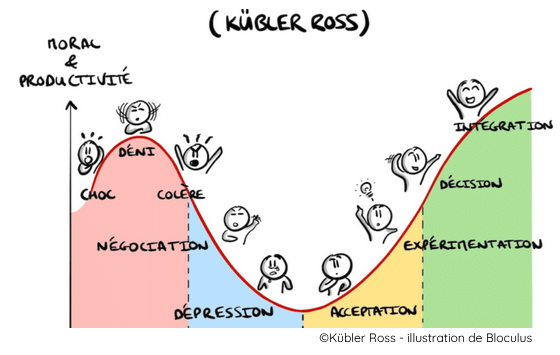
Kübler Ross curve – illustration by Bloculus
⚙️ The Curve of Change (Kübler-Ross) describes the different emotional stages experienced by a person facing an organizational change (shock, denial, anger, resistance to change… until acceptance and integration of the change).
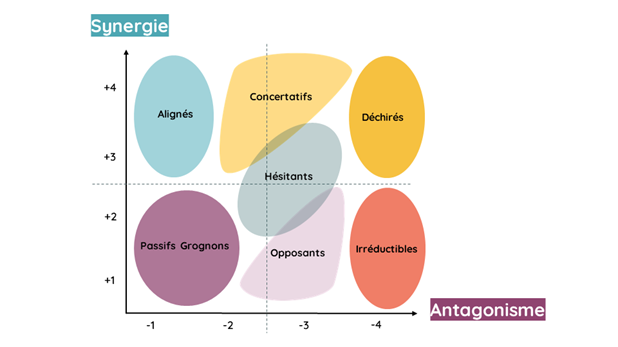
The Allies' Map (Wakai)
⚙️ The Allies' map is a tool that allows people to be positioned according to their behavior in terms of promoting ongoing change (synergies and antagonisms). It identifies 7 categories of behaviors in the face of change by positioning individuals according to their level of involvement and their degree of perception.
For Michèle Ruffault, « These are tools useful for HR and managers to put themselves in their employees’ shoes in order to understand change. ».
In the era of individualized management, these tools strengthen the personalized approach to managerial support to adapt to the different reactions of employees to change.
Driving change: a complex but essential challenge for companies
The success of driving change relies on good anticipation and preparation, on companies’ ability to adapt quickly and create an environment conducive to innovation and adaptability.
That is why it is important to be well-supported and guided in this process.
Access the video replay of our webinar for free and enjoy 60 minutes of testimonies and practical advice to drive change more effectively in uncertainty.