

Every year, the report State of the Global Workplace de Gallup offers a unique insight into the mindset of employees around the world.
The 2025 edition, eagerly awaited, comes in a context marked by technological disruptions (including the emergence of artificial intelligence), rapid changes in employee expectations, and the complexity of work environments.
This study, based on the largest global survey of employee experience, highlights major trends: a Continued decline in engagement, one Rise in negative emotions and one The gap between the teams' expectations and the companies' responses is widening.
This summary summarizes the main findings of the overall report, with a Specific focus on Europe and France, In order to shed light on the current issues facing managers and human resources professionals.
Global employee disengagement: a strategic challenge for companies in the age of AI
A global commitment in decline: a warning sign for companies
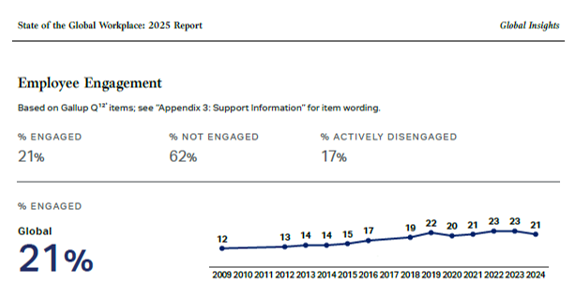
According to Gallup, The employee engagement rate worldwide has dropped to 21 % in 2024 (compared to 23 % the previous year), equal to the decline observed during the pandemic in 2020. Conversely, 17 % employees declare themselves actively disengaged, a figure that is on the rise.
Why? The main identified cause is the decrease in the commitment of managers, The number of managers has fallen to 27 %. Young managers (-5 points for those under 35) and female managers (-7 points) are particularly affected. These difficulties are linked to the increasing complexity of their tasks since the pandemic: increased expectations from leaders, restructured teams, and accelerated adoption of digital tools.
« Since the departure of the leaders, who change jobs before we can really get to know them, it is difficult to build trust.. »
Wonseon K., maintenance technician, South Korea.
Well-being at work: an equilibrium that is increasingly difficult to maintain
Employee well-being, measured by the indicator «flourishing» (people who feel fulfilled in life), fell to 33 %. This is the second consecutive year of decline.
Notable fact: Managers are also those who see their well-being decline the most sharply, With a decrease of 5 points for the older generation and 7 points for female managers.
« I feel physically exhausted, but I can’t sleep or disconnect. »
Anneliese A., Operations Manager, Germany.
Negative emotions remain at a high level in the workplace.
- The stress It is a daily occurrence for 40 % of the employees, which reflects a constant pressure on a large part of the working population.
- The anger touch 21 % employees, revealing an escalation of tensions and frustration within professional environments.
- The sadness is felt by 23 % workers, reporting lasting emotional distress.
- Finally, 22 % employees report feeling only, This highlights a worrying social isolation, even in collaborative contexts.
The Gallup study highlights that engaged employees are twice as likely to report «fulfilling life» and that they experience fewer negative emotions.
Collaboration, alignment, and mutual respect are powerful levers From simplification to complexity. It is by cultivating these conditions that manager-coaches multiply the commitment and performance of teams.
« When we all work together, in the same direction and with respect, even the most difficult projects seem simpler.. »
Bryan V., Systems Engineer, United Kingdom
Solutions exist: three priority actions for leading managers
In a context where employee engagement is declining and managers appear to be the first to be affected by organizational fatigue, Gallup warns that management has become the weak link in collective performance.
However, concrete levers exist. The 2025 study proposes three concrete ways to support managers and foster engagement:
- Train all managers : Management development can halve the risk of active disengagement.
- Training in coaching This can improve managerial performance by 20 to 28 %%.
- Supporting the well-being of managers Continuous development can increase the rate of «fulfilled» managers from 32 % to 50 %.
« I learned new working methods and how to better manage my colleagues; this has helped me a lot in facing the challenges.»
Abu Abdullah A., supervisor, Saudi Arabia
Europe: Low engagement, well-being under strain and caution regarding the labor market
With only % 13 employees employed, Europe remains the region of the world least professionally mobilized, far behind the global average of 21 %.
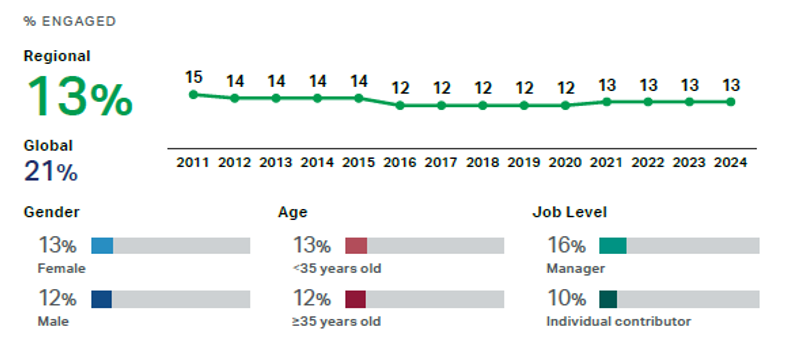
This low rate is accompanied by a worrying figure: 14 % of the European employees declare themselves actively disengaged, That is, they are not only little involved, but sometimes even opposed to the goals of their organization. A very large majority — 73 % — feel neither concerned nor motivated by their work.
This situation reveals a Silent crisis of engagement at work, a symptom of a profound misalignment between the expectations of employees and the dominant management practices on the continent.
Gallup points out that, despite recent transformations in working methods, Europe still struggles to create the conditions for sustained engagement.
« Europe continues to show the lowest level of global engagement.» — Gallup 2025.
A mixed overall well-being within European countries
On a personal level, European employees display a level of overall well-being that is generally higher than the global average 47 % say they are happy in their lives, compared to 33 % in the rest of the world.
However, this positive picture is nuanced by the existence of a significant minority — 5 % — in great distress. Negative emotions, although present, are overall less frequent than in other regions: stress affects 38 % of the respondents (vs 40 % worldwide), anger 14 % (vs 21 %) and loneliness 12 % (vs 22 %).
This European paradox — low professional commitment but relatively preserved personal well-being — seems to reflect a certain disenchantment with work, In a context where individual aspirations have evolved faster than organizational practices.
47 % Europeans say they are fulfilled in their lives, This rate is higher than the global average. However, 5 % report being in great distress.
Negative emotions are weaker there than elsewhere: Stress: 38 % (vs 40 % worldwide), Anger: 14 % (vs 21 %), Loneliness: 12 % (vs 22 %).
« Well-being in Europe remains mixed, reflecting a mature but disillusioned market. » — Gallup 2025.
Perception of the labor market: an optimistic caution
Despite an uncertain economic context, European employees show a renewed confidence: 57 % consider it a good time to find a job, up by 5 points in one year.
But this confidence remains limited, as % only 30 people report being on standby or actively seeking employment.
« European employees see opportunities but remain cautious. » — Gallup 2025.
France: an alarming commitment despite a more dynamic job market
A worrying commitment by French employees
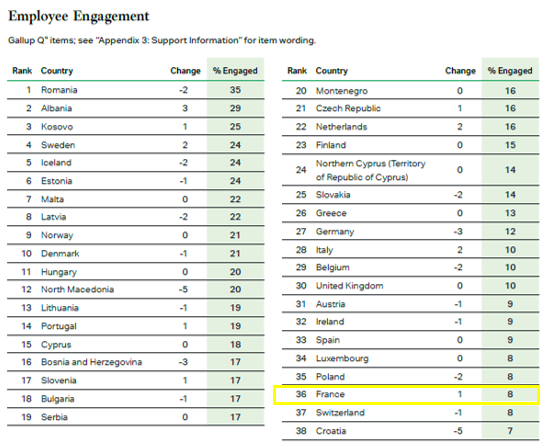
The level of commitment of French employees remains alarming: only 8 % (7% in 2023) declare themselves fully committed to their work, Compared to an already low average of 13 % in Europe. This figure places France among the last in the world ranking in this regard (36th out of 38).
Despite initiatives taken in some sectors to rethink management, strengthen recognition, or promote autonomy, the results are taking time to be felt on a large scale.
This chronic disengagement weighs on collective performance, innovation, and talent retention. It is a strong signal for French companies: rethinking the relationship with work is no longer an option, but a strategic urgency.
« France remains behind in terms of commitment, despite visible efforts in some sectors. » Gallup 2025.
Workplace well-being below the European average
In France, only 41 % of the employees declare themselves to be fulfilled in their lives, a level below the European average of 47 %, which reflects a more fragile well-being in the hexagon.
- The stress it remains a widespread phenomenon, with 38 % employees who experience this on a daily basis.
- The anger is felt by 19 % French employees, at a level higher than the European average of 14 %, may indicate a more pronounced form of tension in professional relations.
- Furthermore, 17 % employees say they suffer from loneliness, emphasizing a Persistent need for connection and recognition at work
« Negative emotions remain a persistent challenge for French companies. » — Gallup 2025.
Professional mobility and the perception of the job market
51 % of the employees believe that it is easy to find a job (an increase of 7 points compared to last year), and 29 % are actively searching or monitoring the market.
« The French job market seems more dynamic than in the past, but commitment remains the weak link.. » — Gallup 2025.
Retained from the 2025 Gallup study
Gallup’s 2025 report confirms a stagnation in overall employee engagement, with persistent signs of emotional fragility, especially in Europe.
France, in particular, is experiencing worrying levels of engagement despite a slight improvement in the perception of the labor market.
The key challenge for European and French leaders remains, through managerial development, to link performance and well-being at work in order to reverse the trend.