


Discover the OKR method in 3 questions (Objectives & Key Results), particularly suited to piloting strategies in a context of change.
What is the OKRs method (Objectives & Key Results) ?
A modern extension of goal-oriented management from the 1950s, the OKRs method allows an organization to have a clear and shared vision of its strategy, but above all to implement it. ensure execution on the ground and at all levels. This approach thus enables the entire company to:
- to move in the same direction by engaging all the teams,
- to hold all employees accountable in the implementation of the strategy,
- to ensure effective management of the company’s transformations.
The birth of OKRs at Intel
Widely deployed in Tech and especially in Google, This method originated with Intel.
The company’s goal was to manufacture ever more powerful computers every two years. This goal requires constant re-evaluation.
That’s how Andrew Grove, the CEO at the time, created The OKR method, So that all Intel employees are responsible for this evolution.
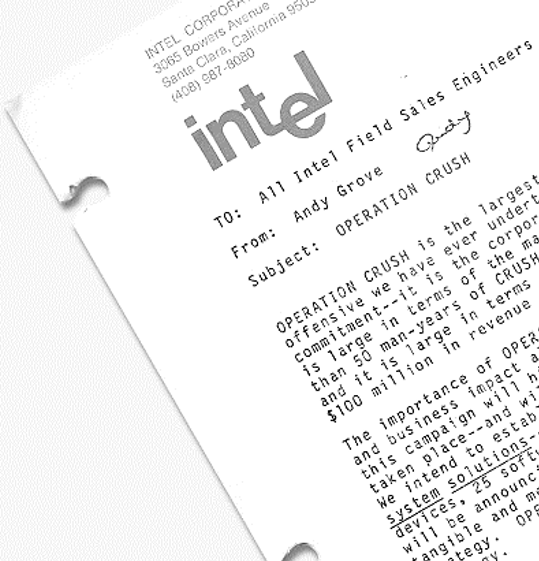
The OKR approach is particularly suitable today in a context of the need for transformation and acceleration in the implementation of strategies.
In what cases should the OKRs method be used and how should it be implemented?
The OKRs (Objectives & Key Results) impose a will: constantly questioning oneself!
This method derived from innovation management It allows for regular management and re-evaluation in order to achieve specific goals. The idea behind OKRs is to challenge ideas and be constantly innovating.
With this method, the role of the Direction and Management is fundamental. They are at the service of the employees to help them achieve their own performance indicators (« Key Results«This therefore leads to a significant change in posture.
While the methodology for implementing OKRs is relatively simple, its implementation is demanding:
- The leader must be clear about the “The ”Reason to Be” of the company and on its own mission. This mission is defined by qualitative objectives.
- Top Management appropriates the CEO’s OKRs and drives the approach throughout the rest of the company (approach « top down«) in order to hold each one accountable for achieving a « bottom up« .
- All managers and employees adopt 3 qualitative objectives, scaled to one year or less.
- After receiving training in OKRs, each individual develops and defines their own performance indicators (Key Results), with 3 indicators per objective in order to provide the means to measure the achievement of the objectives.
What is measured on a daily basis is the alignment of trends and the progressions within an extremely dynamic system. Thus, every 3 months (usually, but the frequency can be shortened during a crisis period, for example), the indicators are reviewed.
An indicator measured at 80 % will be changed because it is considered to be «attained». Key Result A well-defined (and therefore ambitious) goal should never be attainable at 100 % %!
Conversely, if it is only at 40 %, it will be revised downwards or changed, again, because it may be poorly defined.
How to ensure the success of Objectives & Key Results in the company?
The principle of Transparency is one of the foundations of the method (it is one of the The most common OKR errors). All employees must know each other’s OKRs and help each other within a team to achieve the team’s OKRs. In this way, we encourage Collaborative within the company.
Another element is fundamental for the proper deployment of this method: the leader must, upstream, have a clear vision and well work on the “why”The (raison d’être) of the company.
Each collaborator must understand, with the help of a OKR training, That the objectives are qualitative. This is a management completely different from goal-based management based on KPI, often synonymous with linear piloting.
But be careful, this approach can be hampered if managers do not play by the rules.
Indeed, since the employees set their own OKRs themselves, everyone in the company, regardless of their hierarchical level, must accept them and be trained in this way in order to ensure their success.
OKR are not just a tool. This method transforms the culture of the company because it changes the postures and behavior of managers. It is therefore advisable to to have someone accompany you from the very beginning of the design of the first priority objectives that would translate the company’s new strategic vision.
Accompanying sOKRat®