


The 2024 edition of Employee Experience Barometer, conducted by Parlons RH in partnership with Cornerstone, provides in-depth insight into practices and trends in the employee experience within French companies.
This 7th edition of the barometer is part of a context of multiple and intense transformations that affect organizations as well as their employees.
These «Great Transformations», which include digitalization, advances in artificial intelligence, climate change and societal changes, are redefining the contours of the work experience and the expectations of employees.
The study is based on the responses of 542 HR professionals (DRH, RRH, executives...) surveyed between December 2023 and February 2024. The respondents cover a wide range of sectors and company sizes, ranging from SMEs to large groups.

This barometer provides a fairly representative view of The adoption and evolution of employee experience practices in 2024, and to better understand how they influence companies' ability to cope with the major transformations currently taking place.
1. Organizations and professions impacted by major transformations
Key figures
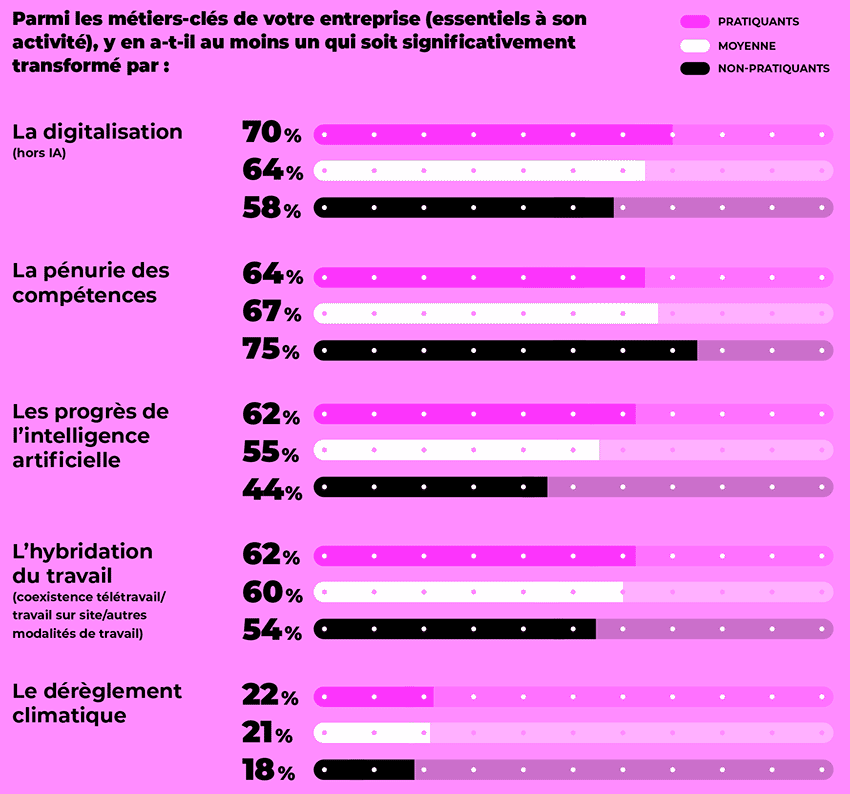
- 94 % Companies report that at least one key job has been significantly impacted by these transformations.
- In 85 % Companies have received concerns and suggestions regarding work organization from their employees over the past 12 months.
- In 2/3 Companies are transforming at least one key profession due to a shortage of skills and digitalization (excluding AI).
To remember
- The Major transformations which affect companies the most: digitalization, AI, climate change and the evolution of employee expectations.
- Work organization, quality of life at work, purchasing power The main concerns of employees remain. But the impact of technological developments and climate change are not far away.
- The skills shortages and digitalization are the first factors of Transformation of professions, and therefore endangering the human capital of non-reactive organizations.
« When there is a shortage, companies are driven to transform the modalities of work to make their jobs more attractive (hybridization), to automate part of the tasks (AI), or to have certain tasks performed by end consumers (digitalization). The shortage of skills tends to significantly boost productivity, pushing companies to invest. »
Laëtitia Vitaud, specialist in the future of work, lecturer
2. Employee experience policy at the heart of the company’s changes
The barometer distinguishes two types of companies: those that «practitioners" » (66 % of the RH sample) who initiated a formal employee experience initiative, and the «non-practitioners» (34 %) which have not yet implemented such practices.
Key figures
- 72 % Proven practitioners have innovated in the field of individual management of courses, against 29 % refractaires.
- 74 % Proven practitioners have innovated in the field of collective culture meaningful, against 38 % refractaires.
- 77 % Proven practitioners have innovated in the field of GPEC, against 33% refractaires.
To remember
- Companies that have implemented a policy around the employee experience have been more proactive than others since the Covid crisis in changing the way work is organized and in involving employees in the transformation process.
- Companies that have implemented a worker experience policy show greater resilience and adaptability.
«The more the HR professional is oriented towards collaboration, the more he or she will be the artisan of a collective culture that carries meaning. Meaning is one of the three fundamental needs of a quality employee experience, just as consideration and security are.»
Anne Vonbank, Co-author of the book «At the heart of the collaborative experience»
3. A collaborative experience approach to adapt to transformations
Key figures
- 81 % Proven practicing companies train their employees in Digitalization, against 31 % for refractors and 49 % Proven practitioners provide training on the consequences of climate disruption, against 17 % refractaires.
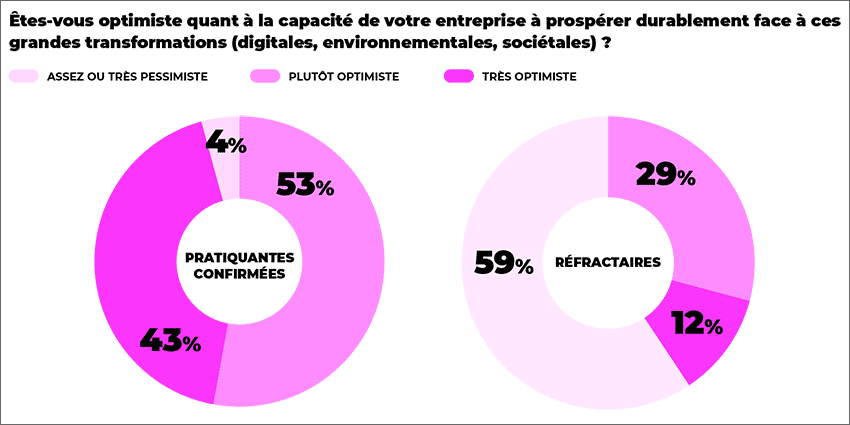
- 96 % Confirmed practitioners (UX policy collaborators > 3 years) are optimistic about their future. capacity to adapt to major transformations, against 40 % companies that do not practice it.
- Large groups form 2 to 3 times more their employees as SMEs in response to major transformations.
To remember
- In the face of major technological, environmental and societal transformations, the practice of the collaborative experience is highly correlated with a Greater reactivity, one greater propensity to action, one Solid optimism.
- Companies that practice it know better where they are going, and display a higher degree of confidence in the future.
«Companies that commit themselves to improving the employee experience are resolutely moving towards the future. They recognize the importance of training their members on the challenges of digitalization and environmental issues. Unsurprisingly, this willingness to prepare and adapt translates into an optimistic vision of the future.»
Samuel Durand, Speaker Future of Work and author of documentaries Work in Progress
4. Increasingly mature HR practices in terms of employee experience
Key figures
- 95 % practitioners have indeed chosen at least one option that involves Listening to employees (collection of feedback, listening to expectations…).
- 75 % Practicing companies have put in place a process of continuous improvement HR services.
- Between 21 % and 43 % companies non-practicing However, they employ processes that resemble those of The employee experience.
To remember
- The concepts of listening and of well-being at work They continue to dominate the practice of employee experience.
- Part of the non-practicing companies would actually be practitioners who don’t know themselves !
- Employee experience initiatives focus on continuous improvement.
- The vast majority of practicing companies have implemented Transformative HR practices.
«The employee experience refers to the work experience. By using all possible levers to improve it, we improve the performance of the organization. A well-understood employee experience leads to increased revenue. It is in times of turmoil that we need to take care of people the most. The employee experience is a stabilizing and growth lever in difficult times.»
Bertrand Duperrin, specialist and practitioner of the employee experience
5. Progress in measuring the effectiveness of the employee experience policy
Key figures
- 74 % Companies that practice it follow labor satisfaction indicators generated by formal surveys.
- 55 % Companies that practice this are equipped with digital solutions to measure the well-being and quality of life at work of their employees.
- 1 in 2 companies uses recurring feedback solutions.
To remember
- Companies are strengthening their mechanisms of feedback, With particular attention to work organization and quality of life.
- Companies that practice it usually follow Relevant indicators to measure the effectiveness of their employee experience policy (job satisfaction, HR indicators, performance).
- However, listening to employees is still very often done through traditional means, and the digital HR equipment, although it is progressing, remains insufficient.
6. A better consideration of employee experience in HR policy
© 2024 Parlons RH / Cornerstone
Key figures
- 86 % respondents are «very good» or "good" at experiencing the employee experience.
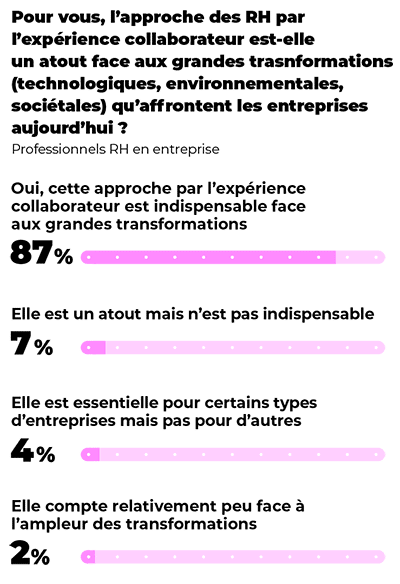
- 87 % HR professionals in companies believe that the approach The employee experience is indispensable to cope with the major transformations.
- 70% HR professionals see the employee experience as a key factor a specific HR policy listening, evaluating and improving HR services for employees.
- 81 % Companies that practice it entrust the «employee experience» topic to DRH.
To remember
- Knowledge of the concept of employee experience is stabilizing at a high level, while also improving in quality.
- HR professionals understand the employee experience better, implement it better, and recognize it more confidently when it is deployed in their company.
- HR professionals play a key role in supporting transformations, By adapting skills to new needs, in particular.
The HR department, a great transformer thanks to the power of collaborative experience
This national barometer shows that Companies that invest in the employee experience are more agile and better prepared for the changes that are coming..
Over the years and through the barometers, The employee experience asserts itself as The weapon of HR professionals to contribute their share to the building of the change.
Listening to employees, analyzing their feedback, and translating it into solutions that it be prioritized and implemented within a defined framework, evaluated and repeated: this is the only way to adhere as closely as possible to the imperatives that the major transformations Environmental, technological and societal factors weigh on companies.