

In a context deeply marked by the health crisis, with employees working either in the office or at home, the hybridization of work modes has become a reality. How can companies (and their managers) successfully implement a hybrid organization?
As early as November 2021, the Cigref-Numeum report on new labor organizations indicated that there would be no possible return to previous working modes, but specified that « To be sustainable, hybrid work must be able to be anchored in a framework, a more agile organization that is nevertheless well orchestrated. ».
That is why, after our article on The challenges of working remotely, Therefore, it is necessary to start today. the principles and modalities of hybrid work to better deploy a hybrid work organization on a larger scale.

The 6 keys to success in hybrid work
«82 % of the employees working in a hybrid mode declare themselves to be just as or even more productive than before»
Study by Groupe Adecco on the new era of work (September 2021)
With the work in a hybrid mode, Now, the teams share their time between the company’s premises and their home or a third-party space connected to the internet and ideal (ideally…) for professional activity.
This Hybridization of work This can lead to a modulation of the weekly rhythm and to an adjustment of each person’s time in the company to meet both the needs of the company and those of the teams.
In this new framework between the present and the distant, The work collective must be more structured and better organized to continue functioning effectively in a hybrid mode despite physical and social distancing.
Maintaining team cohesion, optimizing meeting efficiency, rethinking workspaces… These are, based on our experiences and the recommendations of the Cigref-Numeum report, 6 good practices for successfully implementing hybrid work !
1. Hybrid mode manager to engage the teams
At the heart of the company’s transformations, managers are naturally the key to the success of hybrid work! hybrid management is essential for:
- Bringing the framework and vision of the company and giving meaning to hybrid teams,
- Driving performance by refocusing on action priorities, implementing new routines, and developing the autonomy and accountability of employees,
- Continuously improve and foster innovation by promoting Agile and collaborative work methods and by cultivating the right to trial and error,
- Strengthening the commitment of employees by improving their daily experience, being attentive to their well-being, and developing a culture of feedback and by nurturing their motivations.
2. Balance working time between in-person and remote work
Among the new tasks for managers related to hybrid work, it is essential to adapt the distribution of tasks within the team:
- Coordinate and planning days at the office and remotely According to the «telefragile» activities» (which are difficult to adapt to teleworking) or «Telerobustes» (which adapt well to teleworking) with regular rhythms,
- Not over-demanding the number of employees present in the company compared to those working remotely,
- Taking advantage of the opportunity of remote team meetings bring employees together who could not meet or be present before.
3. Maintaining cohesion within hybrid teams
The physical and social distancing associated with hybrid work is a major challenge for managers who must, more than ever, :
- Organizing rituals communication to maintain team cohesion,
- Bringing the collective together around the «victories» of each person and the group's successes,
- Defining a weekly period without meetings or formal meetings, in order to promote convivial exchanges within the teams (in person and even via videoconference).
4. Structuring the meetings in person and remotely differently
While the successful organization of a face-to-face meeting is already an art in itself, taking into account the hybrid nature of teams is now necessary for managers, as well as project managers, who must, among other things:
- Defining a clear framework upstream and at the beginning of each meeting involving remote collaborators: choosing a rhythm-paced agenda, respecting speaking time, adapting topics to the participants,
- Plan weekly points team work, individual points, moments of sharing among peers, plenary meetings, etc., depending on the mode that best suits the situation: in the office, working remotely, or a hybrid model,
- Balancing the weekly schedule to avoid successive meetings (and the acute hybrid meeting).

5. Facilitate hybrid work through adapted collaborative tools
Beyond hybrid management, the company must adapt the tools for sharing and communication to the hybridization of work modes:
- Equipping the employees of secure laptops compatible with videoconferencing,
- Harmonizing common web platforms sharing (Enterprise Social Network, Shared Drive, Slack…)
- Limit the number of tools and communication channels to avoid the dispersion of information, practices and skills,
- Accompanying by training the increase in skills in collaborative tools, based on their value for use (suitability for the needs).
6. Rethinking work spaces in a hybrid mode
At home
- Ensuring the essential conditions a good working environment : if possible, arrange a separate room with a desk and ergonomic chair, the necessary equipment for the smooth running of videoconferences, and high-quality WiFi access,
- Organize with the team and the employer if the conditions are not optimal.
Third place
- Offering third places based on geographical proximity of collaborators,
- Finding some meeting spaces in third-party locations identified if on-site interactions become complicated due to the reorganization of work spaces,
- Propose something team seminars in third places, to explore other working frameworks.
On site
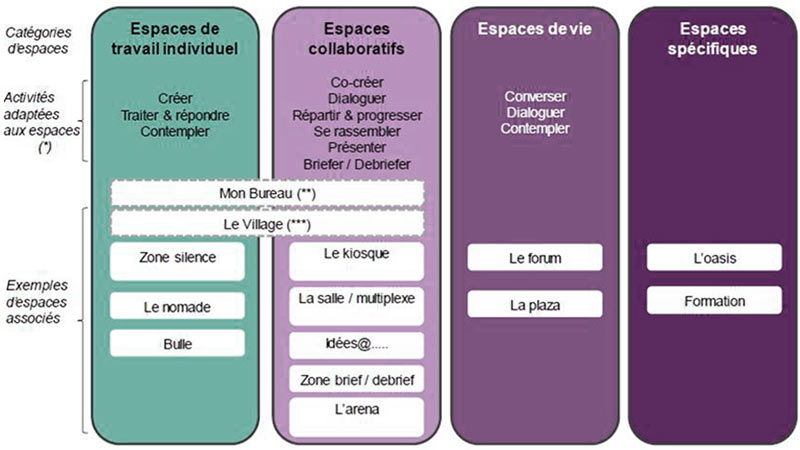
- Create a new workspaces dynamic arrangements combining several workplace proposals that are conducive to collaborative work and informal exchanges:
Modifiable spaces with shelves dedicated to individual work and shelves dedicated to teams
Individual box to conduct interviews, make confidential calls or participate in a solo video call
Collaborative spaces for work and group meetings
Cohesive spaces to encourage informal exchanges and thus to encourage employees to return to the office
Here is an example of how workspaces are organized in companies (DSI Pôle Emploi):
Beyond a cross-disciplinary reflection and possible agreements on teleworking, the inevitable hybridization of work modes makes the implementation of concrete improvement actions within the company indispensable. These actions are primarily carried out by management. While hybrid work fundamentally challenges organizations, it also represents a formidable opportunity to reconcile company performance, well-being at work, and social responsibility. This is precisely the mission that the teams have set talenco themselves on a daily basis… and the essence of our commitment!
Training «Hybrid Management and Return to the Office»
Methods and tools for reengaging hybrid teams
Case study: Adapting management and team-building practices to hybrid work
In a context of hybridization of work modes between face-to-face and remote work, talenco Keolis trained managers in new practices in management and team leadership in a hybrid mode.