

The most successful companies around the world stand out for their inspiring vision, ambitious goals and ability to implement that vision. Among these companies, some, such as Adobe, Deloitte, Meta or Google, They chose the method of Objectives & Key Results (OKR) to achieve their goals.
OKR are becoming a common practice in many sectors of activity and in companies of all sizes, from start-ups to multinationals.
Despite this growing popularity, there was little information available about the key motivations, best practices, and operational performance of OKRs.
OKRMentors and Quantive published in June 2023 « The Global State of OKRs«The first global barometer on the OKR method:
- 466 executives and managers surveyed who use OKRs,
- throughout 13 countries (the United States, Australia, the United Kingdom, France, etc.),
- 20 different sectors of activity and companies of all sizes,
- 300,000 data points collected.
This international study focuses on The performance differences between organizations with mature OKR strategies Compared to their counterparts. Here are the 5 main lessons learned from the responses obtained!

1. OKRs, a method adapted to all types of organizations, activities, and cultures
The OKR revolution is here, and it’s global. From startups to large companies (like OKR Forum France 2023Beyond borders and sectors of activity, the OKR method has taken root.
⚙️ Among the executives and managers surveyed, 28 % belong to organizations with more than 10,000 employees, 29 have % between 1,000 and 9,999 employees, 37 have % between 100 and 999 employees, and 6% have fewer than 100 employees.
⚙️ The panel of respondents reveals a fairly balanced distribution among the different sectors: from retail to services, through the manufacturing industry, telecommunications, the pharmaceutical industry, the automotive industry, etc., with some strengths in finance, banking and technology.
⚙️ Among the 13 countries surveyed, the majority of respondents % come from Anglo-Saxon countries (36 % United States and Canada, 20 United % Kingdom and Ireland), 23 from Europe, and 6% from the United Arab Emirates.
Through the diversity of the «practitioners,» it can be seen that the OKRs do not follow a single approach. The responses are very heterogeneous, which highlights the diverse application of OKRs to meet the unique needs of organizations and managers.
The successful implementation of OKRs does not depend on the size of companies or their geographical location but is played out on whether they are comfortable or not and on The daily practice of OKRs.
2. The Objectives & Key Results to enable managers to implement the strategy
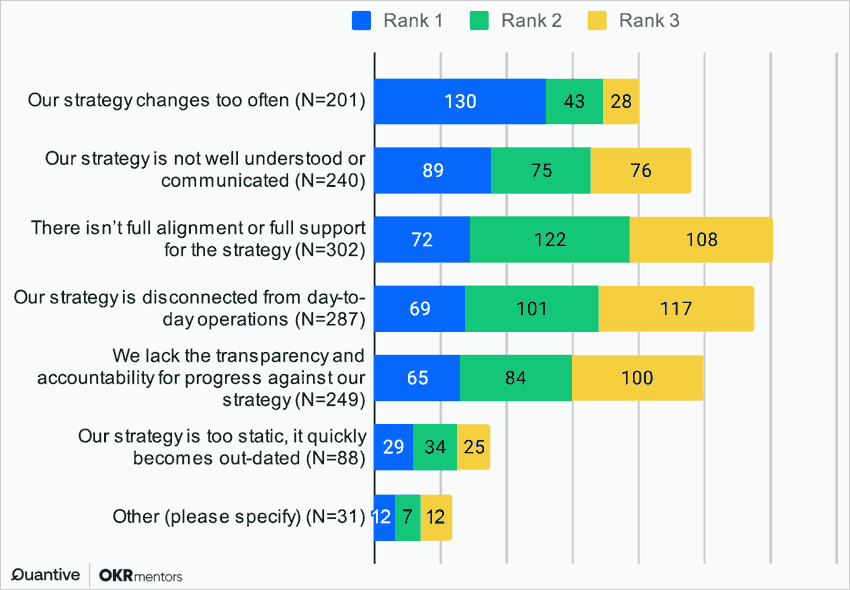
Often, The most difficult thing for organizations is to move from strategic vision to operational execution. The major challenges that leaders face in terms of strategic performance are related to 3 main difficulties :
- 65 % of the respondents mention the Challenge of alignment or total support of the strategy,
- 62 % mention the a challenge of a strategy disconnected from daily operations,
- 54 % mention the risk of a lack of transparency and communication.
It can nevertheless be noted that beyond this top 3 in cumulative responses, the main challenge faced by respondents is the fact that « The strategy changes too often », item placed first in the responses below!
3. Alignment, performance, prioritization: 3 good reasons to adopt the OKR method
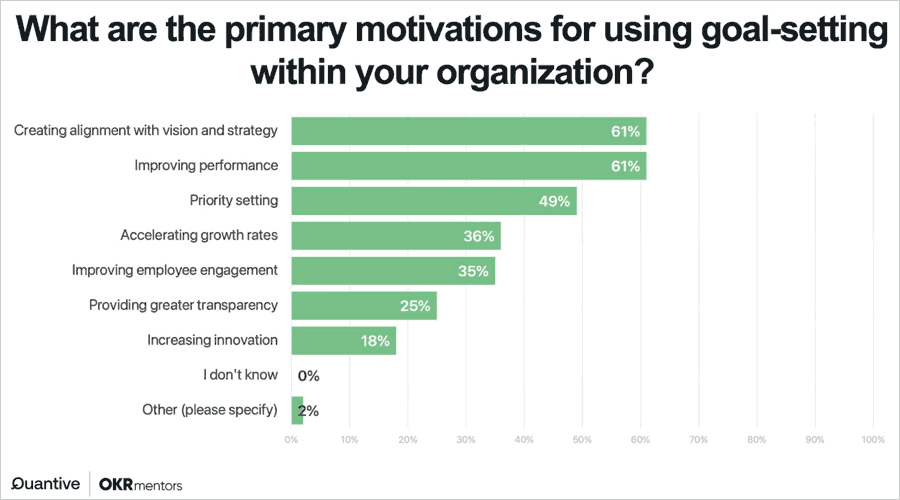
In this context of implementing the strategy, the leaders and managers surveyed about their motivations for implementing the OKRs state that they are looking for: 3 main benefits through the Objectives & Key Results :
- Creating alignment with the vision and strategy (61 %)
- Improving performance (61 %)
- Managing priorities (49 %)
Among the responses, Another important challenge is to improve employee engagement, This was a motivation for 35 % of the people surveyed.
4. A direct link between the OKR experience and the strategic performance of the organization
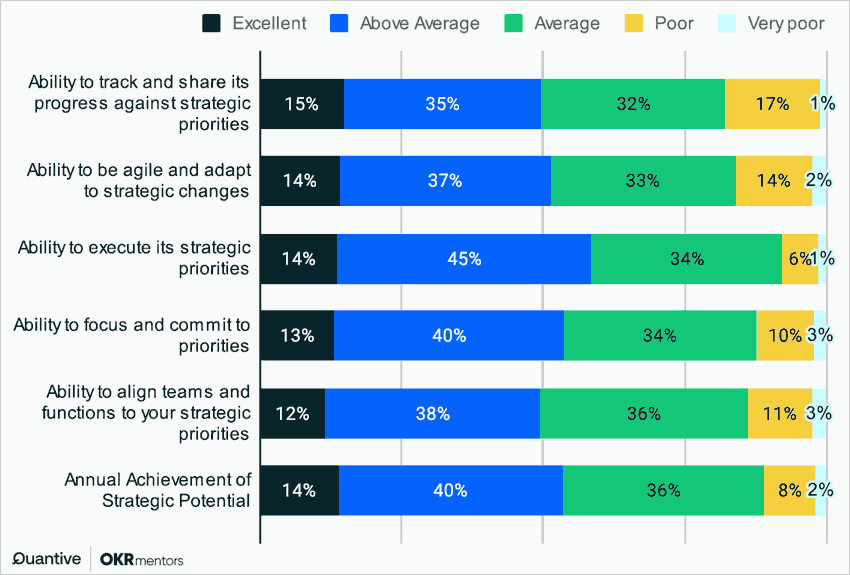
The survey asked leaders how they evaluated their company compared to other companies in their industry. 5 levers of strategic performance (being agile and adapting, focusing and committing to priorities, tracking and sharing progress, aligning teams, achieving goals…)
- More than 50 % of the leaders using OKRs believe that they are at least «above average» in terms of their ability to implement various strategic performance indicators;
- Among them, 14 % consider themselves to be «excellent» in performance;
- respondents who have experience with OKRs for more than 3 years feel 6 times more effective in executing the strategy Those with little experience.
This observation confirms that OKR have significant impact and return on investment for companies that seek to improve their strategic execution.
« Experienced OKR leaders feel 6 times more effective in executing the strategy.»
5. Mastering OKRs to enhance the performance of managers and teams
It exists a direct link between years of experience with the OKR method and strategic performance indicators. Leaders who have more experience and are proficient in OKRs (« overachievers ») are evaluated more positively in all performance indicators.
The proper use of OKRs therefore has a direct correlation and significant impact on the individual performance of managers.
- 33 % of the « overachievers »are considered excellent in execution (10 times better than beginners),
- 48 % are excellent for focusing (16 times more than beginners),
- 43 % are excellent for lining up teams (14 times more than beginners).
Mastering OKRs takes time and effort. But Leaders who prioritize the mastery of OKRs experience significant improvements in all performance areas.
The 6 OKR best practices of the « overachievers«
The surveyed leaders who declare themselves highly experienced in OKRs, or « overachievers«They state that’, they report Clearly superior performance of respondents who consider themselves at a «beginner,» «correct» or «good» level of adoption of OKRs. Here is what distinguishes the « overachievers » for beginners:
- one Dedicated training for OKRs (68 % of the « overachievers » have an internal program)
- of Quarterly cycles to review regularly the Objectives & Key Results
- of more frequent follow-ups (37 % for the quarter, 28 % monthly, 10 % weekly)
- an implementation of OKRs that begins at the highest level of the company
- the integration of OKRs into the existing processes of the company (HR, management, etc.)
- the use of specialized solutions (and not Excel spreadsheets) to manage OKRs
The first edition of the OKR global barometer is rich in lessons learned from companies that have been implementing the OKR method for more than a year (and even more than half of the participants for more than 3 years). The information contained in this report is valuable for addressing today’s and tomorrow’s challenges based on past experiences: improving performance, facilitating the implementation of the company’s strategy, and helping teams fully develop their potential!