


Scale agility, also known as « Agile@Scale »A framework, an organization, that allows several agile «multi-skilled» teams to work together around a single product or service. The implementation of this cross-functional work model therefore necessarily involves touching upon the organization of the company and challenging traditional pyramidal or silo-based models.
Until now, it was mostly confined to the DSI perimeter, Agility tends to develop and deploy its principles and values throughout the entire company.
More than a project management methodology, agility is first and foremost an attitude of mind which is gradually being established to lead to a learning organization, in constant improvement, in order to improve performance and offer more value to customers. This profound transformation involves: an evolution of the role of managers who become leaders at the service of their team.

An agile organization at the service of efficiency
The establishment of agile organizations at the scale allows to effectively respond to the performance and market adaptation challenges facing companies by accelerating productivity gains, encouraging innovation, and attracting and retaining talent.
Agile organization actually promotes the more effective consideration of user needs, a better quality output, and better team synchronization. It allows for:
⏱️ reduce the « time to market » by allowing teams to be more reactive and more free to innovate to adapt to market developments;
bring more value to customers by putting this client at the heart of the project and by regularly exchanging with him to be perfectly in tune with his expectations;
⚙️ optimizing processes by promoting short circuits that facilitate changes in priorities during the project cycle and help to control costs, investments and risks;
giving meaning to the work of the employees by developing autonomy, empowerment, group dynamics, a clear division of roles, and the fluidity of interactions.
An agile model focused on «products»… therefore the customer
In an agile organization, teams are usually Small size and multi-skills. Each team is responsible for his product, from design to market introduction, and its continuous improvement by being in regular contact with users and keeping pace with the market.
Thanks to this agile organization:
- the team is focused on its product/offer/service and its users while taking into account the objectives of the company and internal constraints, including those of the other teams;
- The project does not stop at delivery because the customer/user remains at the center of concerns with regular milestones of results and continuous improvement;
- The piloting is based on Operational efficiency, value creation and user satisfaction.
There are several « frameworks » (Agile frameworks), such as SAFe, LeSS, Scrum of Scrum (SoS), etc.
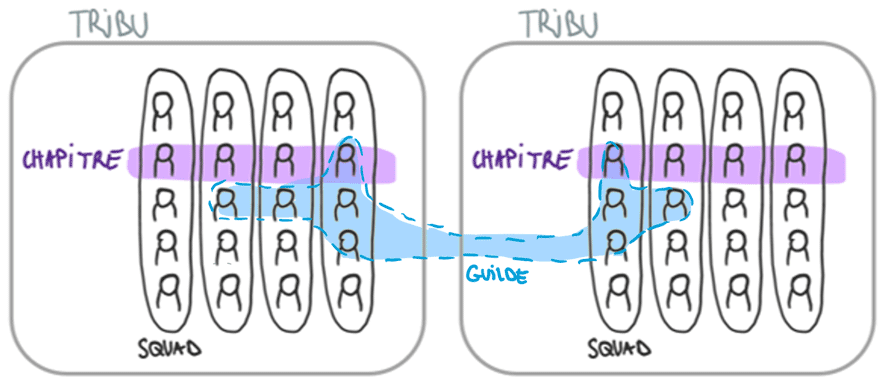
Among them, the Spotify model – the most widespread – is organized around “Teams”. A Squad is an autonomous and multidisciplinary team of 5 to 10 people, free to choose the agile methods to use (Scrum, Kanban, Lean startup, etc.) to carry out a specific project within a specific scope.
Squads working on the same functional or technical issue are brought together in a “Tribe”focused on a part of the overall project, and usually accompanied by an agile coach facilitator.”.
In each Tribe, one or more cross-functional teams called « Chapters » and composed of a member from each Squad, ensure the sharing of information for a better overall view of the project.
Finally, regardless of the Tribes, individuals with common skills or interests can come together in a « Guild » to promote the monitoring of a subject… therefore the success of the project.
Whatever the « framework » Chosen, agility is first and foremost a mindset that involves continuously improving by creating our own practices and adapting them to the context.
New mindset, new corporate culture
There is no agility at the enterprise level without an evolution of the internal mindset and culture. Agility is % 30 practices/tools… and 70 % culture! The main challenge is therefore to develop the « mindset » necessary to encourage collective work, «de-silence» and remove cultural barriers.
Agility at the enterprise level transforms the way of working and the Corporate culture. It creates a mindset conducive to the transformation of the company or organization. Centered on the human being, it promotes creativity, autonomy, innovation, and «happiness at work.».
To infuse this new way of working and break the resistance to change, it is necessary to to provide pedagogical training to the teams and explain to them the meaning, the reason and their role in the transformation. The more involved the employee is in the agile transformation of their company, the more likely they are to take initiatives and invest their time and energy.
Training «Developing agility within your team»
As time goes by, the mindset transforms and builds itself. The process often begins with a pilot team, and then other teams follow suit, take the plunge, and start practicing.
«Little by little, agility takes shape in every action and becomes a way of operating that feeds on the gains in creativity and performance in a virtuous cycle. This contributes to profoundly transforming the mindset and ensures the sustainability of agility at scale.»
Extract from the report «Agile at scale: implementing agility at the enterprise level» from the Cigref association (December 2018)
As employees benefit from more autonomy through agile transformation, The role of the manager is also evolving towards a leadership role at the service of his team..
Manager leader, a new management model
The implementation of agility at scale inevitably leads to profound transformation and the adoption of new management models. based on the autonomy and empowerment of teams, a new distribution of roles and a reduction in management layers. Thus, in this model, the functions of department and service manager tend to disappear in favor of new functions: tribal leaders, chapter leaders, program managers…
Agility changes the role of the manager who conveys meaning, vision (why-what), and delegates the execution (how) to the team, being fully available to his or her employees. Managers thus become leaders at the service of their team (« servant leaders«Imagine the change in posture!
As a leader, the Agile manager It encourages mutual trust, develops the creative and innovative abilities of its employees and promotes collective intelligence. Transparency, trust and the fluidity of information They allow the team to innovate autonomously, take risks and carry out its project, taking full responsibility for it over time.
Thus, it is no longer solely the manager who motivates his teams; it is the working environment created by management that generates motivation and performance.
The manager leader It gradually delegates its decision-making power to the team and supports it in developing the skills of each of its members.
Necessary support for the teams
Implementing agile transformation at the scale of an organization does not happen overnight. It requires a gradual transition to accompany employees and management.
Agility is first established through an acculturation, a realization of the benefits of organizing in an agile way For the well-being of employees, the benefit of customers and the performance of the company. This involves providing support and training for teams before they adopt agility.
Agility at the scale is primarily established through practice, starting with Small projects in a pilot mode which will allow teams to quickly generate encouraging successes and capitalize on these initial successes to begin to evolve the corporate culture.
These early successes will allow for the formation of ambassadors and the long-term dissemination of agility across the organization.

Finally, to facilitate the implementation of agility at scale, the support of middle management, strongly impacted by the evolution of the management model, is inevitable.
In short, The scale-up approach allows teams to foster collaboration, develop and leverage their skills and expertise. This is a key issue for attracting and retaining talent, especially the younger generations.
Agility is therefore a formidable means, at the scale of a service or a company, to prioritize, adapt, and constantly adjust to the needs of the end customer. However, if this model perfectly adapts to IT services, tech companies, startups, etc., the first question to ask is that of the opportunity and interest for one’s own company.
Before embarking on an agile transformation on a company-wide scale, it is therefore preferable to identify the real need for change and the real interest of the organization; after all, becoming agile is not an end in itself, but a means of achieving one’s goals. This is why it is important to be advised and supported in this process!
Practical training in agile working methods
Case study: Rethinking the roles and positions of leadership managers in an agile organization
Credit Agricole Technologies and Services