

The third edition of Todo skills barometer, The study, conducted in partnership with Legisocial with approximately 1,000 HR professionals and executives, reveals the «soft skills expected of managers in 2025» in a context of permanent change.
While certain soft skills essential to managers immediately come to mind, such as decision-making and emotional intelligence, the 2025 barometer lists a total of 48. Among the Top 12, reported and analyzed by Inffo Center, There are five that are particularly useful in a context of change: active listening, problem solving, conflict management, positive attitude and accepting feedback.
In fact, the role of the manager has changed profoundly today to accompany the transformation of organizations. The era of the «knowing leader» is over; it has given way to that of the «leader who listens, understands, and acts with discernment.».
As it is emphasized Raphaël Kattan, Associate Director of talenco:
« In an uncertain and constantly changing context, soft skills have become indispensable for managers, even more so than the development of technical skills!»
Here is a selection of 5 human skills, or «soft skills», which will make the difference in 2025 according to HR professionals:
Soft skill 1: active listening, the foundation of humane and effective management
© 2025 Centre Inffo
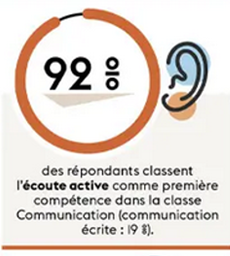
This is THE most popular behavioral skill: 92 % of the respondents consider active listening to be the essential foundation of management in 2025.
And for a reason: a manager who truly listens is not a passive manager. He is a leader who picks up weak signals, understands the expectations of his teams, and knows how to adjust his management accordingly.
In a more horizontal work environment, where the voices of employees matter, listening becomes a lever for engagement, loyalty, and even… driving change.
It acts throughout the employee journey: from onboarding to offboarding, and throughout transformation periods., Active listening creates a climate of lasting trust. It also provides the keys to adjust management practices in line with the values displayed.
Soft skill 2: Problem-solving to act rather than endure the unexpected
© 2025 Centre Inffo
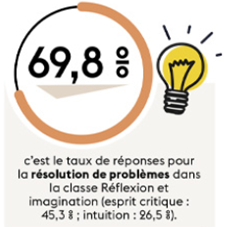
Given the increasing complexity, the ability to solve problems is considered indispensable by nearly 70 % of the respondents (69.8 %%).
Companies no longer seek managers capable of diagnosing a situation or producing analyses. They expect decision-makers capable of charting a path to a solution. proposing concrete solutions in an unstable world Technological disruptions, HR tensions, regulatory uncertainties…
This skill goes hand in hand with other qualities such as accepting feedback (favored by 63.6% % of respondents).
Solving a problem effectively is not doing it alone, but with the help of the field, involving the teams and Capitalizing on collective intelligence.
Soft skill 3: Conflict management to transform tension into constructive energy
In third place on the podium in the category of interpersonal skills, 62.7% % of respondents place conflict management among the key soft skills.
In hybrid, multicultural and constantly changing environments, relational tensions are inevitable.
What we expect from a manager is not to avoid them, but to Knowing how to welcome them, channel them, and bring about solutions.
It is a matter here of adopting a mediation stance, of defusing the tensions before they harm the collective dynamic, and of turning disagreements into opportunities of alignment and progress.
Soft skill 4: a positive attitude to stimulate team motivation
© 2025 Centre Inffo
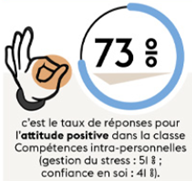
The Softskills Barometer 2025 ranks’positive attitude at the top of the «intra-personal skills» class, with a significant response rate around 73,6 %, This makes it the most valued skill in this category, even ahead of self-confidence or resilience.
Positive attitude ranks 9th among the most sought-after soft skills among managers in 2025.
In a context of accelerated transformation — digitalization, artificial intelligence, hybrid organizations — adopting a An optimistic mindset becomes an essential tool for dealing with uncertainties and stimulating collective motivation.
The positive manager inspires confidence, fosters commitment, and transforms obstacles into opportunities, thus fueling a constructive dynamic.
This attitude becomes not only a driving force for the team but also a strong signal to employees: despite the turbulence, the vision remains focused on the future and solutions.
Soft skill 5: Accepting feedback (criticism) from managers
The’Acceptance of the feedback, which is addressed in the «interpersonal skills» class, is identified as the second most popular soft skill after respect (with about 63,6 % respondents), highlighting its central place in current management practices.
In an environment where change is constant, the manager must know how to welcome feedback — including criticism — with discernment, without taking it as personal attacks.
This involves actively listening, distinguishing constructive criticism from malicious comments, and turning these returns into opportunities for adjustment and evolution.
Such an attitude increases trust within the team, promotes continuous learning, and helps adjust management practices to remain aligned with goals and expectations.
In times of transformation, this ability to integrate feedback is essential for maintaining the organization’s agility and performance.
Human skills more strategic than ever for leadership
The 5 skills identified by HR – active listening, problem solving, conflict management, positive attitude and acceptance of feedback – no longer fall under the category of “nice to have”. Essential to the way we operate, they have become the backbone of modern management.
As confirmed by Raphaël Kattan, «Our clients are not mistaken: at talenco, it is precisely the training in these soft skills that is currently the most popular.
Training managers in these human skills, in addition to hard skills, is investing in their ability to drive change, engage their teams, and build resilient organizations.
In a world where economic and technological changes cause growing uncertainty, it is more than ever the human factor that will make the difference!