


The 6th edition of the Barometer* on training and employment, published in February 2025 by Inffo Center with the CSA Institute, offer a fairly comprehensive overview of the perceptions and perspectives of French workers regarding vocational training and career change with, this year, a more particular focus on the Implications of Artificial Intelligence.
In a context where the transformations of the world of work continue to accelerate, particularly with the arrival of generative artificial intelligence, Vocational training is once again proving to be a key lever for adaptation, projection and action for employees.
The 2025 Professional Training Barometer provides a detailed overview of the perceptions, expectations, and practices of the workforce regarding training and employment. It reveals a strong aspiration for progress and autonomy, but also persistent disparities in access to information and support.
*Barometer based on a sample of 1,621 French active citizens aged 18 and over, representative of the French active population according to criteria such as gender, age, employment status, socio-professional category, region of residence and agglomeration size
1. Vocational training: an indispensable tool in the face of changes in the world of work
In a world of work in constant motion, Employees must adapt to professions that are changing rapidly. However, this pressure does not affect their confidence in the future. Training thus becomes an essential foundation for remaining competent and proactive, especially in a context where there are many opportunities for professional mobility.
© 2025 Centre Inffo
An increase in asset confidence in the future
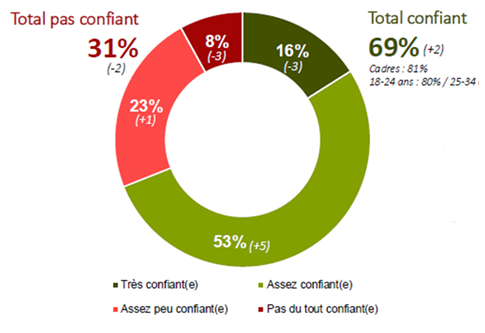
- 69 % of the employees are confident about their professional future (+2 points vs 2024)
- 81 % among executives, 80 % among 18-24 year-olds
Many jobs in fast-paced transformation
- 43 % believe that their profession is evolving very quickly (a record since 2020)
- 85 % believe that their profession is evolving in one way or another
A medium-term projection marked by stability
- 43 % believe they will be doing the same job in 5 years, but in a different form
- % 27 expect to take on another job
A strong desire for professional change
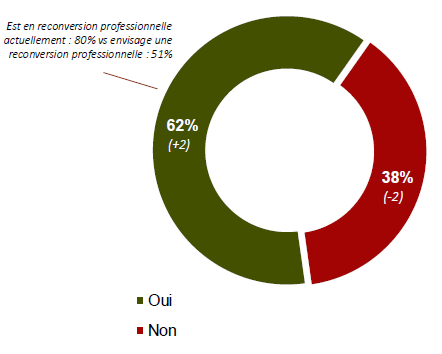
- 51 % of the assets are considering a change in employment
- 34 % anticipate this change within the next 2 years
«Economic uncertainties do not undermine asset confidence in their professional future. (…) The assets are aware that they will have to adapt constantly… which is why continuous training is so important!»
Julie Gaillot, director of the department at CSA (Institut d’Etudes)
2. Training: an individual dynamic that must be strengthened collectively
The assets continue to perceive themselves as the primary actors in their own formation. Nevertheless, The trend is towards increased expectations from companies and institutions. While individual accountability remains the dominant principle, it must not obscure the growing need for support in professional careers.
A responsibility perceived primarily as individual
- 74 % believe that it is up to each individual to manage their training path (down 6 points since 2022)
- This figure reaches 90 % for self-employed people, and 80 % for people in a re-training process.
A declared involvement, but uneven
- 69 % say they are sufficiently involved in their training (stable since 2022)
- This figure rises to 87 % for those aged 18-24, but drops to 41 % for those over 50.
«3 out of 4 active people consider themselves responsible for their own training. The 2018 law on freedom to choose one’s professional future has therefore achieved its goal! (…) However, this does not exclude the need for support in a training system that can be complex or poorly understood.
Pascale Romenteau , General Director of Centre Inffo
3. Information that is progressing but remains unevenly shared
While the feeling of being well informed about training is improving, it remains mixed across profiles. Young people and the self-employed feel more capable of finding their way, whereas the unemployed, public sector employees and those over 35 point to a real lack of information.
A level of information with variable geometry
- 53 % of the assets say they are well informed (+1 pt)…
- …but 64 % of the unemployed and 55 % of the public employees say the opposite
Subjects still poorly identified
- Less than one in two respondents feel well informed about financing arrangements, local organizations, or guidance centers.
First digital channels or relational channels
- 38 % use search engines
- 32 % go through their employer, 27 % through specialized sites, 25 % through their network
4. Well-known training programs… or completely invisible
The barometer reveals a strong imbalance in the visibility of training programs. While some (such as apprenticeships or skills assessments) are well-defined, others struggle to gain recognition despite their potential.
Well-established mechanisms
- Learning: known to 94 % of the assets
- Skills assessment: 92 %
- VAE (Validation of the Acquis of Experience): 83 %
Dispositions in the back
- Pro-A: 36 % (-2 pts)
- Cléa: 31 % (-4 points)
- CEP: 45 % (-2 points)
Strong interest in VAE
- 59 % of the assets are said to be interested in VAE, particularly young people and those in a career change.
5. A desire for training hampered by persistent obstacles
Although almost half of the assets under management plan to undergo training within the year, this proportion is slightly down. Lack of time, motivation, or the inadequacy of the offer are still important obstacles that need to be overcome.
Intentions that are slightly declining
- 47 % want to undergo training within 12 months (-3 points)
- Up to 71 % among 18-24 year olds, 60 % among 25-34 year olds
Brakes that remain structural
- Lack of desire (29 %), lack of time (25 %), unsuitable offer (20 %)
- 53 % do not plan to train this year
An already clear direction for those interested
- 60 % of the interested people have a clear idea of the training they want
6. Professional reconversion: a movement that is taking shape
While the proportion of people currently in the process of retraining is decreasing, interest in such a move remains strong. It particularly affects young people, job seekers and those seeking meaning in life. But it still requires massive support.
A decline in assets in the reconversion sector
- 18 currently % in transition (-3 points)
A stable intention to change careers
- 36 % of the other assets are considering a conversion within 2-5 years
- In total, 47 % of the assets are concerned or interested.
Training at the heart of reconversions
- 61 % are following or will be following training in this context
- 83 % among those already in the process of re-entering the workforce
© 2025 Centre Inffo
A very pronounced need for support
- 62 % believe they need to be accompanied in this process
- 80 % among those already engaged in a career change
7. AI and the world of work: between appropriation and vigilance
Artificial intelligence is fully integrated into professional use, especially for helping with writing or finding information. If the enthusiasm is there, it is accompanied by a strong need to training in generative artificial intelligence to master the challenges and get the most out of these tools.
«There is an extremely important need for training, given the small revolution that artificial intelligence will bring about in the coming years!»
Julie Gaillot, director of the department at CSA (Institut d’Etudes)
A generalized but imperfect knowledge
- 97 are % familiar with AI, but 41 say % they are ill-informed
- 64 % feel comfortable with these tools (84 % among 18-24 year-olds)
An increasing adoption of artificial intelligence
- 53 use % it in a professional context, 64 % in a personal context
- 31 use % it several times a week in a professional context
Generative AI for multiple uses
- Information search (46 %), drafting (43 %), analysis (33 %), automation (32 %), creativity (32 %)
An ambivalent perception of the impacts of AI
- Opportunity for 43 %, threat for 27 %, no impact for 30 %
- 77 % fear dependence, but 76 see % it as a time-saving advantage
© 2025 Centre Inffo
Strong demand for AI training
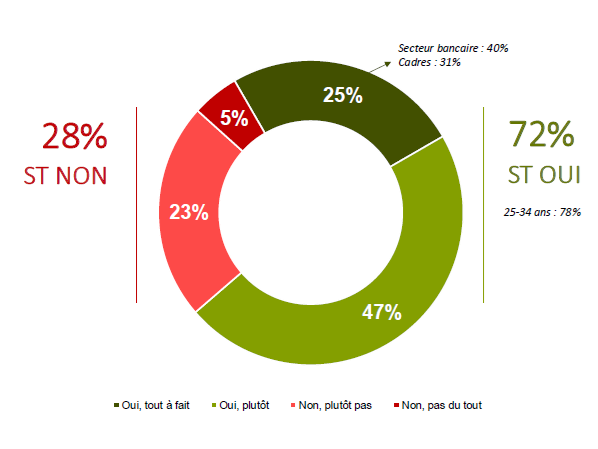
- 72 % of the users feel the need to train in AI
- 52 % want a confirmed level, 41 % a beginner level
- The existing training programs are still little known: only 29 % know that a dedicated offer exists
The key figures from the 2025 Barometer on training and employment show that employees are fully aware of the importance of training, reinventing themselves, and adapting to the changes in the world of work.
It is up to HR and other organizations to provide them with the right tools to get the most out of vocational training: clear information, tailored support, accessible tools and concrete training, especially on emerging topics such as artificial intelligence.

Our professional training programs