The blended learning is booming! Already in 2023, the Digital learning barometer The AFINEF listed 85% French companies that practiced this practice.
The digitalization of professional practices has favored distance training, which in turn has made it possible to individualize learning. training and continuous learning... without, however, completely replacing the impact of the present arrangements in terms of’Experiential and social connection’.
So, how can training and HR teams Effectively evolving the skills development mechanisms towards the blended learning What are the formats and tools for developing the impact of learning modalities? in service of pedagogical effectiveness and learning experience ?
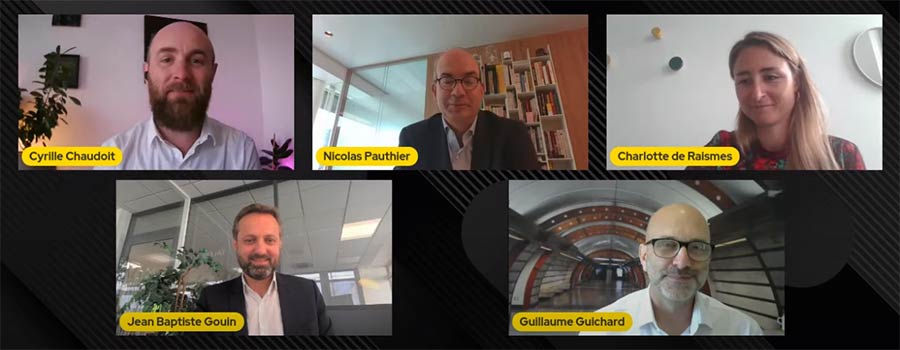
To answer these questions, talenco he collected the experiences of four major witnesses during a webinar designed and hosted by Cyrille Chaudoit, Co-founder of talenco, with:
- Nicolas Pauthier, Global VP of HR, Learning & People Development at L’Oréal
- Charlotte de Raismes, Director of Training at Bouygues Immobilier
- Guillaume Guichard, Expert blended learning at getalearn and talenco
- Jean Baptiste Gouin, CEO and Co-founder of talenco
The definitions of blended learning and hybrid training in the workplace
In a context of’Hybridization of work modes, Accompanying the development of skills – even in remote work – requires a strong adaptation of the learning modalities… and the associated pedagogical content.
This adaptation of the training towards the blended learning is all the more necessary with the evolution of the expectations of employees who now favor short and impactful content (especially the younger generations born with digital technology).
But let’s get back to basics! To better understand exactly what we are talking about, it’s good to recall the definitions of these two concepts:
- the blended learning or mixed training is a combination of presentational and distance learning modalities (e-learning courses, virtual classroom, in-person training…) ;
- the’Hybrid learning or hybrid training is a training model that crosses time (synchronous & asynchronous), place (present & distant) and relationships (collaborative or autonomous). For Guillaume Guichard, « Hybrid learning is a way to break free from the traditional constraints of training ».
According to this expert in digital learning, the most important thing in the design and scripting of a training session is Starting from the objective, then identifying the learning practices the results that we want to achieve. The choice of tools comes last in order to best serve the objectives and uses.
The development and adaptation of skills are crucial issues for the future
For a few years now, in a context of digital transformation and especially since the health crisis, we are witnessing a strong acceleration in the need for skills evolution.
Nicolas Pauthier (L'Oréal)
- For Nicolas Pauthier, « The most significant thing is the speed of evolution, which is accompanied by a form of’Hyperspecialization of skills ».
At L’Oréal, as in most companies, there is now a major issue at stake. strategic foresight on the skills needed tomorrow.

- At Bouygues Immobilier, training supports the transformation and the strategic plan. For Charlotte de Raismes, « We need to change to meet the societal, environmental, and digital challenges… Today, training specifically and individually supports the professions. ».
Individualized learning experience at the heart of new training arrangements
With the digital revolution, we have moved on to The era of individualization and training is no exception to this rule!
- For Jean Baptiste Gouin, « there is a real need of developing a culture of learning, individualize training and hold employees accountable so that it is as effective as possible according to the needs, rhythm and preferences of each person ».
- For Nicolas Pauthier, « Training is like a muscle: the more you train, the more you want to train. ». The whole point is to create various rituals and modalities to enable employees to take responsibility for their own training.
To design and individualize training programs, it is essential to have a UX approach and wondering What an experience, what emotions we want to bring to the learner. This will make it possible to design the right devices and the right modalities.
For put yourself in the learner’s shoes, Therefore, it is useful to create «personas» that will allow for targeted paths based on profiles.
- For Guillaume Guichard, it is also important « to consider training as a comprehensive process that continues after the training, and not as an end in itself ».
The balance of pedagogical modalities, a major challenge of blended learning
Digital learning, Video learning, micro learning, podcasts… These «new» modes of learning (often asynchronous and remote) are already disrupting traditional face-to-face training, which is rapidly becoming a hybrid and blended model.
In this context of blended learning, The distribution between in-person and remote learning and the related modalities may vary depending on the companies and the situations.
Charlotte de Raismes (Bouygues Immobilier)
- At Bouygues Immobilier, each profession is accompanied separately according to needs and usage. For example, for sales representatives, the distribution is balanced between in-person (individual business support) and remote (synchronous or asynchronous) training related to legal developments.

For the other professions, « The presence remains the cement of the formation » because, for Charlotte de Raismes, « People need to see each other, to exchange ideas. ». The e-learning capsules are rather reserved for mandatory training courses.
According to the 2023 ISTF* barometer, Supporting learners remains the primary factor of motivation to complete an online training course.
*investigation ISTF from the 4th quarter of 2022 among 450 training professionals
- At L’Oréal, the mix between in-person and remote work has evolved significantly in recent years. According to Nicolas Pauthier, « Before 2019, we were at 80 in % -person and 20% remote. During the Covid crisis, the trend completely reversed in the same proportions. Since 2022, it has been more like 50/50. The health crisis has allowed Multiply by distance learning modalities and opportunities for training abroad, especially through webinars ». For all programs related to management, leadership and culture, management is advocating for a return to in-person attendance.
« More than ever, training must serve the strategic plan, and for that, the Presence is essential to develop the corporate culture and the sense of belonging in order to generate commitment and social connection. »
Jean Baptiste Gouin, CEO of talenco
The commitment of employees, a key factor in the success of hybrid training
Jean Baptiste Gouin (talenco)
« One does not give drink to a donkey that is not thirsty. ». For Jean Baptiste Gouin, « It is very important to give the participants the desire to continue throughout the course. Communication (before, during, and after training) is a key skill for HR and Training teams to generate impact with employees ».

Creating appetite is also to evolve the in-person training to give it a more experiential and event-based dimension (ludo-pedagogy, large groups…) and make impactful moments for employees come to life.
Naturally, encouraging the desire to study also involves offering – in person or remotely – courses in: relevant and quality content to help employees develop: this is a major challenge for the Training and Human Resources departments.
AI and’adaptive learning in the service of the personalization of training programs
In recent years, the metaverse and especially the Generative artificial intelligences As ChatGPT has already impacted the world of training.
Guillaume Guichard (getalearn)
- For Guillaume Guichard, « It's still a bit early to form in the metaverse. On the other hand, adaptive learning (e-learning powered by artificial intelligence) already exists and allows customize the training course in real time According to the profile, the skills, the answers… Each one has their own path to reach the same result in the end! ».

- At Bouygues Immobilier, a training program for designers has been implemented. adaptive learning at a distance. For Charlotte de Raismes, « This personalization reassures the employees who understand that the training is adapted to them ».
- At L’Oréal, we are still in the phase of learning and testing in terms of blended learning. As for the metaverse, « we look at what can be done, particularly in terms of integrating employees and opportunities to create engagement and emotion ».
Learning agility, the real challenge of the hybrid training of the future
Unanimously, the participants at our blended learning webinar agreed:, Tomorrow's training will be ultra-personalized for enhanced impact, and each employee will be autonomous in their own learning journey, According to your individual needs and... on a permanent basis.
In a context of constant change, learning agility (learning agility) will indeed become indispensable To quickly adapt skills to each situation, dare to experiment with new creative approaches and also learn from your own experiences.
For Nicolas Pauthier, « learning agility, that is to say the ability to learn continuously, It will make a difference tomorrow. The future training will be individualized, personalized, multi-channel… but the real challenge is that it must be continuous! ».
Download our approach now blended learning !