

Our series of interviews on the strategic priorities of companies and their transformation challenges in uncertainty It continues with Frédéricke Sauvageot, Director of QH&S for the Real Estate and Workspace Division at Orange, which addresses our topic from the perspective of the evolution of working patterns, work spaces, and QVCQ (quality of life and working conditions).
With nearly 300 million individual, professional and large corporate customers in Europe, Africa and the Middle East, Orange is among the world leaders in digital services and telecommunications under the brand Orange Business.
In France, the group’s real estate sites represent more than 5 million square meters, at the heart of the group’s social and environmental challenges.
In what context did you initiate transformations at Orange and what are your challenges and priorities?
F.S. We have been living, for a few months, or even a few years, in a a particular socio-economic and societal context that underlies many transformations.
In my view, the context related to the pandemic crisis was quickly dismissed, even though for a while it was the center of attention. Nevertheless, we still do not know enough about the real impacts, both personal and professional, on employees, their families, and we must remain quite cautious on this topic.
What I am observing is that The pandemic crisis seems to have accelerated a number of trends that were already present in companies.
Today, we are witnessing a increasing number of transformations. Unlike a few years ago when transformations kept happening, now they are happening one after another. They overlap and run in parallel, This phenomenon is observable in all companies and requires special attention.
From the point of view of my activities, the topic of Quality of life and working conditions (QVCT) becomes, even more than before, a lever for the performance of organizations.
In any case, it really determines the capacity that companies have to innovate. creating value And that is why it is essential to engage in efforts to improve the quality of life and working conditions, regardless of the transformations that are taking place!
Transformations in companies, Although they seem minor, they are often a significant impact. A change in entity for an employee, even if the job remains the same, can affect their sense of belonging. This transfer can also involve a change in manager and organization, contributing to significant changes.
These transformations, which are called real Changes in work, include aspects of’Hybridization of professions, organizations, and work spaces. As a result, these multiple changes can prove difficult for employees to live with.
Why consider QVCT (quality of life and working conditions) as a lever for transformation?
F.S. Because it impacts employee engagement and commitment, company performance, management practices, etc. The QVCT is a deliberate and strategic approach that links the psychological dimension to the collective dimensions and to the organization of work.
At Orange, we advocate responsible support for the transformations and their consequences human impacts in a comprehensive approach.
Upstream, we have put in place information consultation process With the elected officials, we question the employees using surveys and indicators, interviews with top management… And then, at a more detailed level, we work to evaluate the results. Experiences shared At 3, 6 and 9 months, a report is drawn up, with recommendations and suggestions for improvement.
This is a very important step that allows’anticipate the impacts of transformations on strategic, economic, and organizational issues, and to manage skills, teamwork and socio-economic security.
What are the impacts of the transformations on the employees in the Orange group?
F.S. The impacts on the employees are of different natures. It can be impacts on the Contents of their work, on their skills, of impacts on their organization of work, their relationship at work or the meaning at work, and in the workplace and’environment of work...
Transformations can generate losses of meaning and landmarks, as well as fears, hence the importance of meeting the need for employees to be supported and to have clear and transparent communication about strategic issues the project and the benefits it will bring them, their degree of autonomy, their new responsibilities…
This Pedagogy is necessary and extremely important for carrying out the transformations.
What is the role of management in supporting transformations?
F.S. Managers must Accompanying the teams with attention, By trusting them, we help them grow, by adopting management by the « care«which involves taking care of oneself in order to better care for others.".
Organizing transformations effectively requires having Adapted management styles and a behavior that allows for accompanying situations in a context of uncertainty. Manager by the « care »It's an effective way to engage the teams".
The success of transformations depends largely on managers, and in particular on the managers at the grassroots level.
Their role is crucial and they must receive special attention from the company that must support and accompany them so that they can facilitate membership, whether they are Ambassadors of Transformation, But also so that they learn to protect themselves in these multiple transformations.
The New role for managers involves a systemic vision on their ability to act, their freedom of action within a given framework, the co-construction of the transformation with the teams by promoting collaboration, co-creation, innovation and feedback to work effectively and maintain the collective commitment.
Does hybrid work also evolve the role of managers?
F.S. This is another essential point: Managers need to be made aware of the workload in a period of transition because change in a work organization does not happen overnight.
This is especially true in the hybrid management for which the manager must ensure the availability of the necessary resources (processes and governance, digital tools, physical spaces).
Physical space is important. It is the place for socialization, the anchoring of team rituals and the sense of belonging to a work collective. That is why It is important to organize team work times with physical presence on-site to «do things together».
This balance to be found between remote work and physical work is part of the transformations that are not yet completely complete. It is necessary to succeed in ensuring that face-to-face time is truly a highlight where the team meets, and not times when everyone is physically present but isolated in a video tunnel with interactions only remotely.
These questions touch on the transformations of the office role and how the physical workspace could be much more of a resource available to managers to support their team and collective project.
It can be observed that there are many transformations of organizations and professions that take place simultaneously with a transformation of work spaces. This is undoubtedly for a fairly simple reason, linked to the fact that during the pandemic period, teleworking has changed in scale and dimension.
Where you had 1 in 5 people doing 1 or 2 days of teleworking, you have rather increased that to 4 in 5, at least in the tertiary sector and for the professions considered «teleworking-friendly» and that want to be able to benefit from it. hybrid working mode that promotes a balance between personal and professional life and also addressing issues CSR such as less use of cars and other polluting modes of transport.
Training in hybrid team management
What measures have you implemented to support the teams in these transformations?
F.S. Supporting teams, regardless of the transformations they undergo, involves listening to them and creating expression groups that I believe are indispensable. It is important that teams can express themselves and contribute to transformations, Whether they are organizational, professional, or work environment-related.
Co-construction is a real issue; we just have to figure it out set the framework properly and explain what we can do, what we can co-construct… and then communicate well.
Communication is indeed a real lever for the success of transformations, whether organizational or spatial.
More specifically, in the era of hybrid work, can you tell us about the transformation of work spaces and the associated impacts?
F.S. Regarding Transforming work spaces is now a must Since, since a large number of people can work remotely, the buildings are relatively empty, and even if we talk about returning to the workplace, employees only come for a few days, alternating with teleworking.
At the same time, there are economic issues, climate issues, issues of CSR... Reducing the carbon footprint and the issues related to temperatures are also topics that need to be addressed, and this involves, among other things, a reduction and optimization of the real estate footprint : « less square meters, but better of square meters ».
So yes, it’s true that very often, Current transformations involve a transformation of work modes and the spatial organization of work. because we also need to respond to new needs and new challenges.
In your opinion, what are the keys to a successful transformation of the organization?
F.S. The keys to successful transformation are, I think, communication, co-construction, listening, the expression groups. This is truly one of the indispensable keys to supporting a transformation, as well as the need for support regardless of the type of transformation.
It is also important to Define the impacts and criticality of the projects, This seems to me to be key. It is not so obvious to define a successful transformation because transformations occur one after another and overlap, and it does not really stop.
On the other hand, what is important is always working to the best of one’s ability. capitalization of beginnings or of transformations that have been carried out, and always Measuring impacts and perceptions, The feeling of those who live through these transformations in order to always be in continuous improvement.
Beyond a successful transformation, the real issue is undoubtedly that of continuous improvement. : how to remain constantly aware of what can be improved to facilitate good working conditions and a good quality of life at work in this overhaul of labor organizations.
Indeed, it is not one organization but several that must be supported, and successive or parallel transformations that must be challenged in order to meet the needs of the evolution and transformation of companies.
But the most important point, regardless of the stakes and the company’s strategy, is to always have an interest in the human factor. It is really the human factor that is at the heart of the transformations, and it is not just about communication.
Interviews collected in May 2024 by Cyrille Chaudoit, Co-founder of talenco, as part of a White paper on the levers for transforming companies in uncertainty. A big thank you to Frédéricke for her testimony!
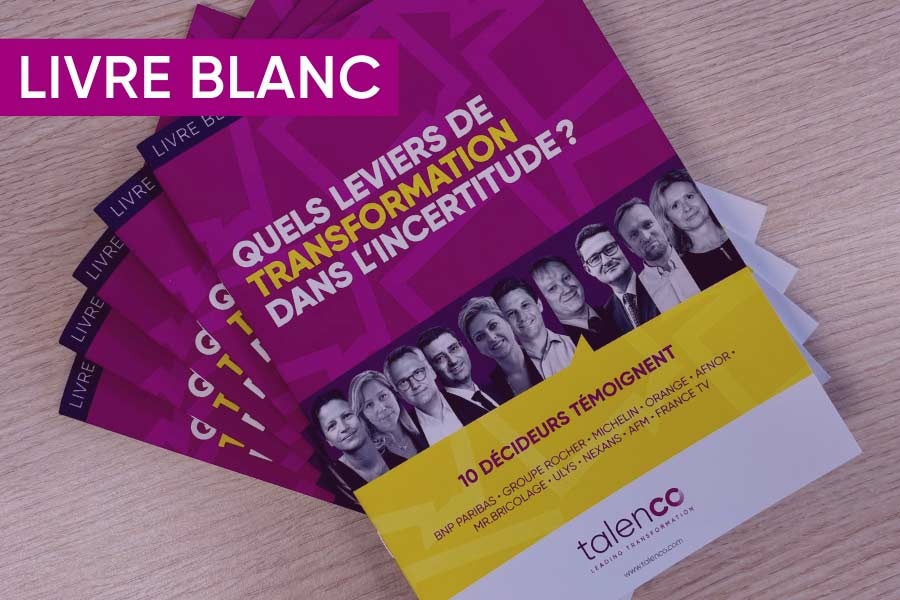
10 testimonies from leaders