

We continue our interviews with decision-makers the strategic priorities of companies and their transformation challenges in an uncertain context with Arnaud Lesaunier, CEO of france.tv studio and France tv distribution, who testifies ongoing transformations in the subsidiaries of the audiovisual group.
France.tv studio, an audiovisual production studio, and France tv distribution, an entity for publishing, distribution and diversification, is a subsidiary of the France Télévisions group. The first French audiovisual group in terms of audience, France Télévisions Manages the activities of public television through the channels France 2, France 3, France 4, France 5, France Info, etc., and the digital platform for accessing programs France.tv.
What are the context and challenges for the audiovisual sector today?
A.L. The sector of Audiovisual and video consumption is doing rather well, This is due, in particular, to the multiplication of publishers and distribution channels, which requires more content.
Although consumption of traditional television is declining, Other means, such as mobile terminals, are growing rapidly..
In recent years, budgets and the quality of productions have increased with the arrival of new players such as international SVOD platforms, which has also increased the production costs and the expected quality.
However, the sector is currently experiencing a turnaround due to budgetary constraints and’Issues related to the social responsibility of companies (CSR). Moreover, l‘impact of new technologies’, Artificial intelligence (AI), in particular, is the subject of many questions and concerns among industry players.
What are the major challenges that france.tv studio and france tv distribution must face in this context?
A.L. As for the The stakes of our production professions, First of all, you need to know follow the trends, make the right creative proposals that meet expectations from publishers and mainly from France Télévisions.
We also have to to control our quality and our production costs by meeting the challenges of CSR. Our sector is considered relatively polluting and we have long focused our efforts on all the elements that can contribute to it. reduce the footprint of our activities.
And then, we prepare ourselves for «Technological »bang" [of artificial intelligence] by trying to’to make it an opportunity, Whether in the production or presentation of our creative proposals, or in other related activities such as subtitling, which can be greatly impacted by AI and therefore become an asset!
On the strict business plan, we strengthen ourselves through a strategic development in areas where we are legitimate and where we immediately create added value. In the current economic context, there are market opportunities that would be quite easy to seize, but at the risk of being dispersed. That is not our choice. We are, in fact, trying to Capitalizing on what makes us strong, By acquiring technologies and skills that can have an immediate impact on the quality of our production and our performance.
In terms of corporate culture, our goals are to strengthen our public service DNA by giving meaning to our actions. and especially within the framework of our projects, by partnering with smaller producers to enable them to bring their creativity to the fore by relying on a slightly more substantial player like France tv studio.
So working on the company culture and strengthening what makes us different The reference to the public service mission is a very strong element within France Télévisions, even though we are a completely private structure, that we do not receive any public contribution and that our only income comes from our activities.
Among the factors of change that affect you the most, you mention the CSR. How do you activate this leverage?
A.L. When we talk CSR, we sometimes tend to narrow down the issues surrounding environmental issues. Of course, environmental issues are addressed, but not just that!
We have worked on both the Governance, on the social climate, on the relationship to representation of staff, regarding the diversity of our workforce, diversity of gender or origin but also of generational diversity, etc.
As for the Environmental issues, to limit the impacts, we have worked on the design and use of the tools, notably the filming sets. As part of a project to build new studios, we have principles of eco-design are applied, including the use of solar energy and low-energy materials.
The France Télévisions group has acquired studios in Vendargues, Near Montpellier, which is very advanced in terms of environmental impact, by working on reduction of energy flows, by optimizing lighting, air conditioning and servers, and waste treatment… Although these investments are costly, they lead to more sustainable production with fewer emissions. return on investment potentially very positive.
This environmental commitment makes it possible to make it a reality. internal communication channel within the company and the empowerment of the teams. This also aligns with our Public service commitments and allows us, in a context of uncertainty, to have a fairly clear, well-defined goal: to be a leading actor on these issues CSR.
Can you give us a concrete example of a major transformation underway in the subsidiaries of France Télévisions?
A.L. The example I could take is the one that consists of adapting the company to its very strong growth of recent years and at the Prepare for the continuation of this growth.
This project of transformation may seem surprising, but based on the principle that It is always better to drive change when businesses are doing well., This is a project that we have embarked on today.
France.tv studio – but that also applies to France TV distribution – has experienced a quite sustained growth these last three or four years, without always taking the time to adapt its organization and work processes to this significant evolution in its volume of activity, its revenue, and its workforce...
We had to we adapt to this strong growth in a reactive manner, By making some adjustments, but in doing so, we realized that we were at the end of a model and that it needed to be rethought.
Today, therefore, our main transformation challenge is to rethink and restructure the way we work., Taking into account the different levels of responsibility, increasingly constrained finances, increased demands regarding ethics CSR and the impacts of technology, particularly AI.
The heart of our approach is to adapt the company so that it can continue its growth, despite the changing and uncertain context in the sector.
In this context of transformation, how do you ensure the transition from strategic vision to operational execution?
A.L. In response to the uncertainties of the moment, the first thing is to set very clear objectives. The more ambiguous the environment, the more clarity teams need. in the objectives or directions that are given or, conversely, in the «prohibitions» that are imposed.
As for the teams themselves, the company’s growth has meant that the staff has doubled growing from a hundred people to almost 200 permanent employees, to which we add the use of non-permanent employees and approximately 5,000 people hired each year to contribute to our activities.
This situation has deeply affected changed the governance and project management issues within the structure. We therefore decided to review the governance.
This consists of moving from a classic management committee, which brings together the N-1s, to a dual governance who will distinguish:
- a management committee bringing together a few people with a strategic vision of the company and the ability to develop the tactical elements to implement it,
- an expanded management committee bringing together about forty people, managers capable of applying these tactical elements and transforming them into management decisions on a daily basis.
The intermediate management line allows for much more effective field sensors, better understanding of the company, and a more immediate and frank return on its decisions.
This intermediate management line also allows you to anchor yourself in the reality on the ground, around the talents that are ours. In a way, it’s about having our feet firmly planted on the ground and our heads in the future to ensure our stability and better take the wind of change.
Have you put in place a support system to help acculturate, support, and train your managers and teams?
A.L. In this case, we brought together the management teams at the end of June 2024 for a one-day seminar. This was the first time they had been involved in this exercise, which had previously been carried out in a more restricted committee setting.
When leaving of the vision and objectives defined by the Top Management, synthesized into 5 clearly defined horizons, we have It involves working with the [managerial] teams to define the path that will lead us to this vision and on the roadmap to follow.
In short, they do not choose the destination in terms of objectives, but the means to reach it. This is a rather new exercise, an issue of managerial leadership, of decentralizing the ability to decide and to carry out actions, which seems to motivate and mobilize the teams.
For the exercise to be fully effective, this requires bring all participants and contributors to the same level of knowledge and therefore to allow access to information that not everyone may have. This is a prerequisite for working effectively with everyone.
Advice and support in management and leadership
And then, more generally, we try to work on the training in knowledge, Because technical training is much more natural. In fact, our television professions are relatively recent and have been driven by technological developments since their inception. These are professions that are accustomed to working in a team and to working under pressure. constantly questioning oneself.
By the way, The production professions are, by definition, project-based professions. Nine out of ten times, the programming projects we present are rejected. For those that are accepted, we have to create the show. Once it is produced, it is intended to last for more or less a certain length of time, and then we move on to a new project…
Our teams are therefore quite used to chaining together projects, This avoids a certain form of conservatism that can sometimes take hold in our sector. This is not the case in production activities! Therefore, we cycle through production cycles, restarting new projects each time, but by capitalizing on the projects we have just carried out, those that have succeeded or failed.
And so The principle of questioning, the notion of failure, the right to make mistakes are real issues in times of uncertainty. It’s something we’re quite familiar with.
What are the priority axes for aligning the teams at France.tv?
A.L. There are two main axes on which the teams work.
Demystifying artificial intelligence
The first axis is Artificial intelligence (AI). It is about demystifying AI, both generative and non-generative, so that teams understand its capabilities and limitations, what it can bring to each person in their daily lives, thus overcoming fears and enabling progress. propose practical uses to improve their work.
We have made AI a development issue for our activities. That is why it is important to mobilize and raise awareness among all teams as early as possible about these essential issues.
Some activities could almost disappear in the face of artificial intelligence; this will undoubtedly be the choice of some operators in the market. We, on the other hand, consider that it is necessary to ensure that Capitalizing on artificial intelligence to do more – much more – with the same level of resources.
The goal is not to replace technology with humans, but to strengthen humans through technology., In particular in areas such as subtitling and dubbing, but also in our project design and writing activities…
Artificial intelligence is a field that is advancing very quickly, sometimes in a chaotic and turbulent manner, but which nevertheless offers opportunities. That is why it is necessary to monitor its developments and understand them thoroughly.
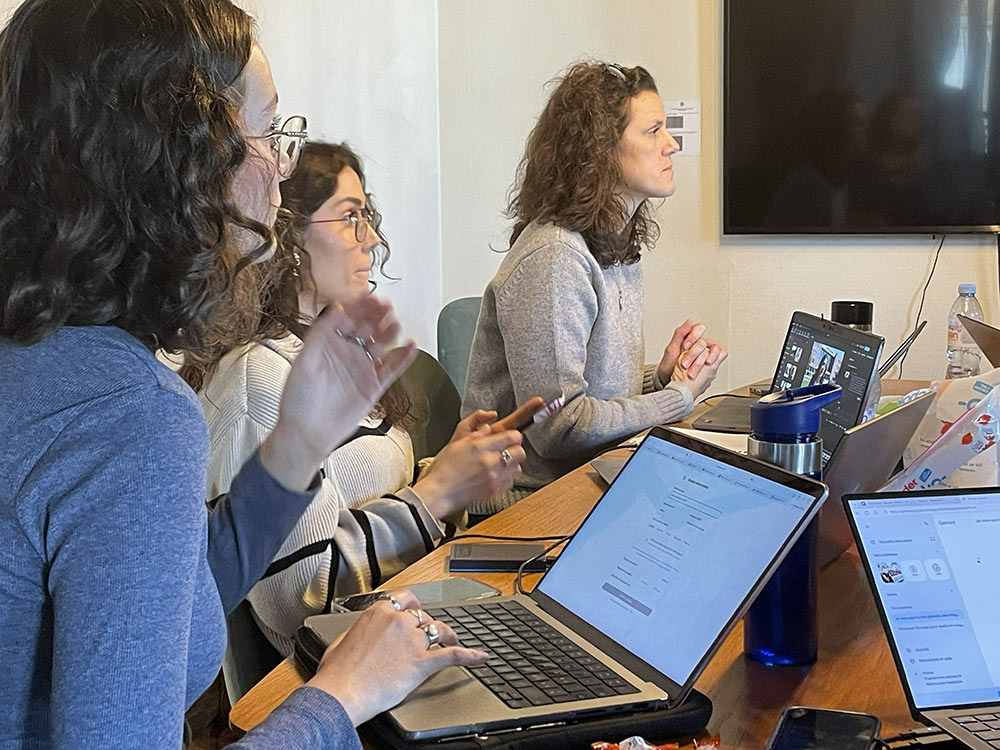
IA generative client case
C.PRODUCTIONS (M6 Group)
Raising awareness about corporate governance
The second development axis, in these uncertain times, revolves around good business management and leadership. It is crucial to work on building everyone’s understanding of the concept of the business, financial management, and operational and financial indicators for guidance, so that they understand their importance and their impact on daily decisions.
The idea is to fill the gap in understanding This is often observed within teams when they are talking about revenue, operational results, net income, depreciation, working capital needs, etc. so that everyone can better understand the financial and management issues and understand strategic choices.
In your opinion, what are the keys to a successful transformation of the organization?
A.L. For me, the key to successful transformation is first and foremost a climate of trust. – the general trust of course, but also the trust of the teams in their leadership. I think we don’t do anything in defiance or fear, and that’s even truer in a complicated economic context.
Allowing everyone to have a good level of understanding of the issues It is also a key to success. Everyone must be able to fully understand the implications of the decisions that can be made, as well as the concerns and enthusiasm that may arise.
The social climate is also very important to me. If your relationship with the staff representation is not working well, you have a lot of difficulty advancing your projects.
Finally, quite paradoxically, I would say that In the keys to the success of transformation, the ability to doubt, to not be too sure of everything, is a fundamental element..
We only transform if we are both imbued with the conviction that we will succeed and also with the doubt that allows us to question established facts. With doubt, I associate the right to error and the right to failure; without these, it is very difficult to try new things.
So if I had to summarize, The key to the success of a transformation is first and foremost to prepare a ground that facilitates change. The social climate, the trust, the fact that teams can know that making mistakes is a right and that failure is not a fatality. From there, we all have every chance of succeeding!
Interviews collected in May 2024 by Cyrille Chaudoit, Co-founder of talenco, on the occasion of our White paper on the levers for transforming companies in uncertainty. Many thanks to Arnaud for his testimony!
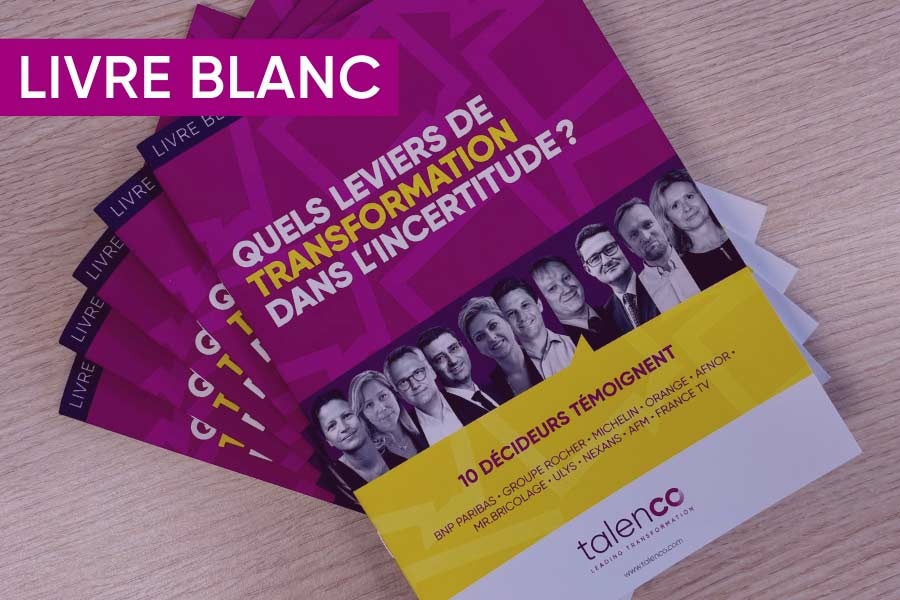
10 testimonies from leaders