


«We are smarter in groups than alone.» This popular saying, which translates The idea that in matters of creativity, collective intelligence is more fruitful than that of a single individual, This was scientifically demonstrated (!) thanks to work carried out in 2000 by psychologists from the University of Texas: starting from a specific case involving the possible uses of a trombone, they were able to observe that in fifteen minutes, a group of 4 people could generate 85 different ideas, compared to only 61 for isolated individuals.
Beyond this anecdotal illustration, collective intelligence is today a « must have » absolutely essential to be developed by companies that, in a constantly changing world, must Facing many challenges and finding innovative solutions in order to remain competitive.
To stimulate collective intelligence and reap all its benefits, management has a key role to play in implementing it by establishing a culture, a framework, rituals and tools conducive to encourage in the end creative emulation and innovation.
The definition of collective intelligence in the workplace
According to the philosopher Pierre Levy who devoted a reference work on this concept, « Collective intelligence is the art of simultaneously maximizing creative freedom and collaborative effectiveness.« .
More specifically, it is the ability of a group to generate ideas and innovations, to solve problems or to make decisions together, In a more effective way than an individual would do alone. It relies on collaboration and the exchange of ideas in order to create a synergy that enables the achievement of common goals.
Why promote collective intelligence?
In a VUCA (volatile, uncertain, complex, and ambiguous) world, collective intelligence is an asset because it promotes creativity, productivity and performance in the company. Collective intelligence can indeed bring significant benefits to companies that decide to implement it:
- it favors innovation and solving complex problems by enabling members of a multidisciplinary team to work together, share their knowledge, and find solutions more effectively,
- it also strengthens the commitment and motivation of the employees – essential keys for a good Employee experience – by giving them the opportunity to actively participate in the company’s projects.
The benefits of collective intelligence
For managers, relying on collective intelligence, by granting more autonomy and decision-making power to employees, is a powerful lever for commitment, motivation, and innovation, serving to improve team effectiveness.
Activating collective intelligence means relying on the skills of each individual and the wealth of complementary profiles within the team to:
- valuing the employees who create value together,
- generate commitment and enthusiasm,
- to build team cohesion and develop collaboration,
- encouraging learning and co-creation among peers,
- foster the transversality and complementarity of profiles,
- ultimately providing the most appropriate answer to the posed problem.
The 5 C’s of collective intelligence
Collective intelligence is based on principles that can be summarized in 5 key words:
- The Creativity is a source of innovation that allows us to breaking out of our usual patterns and proposing new solutions. It can lead to unexpected concepts that make all the difference. Creativity arises from encouraging exchanges between collaborators to share their creative ideas and bounce back on those of others to co-create together and form collective intelligence «1+1=3».
- The Trust, By forging strong bonds, an honest and loyal relationship, it is possible to foster collaboration in a positive and constructive spirit. It is the foundation that allows each individual to express their potential. It is a source of well-being and employee engagement through the creation of a A caring and stimulating work environment, promoting mutual support.
- The Collaboration is one of the key principles of collective intelligence. It consists of pooling the skills of each individual and using them to achieve a common goal. This involves: share their knowledge and experiences, But also to learn to rely on others to successfully carry out a project together.
- The Communication It is essential to enable participants to understand each other and share their capabilities. In collective intelligence, good communication allows the exchange of the right information at the right time, the avoidance of misunderstandings, and the help in finding common solutions. It is important to ensuring good group cohesion and encouraging dialogue. A strong sense of belonging to the group stimulates and improves communication.
- Finally, the Collective reflection It is an excellent way to stimulate new ideas and find relevant solutions. It is important to create a climate conducive to the emergence of these ideas by organizing working groups on concrete elements such as projects, objectives or issues. A collective reflection will then allow the ideas and solutions proposed to be shared.

Management at the service of collective intelligence
The role of management is crucial in establishing and facilitating collective intelligence. It is up to managers to establish a climate of trust to unleash the creativity of employees, foster the sharing of skills within the team, and engage everyone in a continuous improvement process.
How to initiate and develop collective intelligence?
Establishing a favorable framework
To implement collective intelligence, it is important to create a working environment that promotes collaboration and the exchange of ideas. Employees must feel comfortable and confident to share their ideas and knowledge, without fear of being judged or criticized.
It is also essential to promote the diversity of viewpoints and the participation of all team members. Managers must therefore be attentive to the complementarity of the profiles within the team.
Allowing the right to trial or error
In a context of acceleration, management is evolving from a manager who controls to a manager who engages. It is up to them to set a framework, foster autonomy, and allow for the right to trial and error that promotes proactivity and accountability and enables one to learn from one’s mistakes in order to improve. Encouraging innovation, taking initiative, and « test & learn »And the right to error thus promotes continuous improvement, adaptation and constant questioning in the service of the success of projects.
Establishing a culture of feedback
The feedback is a return of information or experience about their professional actions that allows them to improve continuously. By strengthening the trust between employees and their manager and enabling the improvement of practices and behaviors, the feedback they optimize individual and collective performance and promote engagement. They are therefore an axis of management to develop, since, according to the 2022 edition of the Officevibe study, 82 % of the employees appreciate having a feedback about their work… and 98 % of the employees resign in the absence of feedback !
How to manage and make collective intelligence work in everyday life?
The manager, as a facilitator of collective intelligence, He is the guarantor of the framework for collaboration to achieve the set objectives and carry out the missions. It is his responsibility to orchestrate the conditions for the emergence of collective intelligence in the service of continuous improvement and performance.
Establishing rituals and workshops for collective intelligence
Making collective intelligence come alive begins with Establishing rituals, that is, times dedicated to collaboration These rituals provide the framework and conditions necessary to encourage dialogue, exchange, reflection, and listening, allowing each employee to find their rightful place and contribute fully to the goal to be achieved.
Team meetings, Seminars, Collaborative workshops and other collective spaces are all opportunities to mobilize collective intelligence.
Engage employees and make them active participants in the running of the rituals
A second key to facilitating collective intelligence is ensuring that all participants are actively involved in the meeting’s proceedings. This means that Participants must be encouraged to actively participate in discussions, to share their ideas and to ask questions. To do this, it is important to use facilitation techniques such as: brainstorming, Workgroups, problem-solving exercises and discussions.
At Michel et Augustin, collective intelligence is based, among other things, on the use of an instant messaging application: teams and interest groups have been created to facilitate communication and the sharing of ideas and sources of inspiration everywhere (smart packaging, amazing pastries…). Click here to discover the testimony of co-founder Michel de Rovira.
Accountability through delegation of roles
The third key to managing collective intelligence is to hold participants accountable by offering them opportunities to: sharing clear and precise roles.
Roles can vary depending on the type of meeting, but they must be designed to encourage active participation. Role distribution is important because it ensures that each participant has a specific task to accomplish and that they feel responsible for contributing to the success of the meeting.
Here are 5 examples of key roles to delegate during a meeting to encourage collective intelligence:
the facilitator, organizer and conductor (usually the manager, but this responsibility can also be shared),
⏳the guardian of time (watch the meeting time and respect the program),
the scribe (secretary of the meeting; he writes up the minutes),
the decision-making engine (guarantees the progress of the discussions and the effectiveness of the meeting),
the session coach (gives some feedback on the ways the collective operates at the end of the session).
The methods and tools of collective intelligence
To stimulate collective intelligence, it is necessary to transforming traditional meetings into more agile, collaborative workshops.During these workshops, The key role of the manager is to facilitate the exchanges by relying on techniques of creativity and visual management tools.
Brainstorming, mind maps, Metaphorical tools (speed boat for example): the toolbox of collective intelligence offers a rich palette of pedagogical and playful solutions to encourage emulation and creativity among participants.
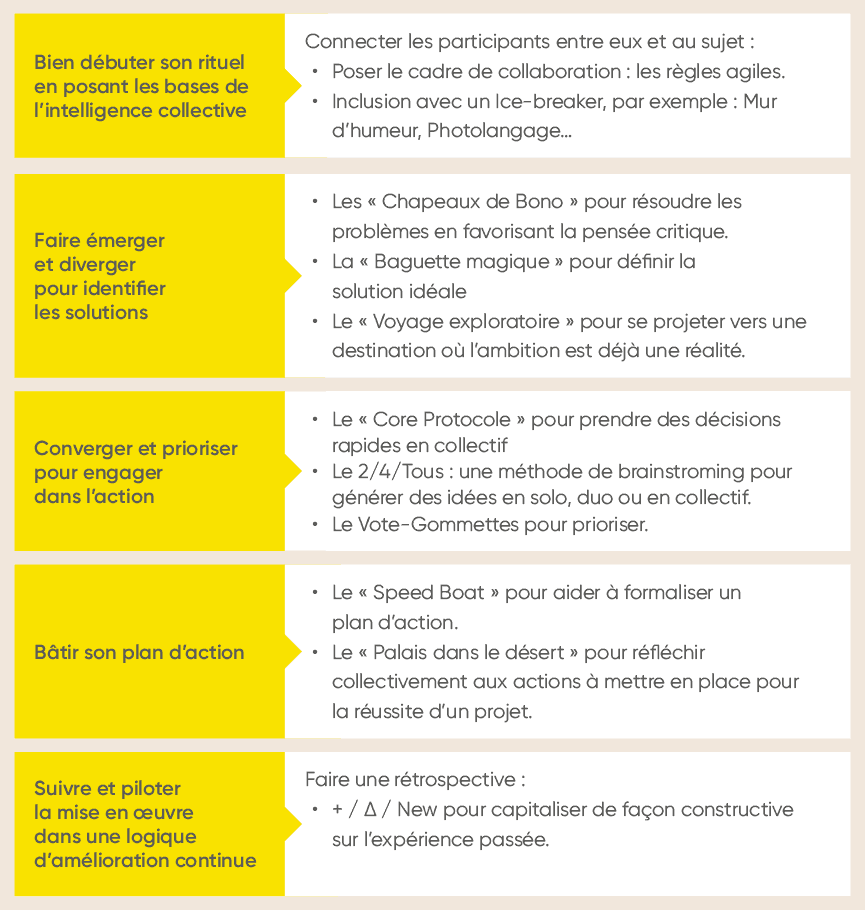
Depending on the objectives of the workshop, we can choose appropriate tools to activate collective intelligence in service of problem solving, decision-making, ideation, continuous improvement, etc. Here are some examples of tools for facilitating and animating collective intelligence rituals:
Collective intelligence is now a major asset for companies that want to accelerate their transformation in order to stay ahead in the “time to market”And adapt to the needs of customers. By fostering collaboration, the exchange of ideas and decision-making, it enables the discovery of innovative and effective solutions, while actively contributing to employee engagement in a context of uncertainty.”.

Serious game intelligence collective