

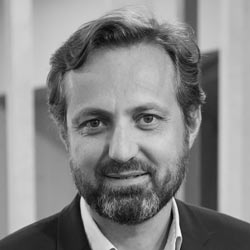
Jean Baptiste Gouin
Guest on the «Innovation & Prospective Talk» podcast dedicated to OKRs (Objectives & Key Results), Jean Baptiste Gouin, CEO of talenco, talks to Matthieu Deboeuf Rouchon and Lionel Tardy about the concrete benefits of the OKR method in serving the effective transformation of companies.

The OKRs (Objectives & Key Results) are one of the most effective tools for setting clear priorities and promoting The strategic alignment and the commitment of the teams. The OKR method has enabled Google, among other things, to manage its phenomenal growth. It also allows for the effective management of transformations.
New! Discover our white paper on the OKR method
The OKR method, a method inspired and inspiring
The OKR method was developed in the 1970s by Andy Grove, CEO of the Intel group, with the aim of serving the growth of the company. The results were phenomenal! Later, John Doerr, a former member of the Intel board of directors and one of Google’s main investors, shared this method with Larry Page and Sergey Brin, who applied it at Google as early as 1999. Today, it is still deployed across all teams and projects (OKR method: case study of Google).
The OKR method has since become much more widespread in the startup and agile culture, mainly in the United States and Asia. It is used in many groups around the world (including Twitter, Spotify, and LinkedIn, but also in more traditional industries…) but, curiously, it still struggles to take root in Western Europe, probably due to a lack of awareness of the approach.
What are the benefits of OKRs?
The OKRs (Objectives & Key Results) is a management method that could be summarized in 5 points of interest:
- Align the company with clear action priorities to carry out its strategic project
- Involve all managers to focus resources and energies on these priority actions.
- Generating a collective commitment
- Holding employees accountable so that everyone can contribute to the implementation of the business project
- Fine-tuning the implementation
John Doerr defines OKRs as the method that allows you to « Ensure that the company focuses its efforts on the same points, at the same time, and everywhere in the organization«It therefore involves a certain degree of agility and the alignment of teams on a common goal.
For Larry Page, it is « The most effective practice for defining and communicating the company’s, teams’ and employees’ priority objectives while factually measuring the results achieved« .
How do OKRs work?
OKR’s are based on a principle of transparency where everyone knows the goals of everyone else. It all starts with the company’s main goal and then breaks down into all levels of the hierarchical line : Company and leadership OKRs, team OKRs, and finally OKRs for the employees.
In practical terms, it is necessary to prioritize and remain very pragmatic:
- Setting a goal: inspiring and very ambitious
- Defining « Key Results » ambitious but achievable and quantifiable with a deadline to reach them (SMART). For example, my sales team must make 100 appointments per month (1 ambitious goal, 1 deadline).
- Assign 3 result indicators for each objective
While OKRs are a form of extension of «management by objectives», which dates back to the 1950s with Peter Drucker…, these objectives can no longer be aligned with an annual structure as was often the case (objectives, budgets, individual interviews…).
All the company’s control systems now have much shorter deadlines, because The annual measure is no longer adapted to the pace of the company. The crisis we experienced in the spring of 2020 proves it once again.
In this way, the OKR method allows for much greater agility and responsiveness.
At the company level, we will therefore define a priority objective and 3 indicators with a maturity of 6 months (or 3 months in times of crisis or recovery, as is the case currently).
At the level of the collaborators, the deadlines and the evolution of the Key Results They expire after 3 months.
Discover our sOKRat® support method
The innovative management tool to help executives move from vision to execution through OKRs
How to properly implement OKRs?
For the system to work, beyond a certain OKR training, Therefore, it is necessary to respect a few simple rules of operation :
- Limit OKRs to 3 per person or entity, each associated with 3 performance indicators;
- Review the OKRs at least quarterly;
- Letting the collaborator fix his own Key Results, the manager putting himself at the manager’s service to enable him to achieve his goals;
- Consider an objective achieved at 70 or 80% to be successful and then evolve it or move on to another objective;
- Be vigilant to avoid confusing OKRs with other HR evaluation systems in order to define the rules for employee benefits… what matters is progress;
- Being transparent so that everyone has access to everyone's OKRs.
Proven use cases with OKRs
One can give some examples of specific cases in the company where OKRs will help the organization achieve its goals:
- To implement the company’s strategic plan and move from vision to execution: OKR’s will allow the manager and co-manager to define the company’s goals and their own goals, the indicators and their deadline (see our article). celio client caseFor example, the recovery management OKRs will be implemented with shorter deadlines.
- To establish and maintain teleworking that requires a certain level of trust: OKR’s provide a clearer framework for guiding, sharing a vision of the objectives and measuring their achievement, whether we are present or remote.
- To animate working groups within the company: define the Key Results grouping allows everyone to align on the same goal.
- To optimize its product design approach: OKR are increasingly being used in the startup culture and in agile organizations.
The effectiveness of the OKR method
In companies that have implemented OKRs, the feedback from the field is unanimous and confirms the results. a large number of benefits Of which we can highlight the main ones:
- Selecting priorities and engaging teams to implement them,
- Communicate effectively with the teams and connect them with each other by promoting cross-functional collaboration between the different departments and employees;,
- Transforming the organization into an agile mode, continuously measuring progress through iterative, agile methods, with the goal of continuous improvement,
- Generate the commitment of employees by empowering them and giving them visibility on their contribution to the company’s project through a clear, structured and easily understandable format.
Thus, by focusing the teams’ vital forces and energy on clear priorities within a given timeframe, impressive results are observed in achieving objectives. We bet that we will continue to hear about OKRs as an indispensable management tool for the years to come!
Download here our sOKRat support method based on OKRs.
Podcast «Innovation & Prospective Talk»
«Everything about OKRs (Objectives & Key Results)»